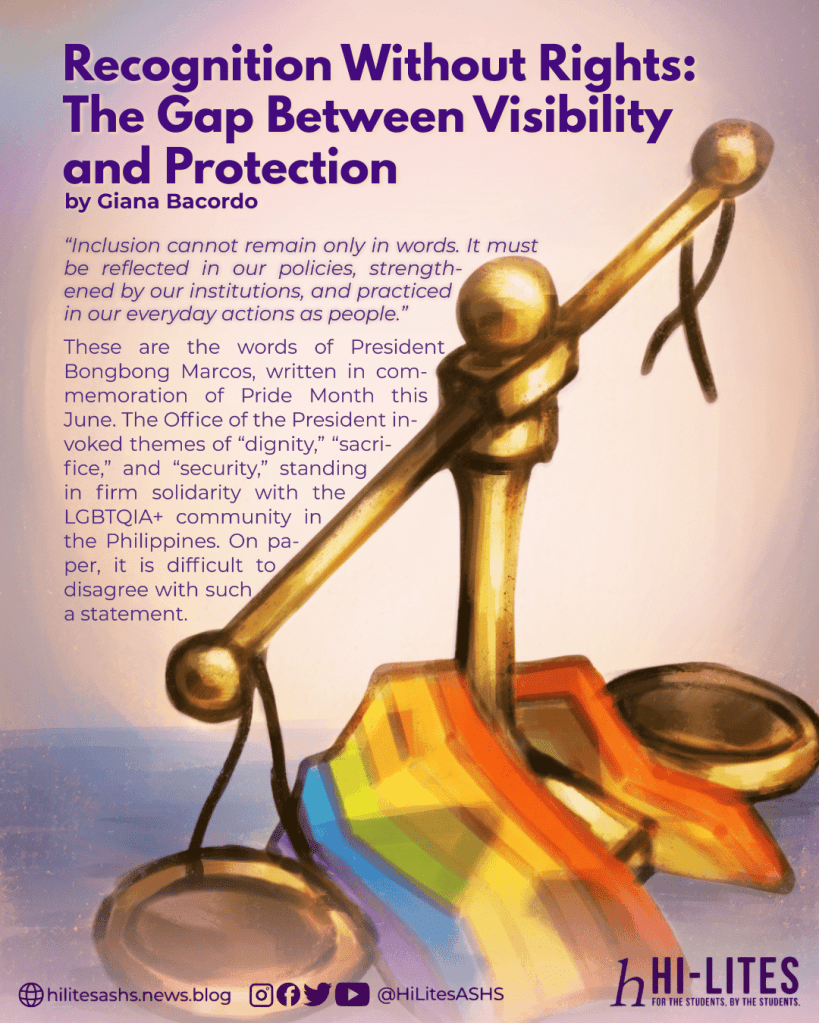
Pubmat by Adrianne Coloma
by Giana Bacordo
“Inclusion cannot remain only in words. It must be reflected in our policies, strengthened by our institutions, and practiced in our everyday actions as people.”
These are the words of President Bongbong Marcos, written in commemoration of Pride Month this June. The Office of the President invoked themes of “dignity,” “sacrifice,” and “security,” standing in firm solidarity with the LGBTQIA+ community in the Philippines. On paper, it is difficult to disagree with such a statement.
However, these words have invited scrutiny. If “Inclusion cannot remain only in words,” then where are the policies that will give those words their substance? The Philippine government’s own track record is revealing. Promises of inclusion have not been matched by policy action. More than two decades after the SOGIE Bill was introduced, the measure remains stalled within the legislative process. Without it, LGBTQIA+ Filipinos are left largely without safeguards against identity-based discrimination.
This disconnect between public acceptance and political reality has made this exclusion ever more prominent. Public declarations of support are not enough to fill the gap left by the absence of anti-discrimination measures. Despite the high turnout at this year’s LoveLab4n Pride Festival, indicating positive public perception, it seems that Pride Month 2026 will pass without any significant legislative progress.
Decades of Delay
The first version of the SOGIE Bill was filed in 2000 by the late Senator Miriam Defensor Santiago. In the decades after, throughout multiple iterations of Congress, it has been refiled time and time again. It seeks to prohibit discrimination on the basis of sexual orientation, gender identity, gender expression, and sex characteristics (SOGIESC), acknowledging the discrimination that is often experienced by the Filipino LGBTQIA+ community. Moreover, it ensures equitable access to employment, education, healthcare, and public services, all the while establishing concrete protections against discriminatory practices.
Despite 26 years of deliberations, committee hearings, and endorsements from civil society organizations, academic institutions, and human rights advocates, the measure has yet to be enacted. The SOGIE Bill, for all its importance, is a victim of both the Philippines’s notoriously slow legal process and the conservative nature of most elected officials.
As a predominantly Catholic country, the SOGIE Bill has long experienced resistance from religious groups that argue that the measures infringe on traditional beliefs. At the same time, rampant disinformation surrounding the bill has shaped public perception. Some have argued that the bill is redundant or unnecessary due to the values already enshrined in the 1987 Constitution, while others have stated that it creates preferential rights. These factors have culminated into the sometimes deliberate legislative delay that, despite its decades-long history, has persisted to this day. How can this prolonged inaction contend with the principle articulated by President Marcos, such that inclusion must be translated into institutional action?
This stagnation has made expressions of solidarity increasingly difficult to declare non-performative. In the words of Macjo Catequista, a Metro Manila Pride official — “Although we see it [Bongbong Marcos’s Pride Month statement] as a good surprise, as long as there is no protection given to the community, that will all be lip service.” For many advocates, meaningful allyship from government institutions demands a measurable commitment to improve the conditions of the LGBTQIA+ community in the Philippines.
Visible, Yet Vulnerable
According to recent surveys, almost one in four Filipinos is “highly accepting” of the LGBTQIA+ community. Indeed, it is known to be one of the most tolerant countries in the world when it comes to queer rights; however, for many Filipinos, social acceptance has not translated into non-discrimination. Rampant harassment and prejudice continue to be systemically enabled by the gap left by the unpassed SOGIE Bill.
The visibility of the LGBTQIA+ community in Philippine media has contributed to this perception of acceptance. Personalities such as Vice Ganda have become household names, Pride celebrations have drawn hundreds of thousands of attendees, and online communities have become support systems for queer Filipinos. Such cultural tolerance creates the illusion that structural inclusion has already been achieved, masking the Philippines’s multiple legislative failures. As Marcos himself noted, rhetoric alone is insufficient if not matched by protections. It cannot replace policies that guarantee equitable opportunities and meaningful safeguards against discrimination.
Remembering this distinction is especially important during Pride Month. Edgardo Tolosa, one of the organizers of the Philippines’s first ever Pride March in 1994, once wrote, “Ang inspirasyon namin sa paglulungsad ng 1st gay Political Pride March ay Ang Pakikibaka ng Mamamayang Pilipino na baguhin Ang Bulok na sistema ng lipunan, tumindig at lumaban sa mga batayang isyu Ng mga LGBT na diskriminasyon, dahas at pagkakakilanlan.” Simply, it began as a protest against systemic discrimination. With this vision still unfulfilled, the struggle for equality remains unfinished.
President Marcos said that the “true measure of a just and progressive nation lies in how fully it allows every person to live with security, purpose, and belonging.” Yet this measure remains unmet in the absence of comprehensive protections. The structural inclusion of LGBTQIA+ Filipinos requires legislation against discrimination, policies guaranteeing equal access, and overarching institutions that are willing to uphold these ideals consistently. As Pride March 2026 comes to a close, decades of injustices, setbacks, and exclusion will forever be a reminder of the LGBTQIA+ community’s continuing call for justice.

