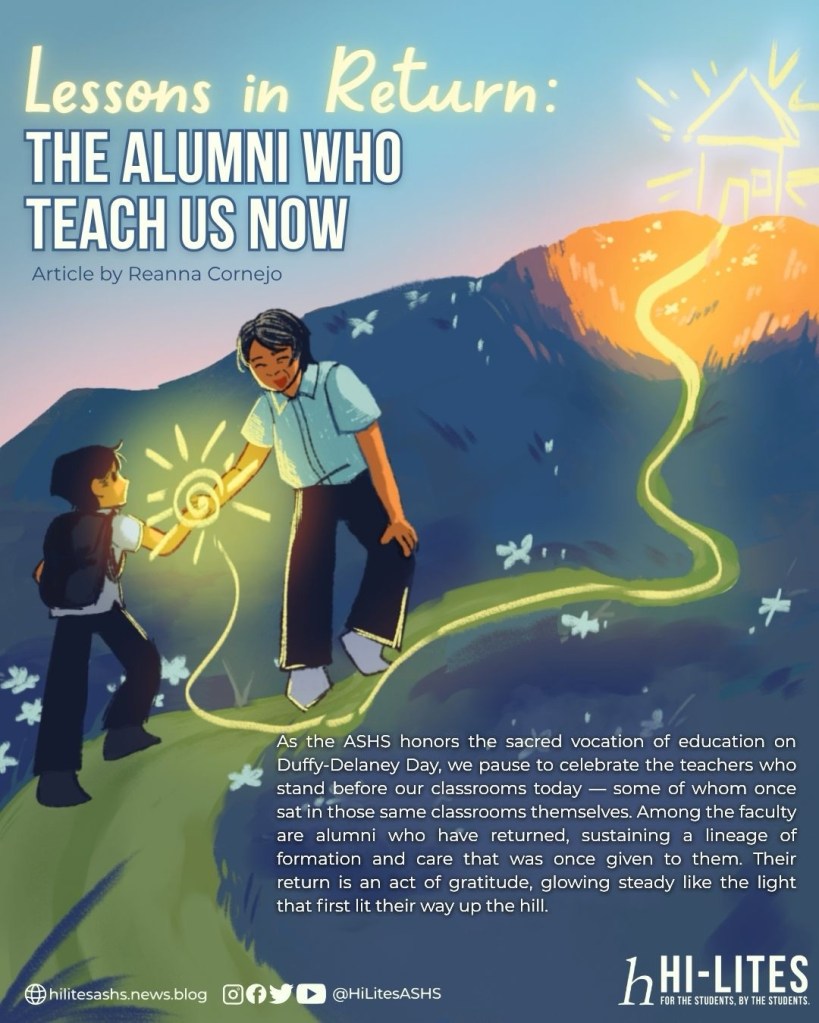
Pubmat by Yana Ramos
by Reanna Cornejo
By its very design, a school is a place you will leave. Yet a true home pulls you back when the wandering is done. For generations of Ateneans, the campus has always blurred the line between the two. Every morning, the Ateneo Senior High School (ASHS) stirs into being beneath the canopy of trees. The scent of freshly cut grass from the fields mingles with the hum of youthful discourse, and somewhere between the shuffle of shoes against pavement, the ringing of bells, and the echoes of school songs, the Atenean spirit breathes life into the campus grounds. While many students inevitably depart from these halls, packing away their things to descend the hill and forge their own paths in the world, a devoted few find that the spirit of this place is enough to draw them back in.
It’s almost poetic to come back to the place that witnessed your coming-of-age; now walking these sunlit corridors as the one guiding others, instead of the high schooler once also seeking direction. For most alumni, Ateneo is the institution that helped shape their moral foundations, forged lifelong friendships, and offered them their first glimpses of Magis and the ceaseless striving to become persons-for-and-with-others. As we celebrate Teachers’ Day and honor the sacrifices of our educators, we look to those who once clutched those familiar blue student lanyards and now hold lesson plans, bearing the responsibility of shaping the next generation of Ateneans. These alumni-turned-teachers bridge the space between departure and return, built upon realizations that the campus that had sheltered them is also a hearth they were being called to tend.
Footprints on the Grass
Memory can reshape landscapes, and for Sir Danielle Aguilar, a Humanities and Social Sciences (HumSS) alumnus who now teaches in the Social Sciences department, the physical transformation of the ASHS was both literal and poetic. Gesturing toward the Saint Ignatius courtyard, where paved paths now slice through the greenery, Sir Aguilar’s memory superimposes a simpler campus. “This used to be just grass,” he recalls, a fond smile breaking across his face. “No paths, no sundial yet. That FLC over there wasn’t even built.”
The ASHS he entered was humbler in its architecture, but no less immense in the feeling. Coming from a public school, stepping into Ateneo felt like a revelation to Sir Aguilar. He describes vividly remembering the sensory overload of his first ASHS Fair — the blinding stage lights, the heartbeat of the crowd, and the music of Ben&Ben, who were then just an up-and-coming band. It was in breathless moments like those, he notes, “where it dawned on me that the ASHS was just this grand land.” It was the sudden awareness that one could belong to something larger than oneself.
Years later, returning as a teacher, Sir Aguilar passed by the very same banner that had first welcomed him as a wide-eyed adolescent, draped boldly across the Main Building’s entrance: This is the place where we belong. Though time and weather had worn its edges, its fundamental truth was untouched. “It’s funny,” he observes. “That sign was already here when I was a student seven years ago… yet that sense of belonging has still stayed with me.”
For Sir Michael Gerochi, another alumnus in the Social Sciences department, that sense of belonging was felt in daily life at the ASHS. He describes the Junior High School alive with the motion of those final sessions before the shift, where the anticipation of a new chapter mixed with the ache of leaving old friends behind. But, as he found, stepping into the neighboring ASHS building brought a kind of joy as well. Looking back now, Sir Gerochi describes those years as nothing short of happy. “Both of my sections, Canisius and Gonzalez, were some of the best classes I ever had,” he says. “My years in the ASHS were a blast.”
The buoyant memories tumble out: moments of laughter, friendship, and spontaneity that defined his youth. “It is too difficult to even mention a most memorable moment as a student, because there were too many,” he shares, describing the simple joys of recess and lunch breaks, when someone would drag out a speaker and they’d form circles to dance for no reason at all. The magic of it came from the accumulation of all those ordinary days made memorable by companionship. That was the ASHS he knew — carefree, vibrantly alive, and always full of laughter.
Time and the Tradition of Growth
Time has inevitably altered the physical and digital landscape of the ASHS. Today, the campus hums not only with lively debate but with the ping of notifications. Requirements that were once hastily slipped into Pigeon Halls now travel invisibly through online portals. Sir Aguilar looks back at the tactile reality of his student days: gathering around tables in the library, paper and pens scattered wildly, drafting handwritten submissions, and trekking down to the Junior High grounds for P.E. classes.
Sir Aguilar describes the way today’s Ateneans have to navigate a hybrid existence; one part in classrooms and the other illuminated by screens. “The rigor of academics hasn’t become just easier or harder, it’s just different now,” he reflects. “But what’s constant at least is how Ateneo teaches us not just to study, but to grow — lumago, not just mag-aral.”
That distinction is the heart of Ignatian formation. The retreats, the silent recollections, the long formation talks; these are never mere ornamental traditions. It’s this Ignatian principle of holistic formation, Sir Aguilar notes, that shaped him as a student and something that continues to define him now as a teacher. Standing now at the front of these formation sessions, he feels the weight and wonder of continuity. “It’s surreal,” he admits. “I’m now part of the process that once formed me.”
Sir Gerochi echoes how surreal this kind of return was. Coming back made him smile, he says, but it also brought a wave of nostalgia that caught him off guard. “Coming back to the ASHS made me remember all the memories I had in this place,” he says. “I can’t deny the wave of nostalgia that overcame me as I wondered about all my friends and former classmates.”
For a fleeting moment, it felt as though he had just wandered into a slightly rewritten version of his own adolescence spent here. However the students he taught now were unmistakably born of another generation. “When I came back, I was a little shocked at how different the students looked and talked compared to my time,” he describes. But past the differences in eras, the foundation of formation held firm. “The place itself has that same air of home,” Sir Gerochi says, noting how the campus still bears that same enduring sense of warmth that had always been there, recognizing the warmth that now welcomes him as a teacher called to serve.
The Standard of Care
If there is a singular force that compels an Atenean to return to the classroom, it is in being inspired by the formators they had themselves as students. Excellent teachers, after all, don’t just impart knowledge; they establish a standard of care so transformative that it compels us to replicate it for others. It sets a benchmark for what it means to truly educate.
Sir Gerochi attributes the welcoming nature of the hill to mentors like Ma’am Ryza Martinez and Ma’am Caroline Laforteza. As his class moderators, they went beyond just academic instruction. “They were deeply influential in my formation as a student,” Sir Gerochi shares. “They actually helped me in discerning what I wanted to do for college.”
More importantly, they showcased the kind of togetherness that Sir Gerochi now strives to cultivate in his own classrooms. Observing them taught him that education is a relational act. “One of the best things a teacher can be for their moderating classes is someone who facilitates meaningful experiences the students can share with one another,” he reflects.
In a similar way, Sir Aguilar traces the start of his path to a classroom, helmed by Sir Josh Madarang, who is now his boss as the Social Sciences subject area coordinator. “He was much stricter then,” he notes, but it was a strictness blooming from the respect of his students’ own intellect.
Sir Aguilar describes how it was in Sir Madarang’s classroom that politics stopped being full of just cynical, abstract mechanisms and concepts; instead it became a class where you could prod questions about faith, society, and human responsibility. The subject came alive, and with it a curiosity about the world and one’s place within it. It was Sir Madarang who inspired him toward studying political science and showed him what expertise could look like when it is joined with care.
In their return, Sir Gerochi and Sir Aguilar both continually recognize the chain of teachers who become mentors, students who become teachers because of them, and the care that passes forward with each. It is the ongoing heartbeat of the institution, always passing the flame forward.
Staying is an Act of Love
To teach in the very rooms where you once wrestled with your own youthful uncertainties is both a privilege and a responsibility. Sir Aguilar views his profession as a continuous act of “passing down the torch.” The warmth and care that defined his own Atenean experience has permeated into his life’s work and brought about a desire to give it to others as well. “The care given to me as a student is now my big responsibility,” he says. “Ateneo showed me what care means, and now I have to show it to you guys too.”
When pressed on his reasons for returning, Sir Aguilar might deflect with a practical joke about employee benefits, but the truth beneath the humor goes back to the university’s central values. “I knew before coming back that Ateneo would take care of me,” he affirms. He cites ‘cura personalis,’ (care for the whole person), and how it was embodied in the way teachers once treated him and in the way the institution values its people. He stresses that Ateneo doesn’t just take care of its students — it extends that pastoral care to its workers and teachers. There’s a formation even in how the formators themselves work. In his words, “it’s not just about professional development, but about being a better human.”
Sir Gerochi’s return, conversely, was a beautiful accident. It was not a premeditated career path, but born from the stirring of curiosity when a vacancy in the Social Science department popped up. What began as a moment of curiosity turned into a week of discernment — small acts that ended up reshaping his direction entirely. Life, he realized, has a way of steering us toward the unexpected, offering choices that ask only for an open heart and a bit of trust.
When he first returned to Ateneo, Sir Gerochi thought he already understood the famous 5Cs and the Ignatian principles repeated in countless formation sessions. But it was only through teaching that those ideas became real. Standing now on the other side of the classroom, he realized that embodying those values is far more challenging and far more rewarding than simply learning them. “Only through coming back did I truly understand the values Ateneo taught,” he says thoughtfully. “It’s one thing to be taught these as a student, but it’s another to live them every day. Through teaching, my Ateneo journey has truly come full circle.”
Both teachers lament that teaching in Ateneo is more than a job — it’s a calling. To them, it’s not just about lectures or deadlines; it’s about shaping character. “It means doing something I can be proud of,” Sir Gerochi says. Each week, he finds pride in the steady routine of crafting lessons, guiding reflections, and seeing his students grow into more thoughtful versions of themselves.
Home-Making
To come back to the Ateneo Senior High School is to understand that home is not just a place, but a feeling; the unshakable sense of belonging that never quite fades, no matter how many years pass. For alumni-turned-teachers, it is the feeling of walking upon familiar floors and realizing they are a different person from the one who sat in these classrooms, but still someone who belongs all the same.
When asked what “coming home” means to him, Sir Aguilar smiles in a way that suggests both pride and peace. “When I was a student, ‘home’ was a word we used a lot,” he says. “Especially in HumSS. We were a tight-knit bunch. It felt like home because it was a place where you could be yourself. We had all kinds of people, with all kinds of challenges, but everyone found their place. I felt like it was where I belonged.”
Looking out into the courtyard as the late morning sun filters through, his tone shifts into something somber and soft. “This is the very last HumSS batch the ASHS will ever produce,” he says with a thoughtful pause. “And I get to be part of that. I get to show them the same traditions, the same care that I once felt. The same home.”
Sir Gerochi finds himself caught in similar reflections, pausing outside the doorways he once rushed through as a teenager. The memories of carefree moments and laughter spent with friends seem to echo down the corridors for him, overlaying the present reality of students looking to him for guidance. “I realize I’ve come full circle,” he says. “Not just returning to the place that formed me, but becoming part of how it forms others.” He reflects on the parallels of it all. “Home,” he says, “isn’t just where you begin. It’s also where you return once you’ve learned enough to give back.”
As the campus bell rings and a new batch of students punctuate the hallways with their chatter, they are unaware that some of their teachers once sat in their same chairs, dreaming the same dreams under the same Katipunan sky.
“Now,” Sir Aguilar adds, “I realize I’m no longer the one being welcomed home. I’m the one keeping it warm. The homemaker, so to speak. I’m the one making sure others feel what I once felt.”
If true commitment asks for a humbling, self-emptying love, then the alumni who teach us now are well-versed practitioners. They are the enduring homemakers of the hill, staying when the music of the Fair fades, when the grading periods grow heavy, and when the work becomes ordinary. It is the beautiful realization that the truest way to honor the standard of care they once received from their own mentors is to do the same for the next generation.
As Duffy-Delaney comes and goes, we are reminded to see the people at the front of the classroom not just as our teachers, but as living symbols of a love that returns, remains, and chooses, day after day, to call Ateneo home.

