
By Mary Therese Catapang
To open an online space for discussion on mobility issues plaguing the Katipunan Avenue and the Greater Capital Region (GCR) as a whole, the Ateneo Institute of Sustainability (AIS) initiated dialogues through their online event entitled “Reimagining Katipunan: A Sustainable Mobility Webinar and Workshop,” held in Zoom, November 26.
In partnership with Move as One Coalition, the event featured speakers namely Riz Comia and Katreena Chang who belong to the coalition; Comia majors in policy reform and community engagement while Chang specializes in policy research and civic engagement.
To kick off the discussion, Mr. Rizalino D. Rivera, Vice President for Social Development of Ateneo de Manila University (ADMU), emphasized that congestion is a wicked and complex problem, thus there is so much more left to be done.
“This (the event) gives everyone the opportunity to reflect about our responsibility to advocate for a healthier and more inclusive city, starting with our very own Katipunan spaces,” Rivera stated as he stressed the purpose of the event at the end of his speech.
State of public transportation in GCR
As Comia started her talk, she recalled her experience as a commuter while emphasizing that the public transportation is “inadequate, poor, and very unreliable.”
“…public transportation ang gamit ko para makapasok sa school, three hours before class ako gumigising para siguradong makapila at makasakay ako sa jeep bago mag-rush hour. Laging mahaba yung pila pero konti yung jeep. Pagsakay ko sa jeep, siksikan talaga, yung waluhan, nagiging sampuan, at nakadepende talaga sa dami ng pasahero yung laki ng kikitain ng drayber,” Comia recounted.
Two months ago, Comia saw how jeepney drivers were begging for money along the streets of Katipunan because they were prohibited to travel due to quarantine restrictions—which has also become a disadvantage to the commuters.
“At wala na nga halos jeep, hindi rin maasahan ang tren. Bigla-bigla na lang magsasara pag may aberya…at kapag walang jeep o tren, paano na tayong mga commuter,” Comia said.
Additionally, Comia brought up the issue on pedestrian infrastructures which commuters also deal with every day.
“Pagbaba ko sa jeep, kailangan ko pa makapunta sa other side para makapasok sa school. So tatahakin ko etong malabundok na overpass. Buti na lang yung overpass na ‘to may bubong, di ako naarawan ‘di nauulanan pero malalanghap mo pa rin yung usok galing sa traffic sa baba,” Comia said as she stressed how much harder this setting is for bikers, kids, pregnant women and PWDs given that pedestrian infrastructures are inaccessible, hostile, and poor.
Car-centric transportation in the country
After Comia highlighted the struggles of commuters, she then described how the public transportation in most places in the Philippines and other countries is car-centric, prioritizing private vehicles.
Chang substantiated this later when she presented the 2014 data from Japan International Cooperation Agency (JICA) which says that 70% of road users in GCR rely on public transport, but are crammed into 22% of road space, while 30% rely on private transport but they claim 78% of road space.

“There is really a great inequality happening there. There’s a great mismatch in what is meant to serve the people. It’s not actually serving most of the people that need it. So given that, what we really need is kind of like a better balance for a better normal,” Chang expressed.
Chang further mentioned that there has been a “near-zero investment on road-based public transportation.”
From 2010-2021, 99% of the Php 2.8 trillion road-based infrastructure budgets were used for road construction, widening, and maintenance while only 1% or Php 40 billion was used to fund public transport.
As a result, 88% of Filipino households that do not own cars are affected by the poor public transport while they (commuters) were also financially affected by the sharp inflation causing the rise of road passenger transport prices this year.
However, it was also emphasized that car-centric public budgeting has harmed not only commuters, but car users too as traffic worsens all over GCR.
Additionally, there are a limited number of green and open spaces in Metro Manila, resulting in poor air quality, low biodiversity, and overcrowding in public spaces.
On average, the World Health Organization (WHO) recommends 9m² open space per person, but in the Philippines, an individual can only have 5m².
Addressing mobility needs and awareness of the issue
To achieve a better balance in the mobility issue, Chang stated 3 ways on how to immediately address the mobility needs of the people.
On a policy standpoint, Chang calls on the leaders to invest in more active and road-based public transport infrastructure, to improve overall transport network planning, and to shift focus from private vehicle dependency to walking, cycling, and road based public transport.
Meanwhile, Comia encourages the audience, mainly the students, to follow these steps on how to further one’s knowledge on mobility issues as well as how to address such.
- Learn more about the movement: bit.ly/MoveAsOneAdvocate
- Read up on local and national policies: bit.ly/MoveAsOne-AT-Policy
- Check out our research papers:
- Systematic Shortage in Philippine Transportation
- Paper: bit.ly/MoveAsOnePaper_shortage
- Slides: bit.ly/MoveAsOneSlides_shortage
- Data: bit.ly/MoveAsOneData_shortage
- Move people, not just cars
- Paper: bit.ly/MoveAsOnePaper_budget
- Slides: bit.ly/MoveAsOneSlides_budget
- Data: bit.ly/MoveAsOneData_budget
- Biyahenihan for a Better Normal: 2022 Budget Proposal
- Proposal: bit.ly/MoveAsOnePaper_BudgetStatement2022
- Slides: bit.ly/MoveAsOneSlides_proposal
- Data: bit.ly/MoveAsOneData_2022
- Systematic Shortage in Philippine Transportation
- Answer the survey of the group of students from UP Diliman conducting a feasibility study on pedestrian experience along Katipunan Avenue in Quezon City: bit.ly/235katipsurvey
- Dig into mobility data
- Demand from your schools
- Engage your own LGU: bit.ly/MoveAsOneEngage
- Promote walking, cycling, and public transportation
- Organize or participate in mobility events
As the main talks ended, the speakers advised during the Q&A portion that if we want to influence policymakers to make changes on the current public transport system, it is imperative to prepare research points and arguments to make demands stronger.
After the Q&A portion, participants who signed up for the workshop were then divided into breakout rooms to share their insights about the discussions on mobility through first inputting their answers in the Jamboard before taking turns to speak.
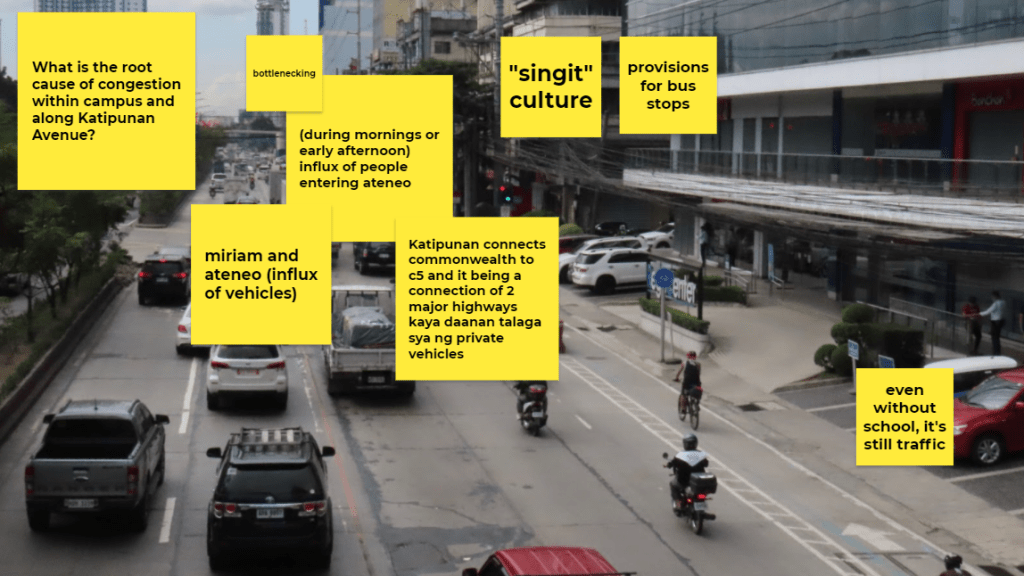
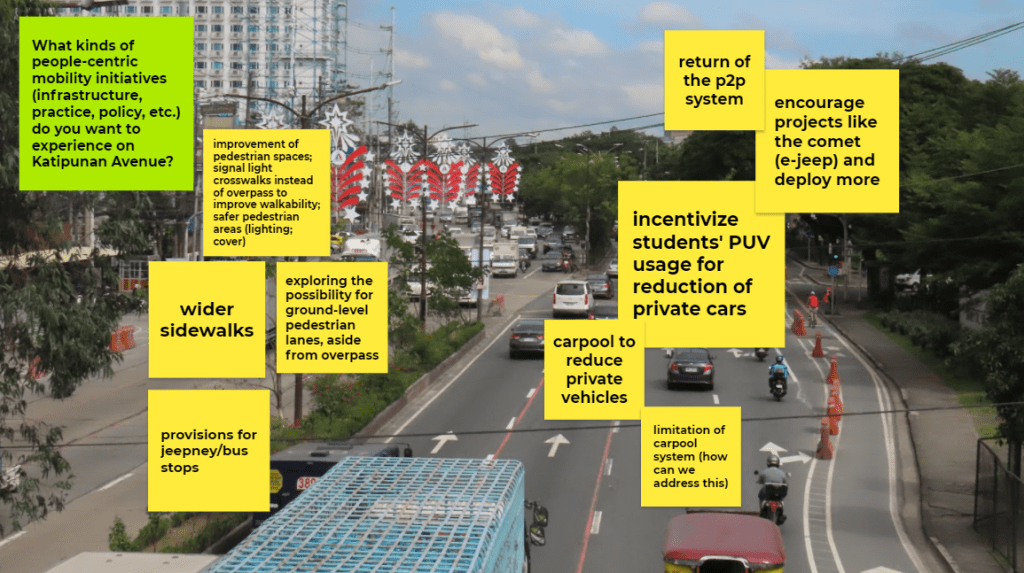
While GCR is grappling with the mobility crisis, other cities have successfully addressed mobility issues such as in Iloilo City and Naga City where they have made their roads bicycle-pedestrian-friendly coupled with green spaces.
As the event comes to a close, it was highlighted that the advocacy for sustainable mobility must continue.
 HiLites ASHS