
By Gian Angnged
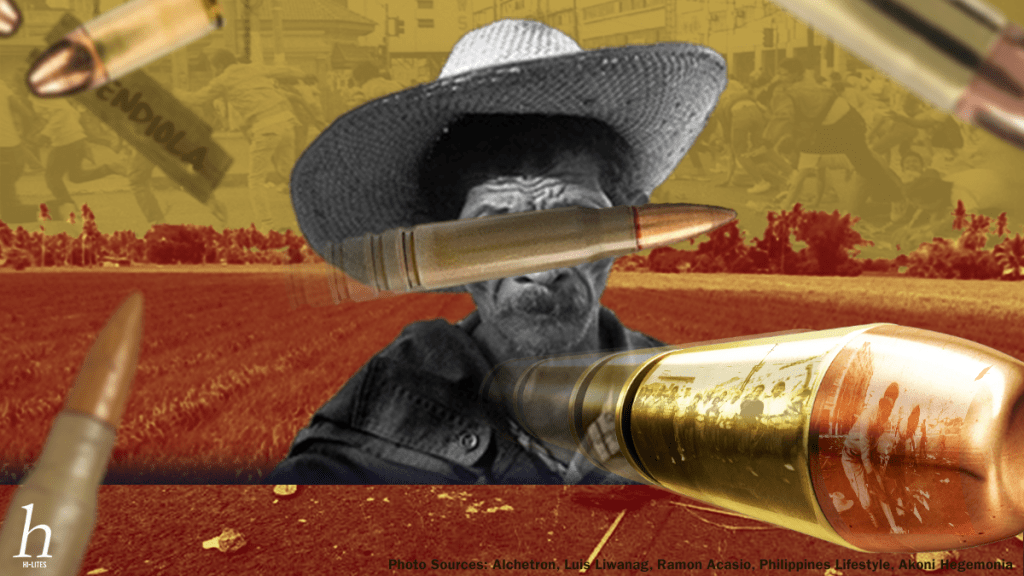
On January 22, 1987, thousands of farmers flocked to Mendiola Street in Manila in the hopes of opening a dialogue with President Cory Aquino on land reform and free land distribution. Instead, they were met by state troops wielding bullets and tear gas. 13 farmers were killed, 39 sustained gunshot wounds, and 20 suffered minor injuries.
Decades later, the struggle for agrarian reform is still stained with the blood of farmers who tilled land they didn’t own. Mere days before the 35th anniversary of the massacre, farmer couple Silvestre Fortades Jr. and Rose Marie Galias were gunned down in Barcelona town in Sorsogon.
Fortades Jr. and Galias were members of progressive groups, Anakpawis Partylist and Samahan ng mga Magsasaka sa Sorsogon, which push for land reform and peasant rights. Their killing moved up the number of politically driven peasant killings under the Duterte administration to 347.
Under the slew of repressive policies Duterte has railroaded on the pretext of counterinsurgency and counterterrorism, killings and human rights abuses come left and right as militarization bears down on the countryside.
Since he took office, 22 massacres—which largely victimized peasants and indigenous peoples defending their right to land—have been documented by farmers group Kilusang Magbubukid ng Pilipinas. Most of the massacres took place in Bicol and Negros, where state troops were deployed in line with Memorandum Order No. 32, and in Mindanao, where Duterte declared martial rule.
144 peasants have also been killed since the issuance of Duterte’s Executive Order 70, which institutionalized the “whole-of-nation” counterinsurgency approach—a framework that blurs the line between unarmed civilians and armed rebels.
Furthermore, at least 61 peasants have died at the hands of state security forces under the pandemic as the administration uses the health crisis to curtail civil liberties.
Peasants were also the first victims of the heavily contested Anti-Terrorism Law, whose overbroad and vague provisions render it open to abuse. In February, two Aeta farmers charged with violation of the law suffered torture and 11-month detention before being acquitted by a local court due to insufficient evidence.
Low prioritization, neoliberal policies
Against a backdrop of killings and rights violations razing the countryside, the Duterte administration has continued to compound the plight of the peasantry, enacting laws that further plunge farmers in poverty and leaving the agriculture sector a pittance in comparison to what it gives other sectors.
Despite the agriculture sector’s accounting for 24.5 percent of the Philippines’ labor force, as reported by the Philippine Statistics Authority (PSA) in its November 2021 Labor Force Survey, and its indirect contribution of 35 percent to the country’s gross domestic product in 2020, the Department of Agriculture (DA) will only receive a paltry P72 billion from the P5.024 trillion national budget for 2022.
The budget for agriculture, says independent think tank IBON Foundation, reflects the Duterte administration’s “glaringly low prioritization” of the sector. “The already dismal 3.6% average annual share of agriculture and agrarian reform in the 2017-2021 national budgets under Duterte has fallen to an even smaller 3% in the proposed 2022 budget,” the think tank said in a statement.
The group added that the government’s lack of support for agriculture had compounded the sector’s decades-long decline and led to a heightened dependence on food imports.
From 2017 to 2020, the agriculture sector posted a 1.6 percent annual growth rate—only almost half of the 2.9% rate reported from 2001 to 2016. Meanwhile, the rice import dependency ratio rose from 5% in 2016 to 20.2% in 2019 following the passage of the Rice Tariffication Law (RTL) in 2017.
The same period saw significant increases in the import dependency ratios of garlic (89.1% to 92.2%); potato (14.8% to 18.1%); beef (32.7% to 40.3%); tuna (3.7% to 17%); pork (10.6% to 12.9%); and galunggong (0.4% to 21.9%). The country also posted a $7.7 billion average annual agriculture trade deficit in 2018 to 2020 —the largest three-year deficit in the last four decades.
The agriculture crisis has brought massive loss of livelihood and poverty to Filipino farmers, with an average of 328,000 agricultural jobs lost annually from 2017-2020—the worst among the last six administrations, and a 31.6 percent poverty incidence rate among farmers—almost double the 16.7 percent national average.
Bogus reform
But the root of peasant poverty—landlessness—has plagued the Philippines long before Duterte, tracing back to the Spanish colonial period. For generations, empty-handed farmers were kept in poverty while the bulk of the country’s land was concentrated in the hands of the elite few: inter-marrying families and multinational corporations.
Packaged as an antidote to the centuries-old problem, the Comprehensive Agrarian Reform Program (CARP) was passed into law under President Cory Aquino—herself a landlord—amid mounting pressure in the wake of the Mendiola Massacre.
CARP, which sought to redistribute 7.8 million hectares of land to millions of farmers by granting them Certificate of Land Ownership Awards (CLOAs), was beset by legal loopholes and defects. Acquisition of private lands fell far below target as landlords filed petitions for land exemptions and installed dummy beneficiaries.
There was also a need to evaluate and validate whether CARP beneficiaries remained in actual possession of awarded lands, former Philippine agrarian reform secretary Rafael Mariano said in an interview with Bulatlat.
“It has been too easy for [the Department of Agrarian Reform (DAR)] to show off CLOA distributions as successes, but whether the farmers retain possession and control over the awarded lands long after the ceremonies is a wholly different matter,” Mariano said, citing a 2017 DAR revalidation under his term where 83 percent of Hacienda Luisita agrarian reform beneficiaries were no longer in possession of awarded lands.
In 2016, Duterte, campaigning on a vow to uplift farmers’ lives and implement genuine agrarian reform, expressed that the CARP extension law failed to benefit and empower farmers.
Five years later, he told the DAR to hasten the process of land distribution under CARP to stamp out insurgency in rural “hotbed” areas. Now, as Duterte nears the end of his term, farmers group KMP says nine out of 10 farmers still do not till their own land.
PSA data show that his administration has distributed the smallest area of land since 2005, with a total distribution of 142,806 hectares—a small fraction of the highest record: former President Ramos’ total distribution of 1,113,019 hectares. DAR data also shows that the department only distributed a total of 18,789 hectares of new agricultural landholdings nationwide in 2020, falling nearly 40 percent short of its 30,154-hectare target for the year.
Meanwhile, the Genuine Agrarian Reform Bill (GARB), which peasant groups say would legislate free land distribution and provide better support services for farmers, thereby addressing the inadequacies of CARP, has languished in Congress for over a decade.
Land, justice, and an end to tyranny
Amid the persistence of landlessness, poverty, countryside militarization, and rights violations, peasant groups continue to call for genuine agrarian reform and national industrialization as well as seek justice for the victims of political killings.
They also opposed the possibility of a Marcos restoration and a Duterte extension in light of the approaching 2022 national elections.
“Ngayong Halalang 2022, halos ialay ng lahat ng kumakandidato ang langit at lupa sa magsasaka. Subalit napakadaling magbitiw ng mga salita at mga pangako tuwing eleksyon. Dapat suriin ang kasaysayan ng mga tumatakbo at kanilang mga kongkretong nagawa (o hindi nagawa) para sa mamamayang Pilipino. Hindi na dapat mailuklok muli ang mga kagaya ng mga Duterte at mga Marcos,” KMP said in a statement.
“Ang kailangan ng bayan ay gobyerno at mga lider na makatao, makamamamayan, at makabayan. Ang ganap na katarungan para sa mga biktima ng Mendiola Masaker ay makakamit lang sa pamamagitan ng pagpapatupad sa isang programa ng tunay na reporma sa lupa at pagpapa-unlad sa agrikulturang Pilipino.”
 HiLites ASHS