
By Johann Escalante
To say that the current regime isn’t known for treating its critics very well is an understatement. If not subjected to personal attacks from the president himself, voices of dissent are met with red-tagging and immediately labeled as enemies of the State.
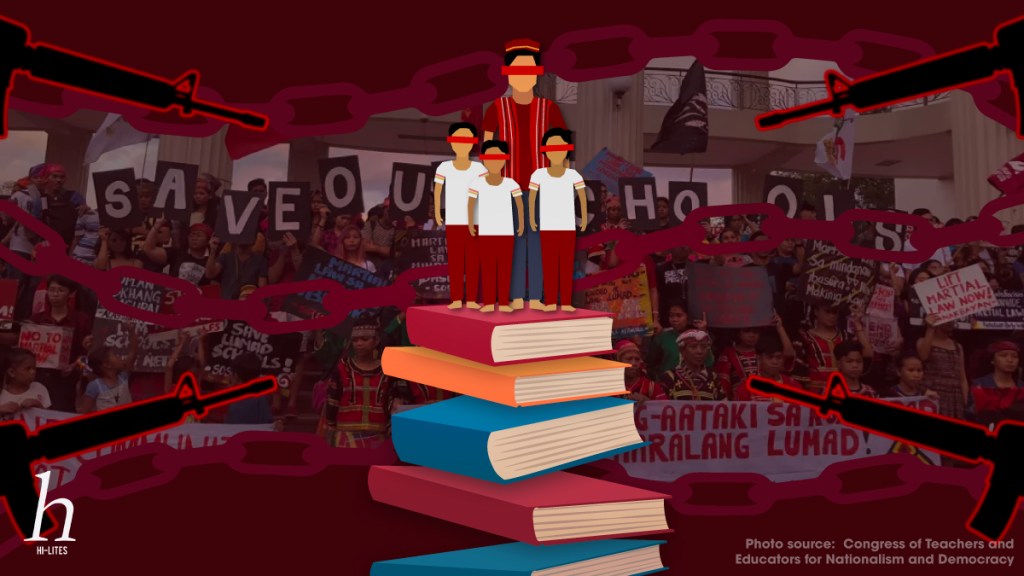
Such is the harsh reality of the several indigenous peoples of Mindanao, collectively called the Lumad, and the institutions and organizations associated with them. As Duterte nears the end of his term, let us look back on the state of Lumad schools under his reign.
When it all started
The Lumad pledged to defend their mineral-rich ancestral lands from money-grubbers on June 26, 1986, which went against the way the late dictator Ferdinand Marcos ran the economy during his reign. IBON Foundation’s executive director Sonny Africa wrote, “The [Marcos] regime worked hard to give foreign capital profitable opportunities.” With Marcos’ assistance, foreign corporations exploited and nabbed the country’s natural resources.
Lumads were taken advantage of by mining companies through misleading contracts, which faults went unnoticed by the Lumad due to their low literacy rate in the past. However, when they did awaken to the abuse and exploitation they had received, they performed active measures to prevent the occurrence of such events in the future.
One of these measures is to provide ample education to their children. Through the establishment of numerous and more accessible schools, they aim to supply enough knowledge to the youth so that no more land would be given up and that they would be able to reclaim what is rightfully theirs in the future.
Naturally, given their unique circumstances, the education they receive is different from the education endorsed by the Department of Education (DepEd) that mainstream public schools give. Lumad schools curriculum revolves around being inclusive and considerate to Lumad people, being patriotic or loyal to their ancestral domains, and having a scientific approach to life. Moreover, volunteers also teach in these schools their rights as citizens and indigenous peoples of the country.
The more educated they become, however, the more they resist efforts to implement mining and logging activities within the Lumad territories. Duterte, being the one who lifted the 9-year ban on new mining ventures for revenue, did not like this defiance.
Allegations and threats
In the pretext of resolving the tension between the country’s military and extremist forces in Marawi City, Duterte imposed martial law in Mindanao on May 23, 2017. The suspension of the writ of habeas corpus then gave rise to a sweeping crackdown on suspected insurgents and armed communists, painting targets on the backs of progressive institutions like Lumad schools.
Two months after the proclamation, Duterte explicitly stated that he would not hesitate to mobilize military forces and bomb Lumad schools, claiming that “[the schools] are operating illegally and [they] are teaching the children to rebel against the government.”
Since then, the Lumad community has been subjected to multiple accounts of violence at the hands of military forces. From 2017 to July 2019, 500 acts of “systematically destroying, burning, and vandalizing Lumad schools” were documented by the Save Our Schools (SOS) Network, a group that advocates for children’s rights. The declaration of martial law in Mindanao virtually gave the military free reign over the area, citing possible terrorist activities to justify their clear violation of human rights and even its extension after the 5-month long Marawi Siege.
Forced closures
July 2019 was also the month when the DepEd issued the simultaneous suspension of 55 Lumad schools operated by the Salugpongan Ta’ Tanu Igkanogon Community Learning Center Incorporated across Davao.
In a blatant attempt to curtail dissent, the schools, meant to provide education to remote areas in Mindanao, were ordered closed as DepEd spokesperson Jenielito Atillo cited a National Task Force to End Local Communist Armed Conflict report by Hermogenes Esperon alleging that the schools were teaching “ideologies that advocate against the government.”
Salugpongan denied the allegations in their appeal, while SOS condemned DepEd for “ordering the closure of schools without even verifying the wild, baseless claims of Esperon”.
Three months later, on October 8, DepEd formally closed the schools mainly on the grounds of non-compliance with DepEd regulations. As a result, 3,500 students were forced to enroll in surrounding schools, and more than 30 teachers lost their jobs.
178 out of the 216 Lumad schools in Mindanao, including those owned by Salugpongan, were shut down by September 2020, causing around 5,500 students to either enroll in other schools or stop going to school completely.
De facto martial law
The forced closure of Lumad schools, and the red-tagging of their students and teachers persist even after the lifting of martial law in Mindanao at the very beginning of 2020. That same year, Duterte signed into law the Anti-Terrorism Law (ATL), which has generated widespread concern from both local and international human rights groups for its overbroad provisions of “terrorism” that conflate legal activists with armed revolutionaries.
Less than a year after the ATL was enacted, a video of police officers forcibly arresting 21 students, 2 teachers, and 2 datus in Cebu went viral on February 15, 2021. Branding the arrests a “rescue operation”, authorities claimed that the students, 15 of whom were minors, were being coerced into joining the communists. 7 of the 11 adults were detained under charges of kidnapping and serious illegal detention.
However, according to the video, as well as a testimony of one of the students, the adults posed no threat and that everyone there was present of their own accord, with documents of consent forms from the parents available. Moreover, the police officials’ use of brute force to the point that the screams of the students and teachers echoed throughout the video made it hard to believe that it was indeed a rescue operation.
The minors were brought back to their hometowns in Davao del Norte after their stay in Cebu, initially caused by their “bakwit” or evacuation from militarized Mindanao in 2017, which was prolonged by coronavirus quarantine restrictions.
“The Lumad [were] there because the military destroyed their schools in Mindanao,” Bayan Muna Party-list Representative Carlos Zarate said. “And now even in their evacuation or evacuation school they are being harassed and abducted. The government won’t even let Lumads study,” he added.
Knowledge is power
Denying anyone of their right to education is tantamount to denying them power. This holds true especially in the context of the Lumad, whose ancestral lands are repeatedly nabbed by government officials and foreign businesses who exploit their illiteracy.
Equipping them with the necessary knowledge so that the same things would not happen again is the purpose behind the establishment of the same Lumad schools the administration is so fixated on shutting down.
It is in cases like these where the Duterte regime’s blatant disregard for the Lumad’s basic human rights is in full view that the Filipinos’ ability to select a proper leader comes into question.
Seeing as how DepEd willingly closed more than 75% of all the Lumad schools in the country, as well as how even the National Commission on Indigenous Peoples (NCIP) participated in the red-tagging themselves, an ideal leader would be someone who exhibits integrity and good judgment of character so as the appointed heads of these agencies would fulfill the organization’s role in the country.
With the 2022 national elections being just 3 months from now, it is now more imperative than ever to reflect on the events that transpired during the past six years and use them to determine the best possible course of action for the prosperity of the country and its people.
 HiLites ASHS