
by Billie Mercado
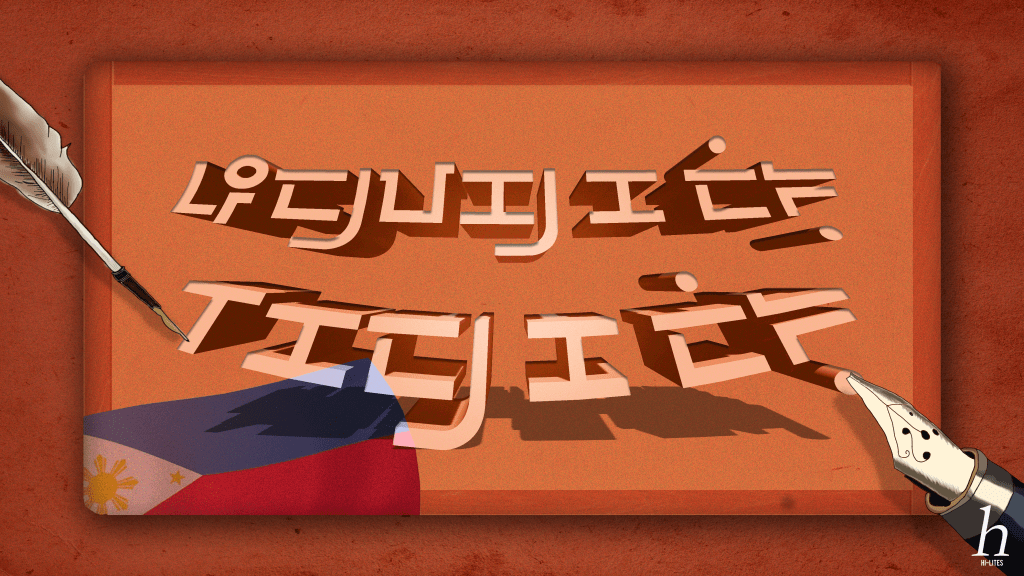
“While a people preserves its language; it preserves the marks of liberty,” once said the Philippine national hero, Jose Rizal. Yet, in the case of Baybayin, the proper way to apply this statement seems to be quite debated upon.
Last June, a post displaying Baybayin road signages in the jogging and biking lanes in UP Diliman circulated online, garnering mixed reactions both on Facebook and Twitter. Many Filipino netizens expressed their thoughts on their respective social media platforms, with some admiring the beauty of the Philippines’ ancient writing system, and others questioning its purpose and practicality in the present age.
The said writing system, once used by our ancestors prior to the Spanish occupation, is evidently being brought back and used in designs for events, local businesses, merchandise, and the like. However, in addition to the lack of inclusivity of the various languages and dialects in the Philippines—not just Tagalog—to many, it looks as though this seeming artifact from our country’s pre-colonial history may have been reduced to a mere aesthetic.
On one hand, as Baybayin is an outcome or evidence of our nation’s own “pure” culture and not one that has resulted from centuries of external colonization and occupation, many argue that being able to read and write in Baybayin reflects one’s yearning to be acquainted with the country’s true roots. Artist Kristian Kabuay, whose works focus and shed light on Baybayin, conveys this thought simply yet comprehensively. Through a slogan shirt he crafted, he urges Filipinos and his other constituents to “decolonize” and “indigenize”. Hence, in his own way, firmly denounce colonization and embrace the culture yet untouched by foreigners.
This writing system may also be likened to those of Korea, Japan, or China, to name a few. Such scripts may be perceived to showcase a language that is truly and uniquely one’s own—compared to countries like our own, which use an alphabet similar to other languages like English.
Nonetheless, Filipinos must be careful so as not to fall victim to surface-level love for country.
If the ultimate goal is to have Baybayin as the country’s centralized writing system once again and embrace past traditions of the country through it, then it must already be used as it is intended to be, and not simply for creating eye-catching designs as many find themselves either consciously or unconsciously doing.
Not only that, but maximizing the functionality of Baybayin is also a problem to be addressed. For instance, calling back to attention the widely-circulated post regarding the UP Diliman jogging and baking lanes, road signages are meant to help ensure safety and direction—and no matter how nicely laid out the design may be, if the common folk cannot understand the instructions, how are they supposed to follow? Its main aim would not be fulfilled.
Thus, as Filipinos of the present age, it is vital to assess the motives behind the desire to learn and integrate Baybayin in our lives today. With this, each one could evaluate: through the use of this script, are we truly basking in the richness of our culture, or are we simply giving in to shallow forms of nationalism? Where do we set the line between preserving our cultural heritage and committing performative patriotism?
It is without a doubt that Baybayin gives us Filipinos of today a glimpse of how our ancestors lived and communicated during their time—a time that was free from colonially-driven oppression, free from years and years of exploitation from those who took us captive for their own advantage.
However, while it is a very beautiful trace of our origins, different times bring different circumstances. After all, it is believed that very few Filipino citizens know how to read and write in Baybayin, as not even the Philippine Statistic Authority can give a solid number. Mandating that millions of people learn the writing system is a very ambitious goal, and while it is certainly possible through an outpouring of individual, sectoral, and systemic efforts, it is difficult to determine if we are at that point where each one can learn Baybayin and implement it on a national level. Only time can tell if those efforts will indeed be carried out and executed.
Most of all, being a Filipino who is wholeheartedly proud of their own language and culture is not defined, measured, or compared with others by one’s proficiency or even willingness to learn a practice like using Baybayin. What we can do for now—and continue to do—is to constantly speak and enhance skills in Filipino, and more so, recognize and appreciate the beautiful plethora of languages and dialects in the various regions and islands of the Philippines.
 HiLites ASHS