
By Francesca Ote
“The audacity of the aggressor is a clear signal to the West that sanctions against Russia are not enough, because they did not understand, did not feel, did not see the world is really determined, really determined to stop this war. You will not hide from this reality. You will not hide from new murders in Ukraine.” Those were the words echoed by Ukrainian President, Volodymyr Zelenskyy last March, during the early developments of what would be a prolonged and devastating battle.
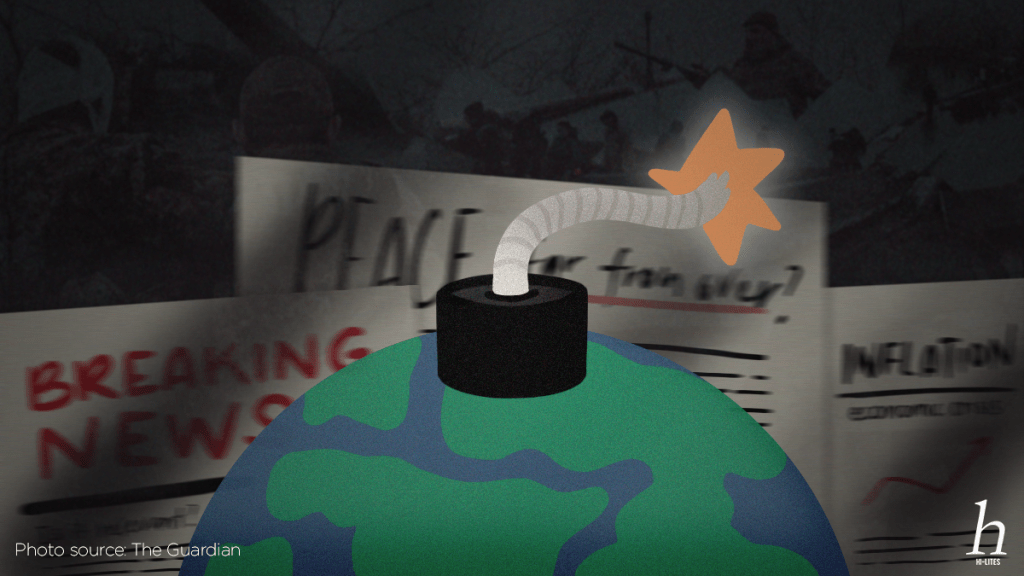
Yet, with the accelerating victories that Ukraine holds in recapturing their southern territories, Russia vigorously retaliates by bringing the issue to the international stage, as they spread allegations that their adversary is “planning to detonate a nuclear-laced improvised device”, otherwise known as a dirty bomb. In light of the recent shift of events, the United States of America, France, and the United Kingdom unanimously agreed that “the world would see through any attempt to use this allegation as a pretext for escalation.” This, amongst other things, is a frank reminder that Ukraine’s valiant struggle for peace is far from over.
The rest of the world continues to stand as collateral damage amidst all of this as Ukraine and Russia’s key role as major commodities producer hangs in the balance. Ever since Russian troops stepped foot on Ukraine soil on the fateful day of February 24, circumstances have not been too appealing for a global economy that lives off of stability—the Philippines, of course, being no exception.
Nearing the inevitable day that economies all over were dreading, experts foresaw minimal disruptions of oil supply in the Philippines due to the fact that the country does not directly trade with either one of the war stakeholders. However, Russia’s immense leverage over the flow of global events is one that should not be glossed over, as the war they inflicted almost instantly tagged the price of international crude oil to be 100 dollars per barrel, thus skyrocketing gasoline to Php 8.75 per liter, kerosene to Php 9.55, and diesel to Php 10.85. For Russia to quite literally rock the balance of the world’s financial sector serves as yet another eerie reminder of their big, bold title as a “global superpower.”
As a somewhat “apex predator”, Russia has indirectly placed a chokehold on the cost of crude oil, and hence, 90% of the Philippines’ energy requirements. Those needs, quite frankly, are deeply intertwined with the very livelihoods of innocent citizens. A tell-tale sign of this was when former President Duterte had to distribute over Php 2.5 billion in fuel subsidies to jeepney drivers; and despite the Department of Transportation providing compensation to the drivers affected, it is still not enough to cover half the costs for the damage done in the long run. It is unsettling, to say the least, that conflicts oceans away are still able to creep into the peace and harmony of another country, and that the national government fails to effectively mitigate their struggles.
Inflation was yet another looming concern in the atmosphere, as it hit around 4% in March and further spiraled to 6.9% in September. This staggering number has even prompted President Marcos Jr. to consider rehashing a deal with Russia for oil and fertilizer, in spite of the nation’s condemnation of the invasion months prior. In fact, fellow Southeast Asian country Indonesia has been deliberating to follow suit. Will world leaders be forced to the brink by this seemingly perpetual economic crisis?
However, while all of these continuous ill effects clearly manifest to this day, news coverage on the matter has seemed to have lessened over time, as if it is no longer pressing nor significant. Nevertheless, the war’s economic dents are one of many substantial and logical reasons to debunk that. Despite the months that have passed, the world still needs a reminder of the gravity of this war. This cannot be achieved, of course, if news outlets feel the need to reduce the spotlight on the topic.
Back then, headlines were flooded with the latest details of Zelenskyy’s exceptional leadership and drive to serve, which was then further adorned by moving stories of volunteers from all walks of life joining in on the fight. What has happened to all of these? Why has the war become an afterthought when it comes to deciding what’s “news-worthy”?
There is one main prerequisite to gaining any form of news coverage: relevance. Yet, recent statistics by the Pew Research center seem to say otherwise. Roughly around 26% of Americans confessed that they “are not too concerned about Russia defeating Ukraine.” The same percentage represents those who share similar sentiments regarding Russia invading Ukraine’s neighboring regions. As for the heightened tension between the United States and Russia as a byproduct of this, 30%, unfortunately, attest that it barely troubles them, and 20% believe that the support is “too excessive”.
Certain members of the European Union can find common ground with this report. In Greece, the Ukraine War was ranked the lowest of their concerns, with only 25% affirming their worries on the issue. This is not to insinuate that other nations have the same views as the aforementioned, as it is quite the opposite. Italy, in particular, has been the most vocal amongst the rest, with them showcasing that around 9 out of 10 interviewees are gravely concerned. Nevertheless, these numbers are troubling as it is, knowing that thousands of buildings are being obliterated and Ukrainian citizens are losing their lives simultaneously.
Reiterating Greece’s stand which they mentioned that more domestic issues are their prime focus of the moment, the same reality applies to other nations as well, including the Philippines. As of recently, local news has revolved around the forthcoming face-to-face classes, the emergence of another typhoon, the performance of the new administration, and much more. This was never to diminish the other internal dilemmas other countries are enduring, but rather was intended to push global disputes to be at a relatively same level of spotlight as these. The truth is that while local headlines may not always reflect this, the world is interconnected, and thus the happenings of one nation will forever be pertinent to that of the others.
The economic shock waves sent forth by the war still remain until this day. The Philippines, just like any other country, is still trying to recover from its trauma. However, just like the rest of the world, the magnitude of the war and its ramification has been overtaken by other events thus relegating it to the back burner. Likewise, the news, which is one of the most powerful tools known to man, has the power to ignite a flame in everyone to stop this once and for all. Let this be a reminder to everyone, to hone their inner flame and stand in solidarity with Ukraine and the rest of the world by not letting their suffering become a figment of the past.
 HiLites ASHS