
by Patrick Lu
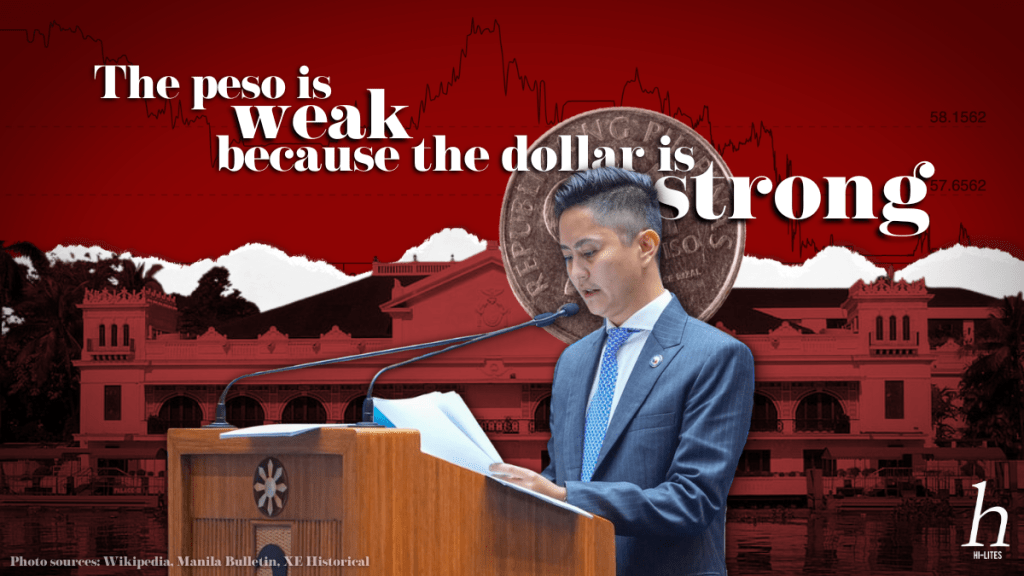
Recently, Senior Deputy Majority Leader Ferdinand Alexander “Sandro” Marcos has been under heavy flak for some of his recent statements. These include his suggestions for Filipino rice farmers to switch to producing dragon fruit during the Taiwanese off-seasons, and his claims that the Philippine Peso is weak due to the fact that the U.S. Dollar is strong.
With his words evoking criticism from netizens all over the nation, it is crucial to be able to examine and evaluate the validity of these statements.
Filipino Rice Farmers Switching to Dragon Fruit
“Dahil malapit ‘yung Pilipinas sa Taiwan, ‘yung Taiwan malaki ang demanda ng dragon fruit. Eh they can only plant dragon fruit three or four times, three or four months of the year. Kapag hindi na nila kayang itanim, planting season na rito. So if we can shift our farmers to plant dragon fruit kapag hindi na kailangan ‘yung palay, para maibenta sa Taiwan kapag kailangan.”
Dragon fruit is popular and in demand in various countries in Asia including China, Vietnam, Thailand, and Taiwan. Often flowering in sunny, warm, and humid environments, the typical harvesting season for these plants is around June to November every year, and they often take up to 8 months for a seedling to start flowering.
At first glance, it seems that this suggestion could be a viable option for farmers; however, digging deeper into the context of Filipino rice farmers, this suggestion falls utterly flat.
For dragon fruit to flower and bear fruit during the off-season, they require two more hours of sunlight than what they are usually given because of the shorter days during the aforementioned time of year. Research from the Mariano Marcos State University shows that this lack of exposure to sunlight can be supplemented by the use of LED lights. It would take one six-watt LED bulb for every four posts of dragon fruit. This alone makes it very inaccessible for Filipino rice farmers to farm during the off-season because many farms do not have access to the electricity or light bulbs needed to farm during this time of the year.
In addition, each dragon fruit plant would require a post to be set up to allow the dragon fruit to latch on while growing. This post would take up a significant amount of space and could damage the fertility of the soil around it. Not to mention, the long waiting time of eight months before the dragon fruit starts flowering, the huge upfront costs of buying the LED bulbs per plant (80 Pesos per six-watt light bulb), and the operational costs from the electricity used (amounting to 62,914 pesos per year) make it even more difficult for Filipino rice farmers to switch to growing dragon fruit.
All these combined, along with the unfamiliarity of growing a new type of plant, make the suggestion completely unviable and extremely inconsiderate for Filipino farmers.
The Reason for the Weakened Peso
“The peso is not weak because the peso is weak. The peso is weak because the dollar is strong.”
The U.S. Dollar is indeed a strong currency and is what is often invested in during times of economic crisis. As investors panic, they are more likely to play it safe and invest in the Dollar. This is due to the fact that the Dollar is the most widely used reserve currency in the world, which makes it a safe choice for an investment or simply a safe option for storing cash in. Countries around the world are experiencing this phenomenon with record-high inflation and depreciating currencies, and the Philippines is no exception.
The Philippine Peso has recently reached an all-time high of PHP 59.34 per USD this September. It is normal for the Peso to experience a drop in value because of the environment it has been exposed to, but it must never be an excuse for the lack of comprehensive economic policies and plans to try and wrestle the current record high October 2022 7.7% inflation rate and the myriad of socio-economic problems the country still faces. One such unresolved socio-economic problem would be the country’s non-compliance with EU maritime standards for Filipino seafarers, which could make 50,000 OFW seafarers lose their job. Despite facing similar risks in the past, the Philippine government still fails to fully address the pressing issue.
All of these only worsen the strength of the Philippine Peso. In fact, these factors might only be multiplying the effect of the troubled foreign exchange market that is safely investing in the U.S. Dollar. Yes, it may be true that the U.S. Dollar is strong, but it does not discount, nor is it completely responsible for the fact that the Philippine Peso is weak.
With all this being said, one may say that the statements of Sandro Marcos aren’t without truth. However, they do not show the full picture and are very misleading upon further investigation, for these words continue to leave the Philippine government not being held accountable for the problems this country faces.
 HiLites ASHS