
by Paolo Velilla
On the 14th of January last year, the Philippine government authorized the use of the Pfizer-BioNTech COVID-19 vaccine for emergency use; and ever since that day, it was made clear that the virus’ reign on Philippine streets was numbered. Almost two years later, at least 78 million Filipinos have taken at least one COVID-19 vaccine dose. The COVID-19 vaccination rollout seems to be in full swing in the country, with the government even declaring vaccination holidays, which have handed out millions of doses to the masses.
However, it appears that vaccinations have plateaued in recent months, based on vaccination data given by the Department of Health, with only a few thousand or so Filipinos being vaccinated these past few months, nowhere close to the hundreds of thousands vaccinated during the latter part of 2021 and start of 2022.
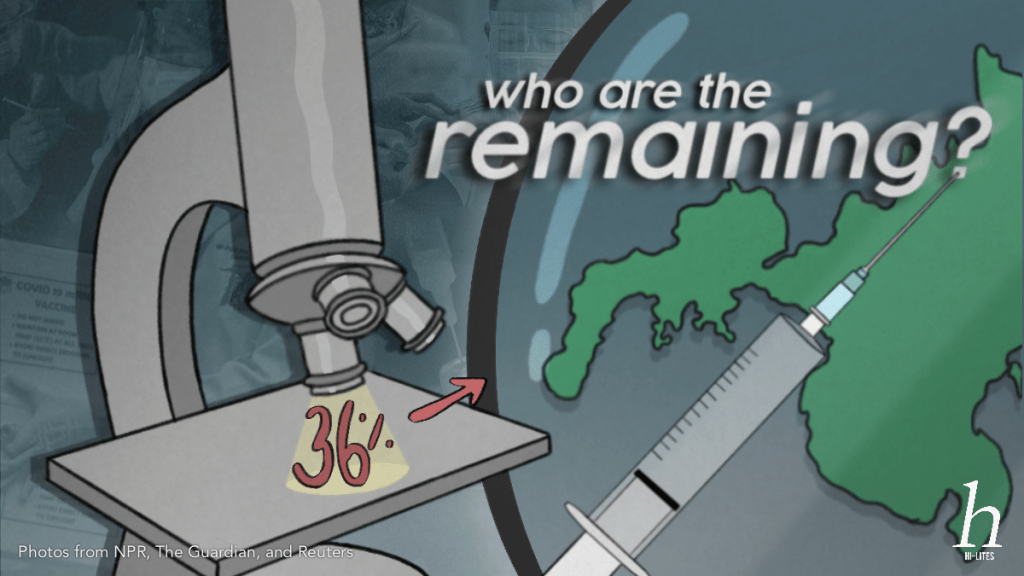
The Philippines is still far from where it should be regarding the ideal vaccinated population. In terms of the percentage of vaccinated individuals, while the Philippines is on par with the global average, vaccinating 64% of a population of 109 million, the country has been drastically lagging behind its Southeast Asian constituents, such as Vietnam (88% of 97 million) and Indonesia (62% at 270 million). To this day, 36% or 30 million Filipinos remain unvaccinated despite urgent calls for vaccination.
This raises an important question regarding the state of the Philippines’ vaccination effort, especially for the 30 million or so Filipinos who have not taken a COVID-19 vaccine. However, before we can determine who these people are, and why they have not been vaccinated, it is first crucial to answer the question of “where”. The Department of Health keeps track of COVID vaccinations by region, and by comparing this with regional population data, it is possible to narrow down which parts of the country are the least vaccinated.

Referring to the numbers above, 10 of the country’s 17 regions fall under the 64% national average mentioned earlier. 20,977,238 of the 37 million partly or unvaccinated Filipinos reside in these areas. Furthermore, 6 of the 7 regions above the 64% mark are Regions I, II, III, NCR, CAR CALABARZON—all of which are from Luzon. Meanwhile, the 2 lowest-performing parts of the country, BARMM, and SOCCSKSARGEN, are from Mindanao.
Furthermore, there appears to be a clear gap in vaccination rates between the north and south. This does not seem to be a matter of population either, because as mentioned earlier, there are a lot of unvaccinated people within these parts of the country. Thus, it begs the question: what are the factors that have made vaccination progress within Mindanao so slow?
First would be a matter of vaccine distribution. Distributing COVID-19 vaccines in a dense, urban metropolis is much easier than in more remote parts of the country. Sulu, a province housing 1 million Filipinos, has suffered from various challenges that have hampered the vaccine rollout, such as unfriendly weather, a lack of consistent electricity, and even armed conflict. These setbacks have unfortunately resulted in a vaccination rate of only 28.88% as of October 2022. Even Northern Mindanao has had its own supply issues, at one point putting on hold vaccinations for children aged 5 to 11 simply because they did not have enough shots.
The other reason why vaccine distribution in these regions has been so slow is due to vaccine hesitancy, brought about by vaccine misinformation. It is no coincidence that the two regions with the highest Muslim population, SOCCSKSARGEN, and BARMM, are the ones with the lowest vaccination rate, as misinformation has been a major problem. There have been many concerns regarding the COVID-19 vaccine among Muslim communities all over the world. Rumors of the vaccine containing traces of pork, and conspiracies that the vaccines were created to “make Muslims impotent.” However, religious leaders within BARMM have stated that these vaccines do indeed abide by the Sharia, and the challenge for them now is spreading this information in a region with poor access to the internet and traditional media.
It is much simpler to administer a vaccine in areas such as Metro Manila, with its hundreds of facilities and hospitals capable of administering vaccine doses, and relatively stable access to electricity and transportation. Unfortunately, it has not been as straightforward in more remote areas of the country, areas with inconsistent power supply and infrastructure more susceptible to harsh weather conditions; and then there is its population that has been a victim of many misconceptions regarding the vaccine. These are issues that require much more planning and resources in order to address. The government needs to create more facilities that are capable of administering vaccines to far-apart communities. The people need stable electricity and access to media and information, in order for its religious leaders to set the record straight regarding vaccination. These final battles against COVID-19 are proving to be some of the most challenging ones for the country, requiring many sweeping changes to the regions’ infrastructure, but these are battles that are essential to fight if the nation wants to end the war.
 HiLites ASHS