
by Francesca Ote
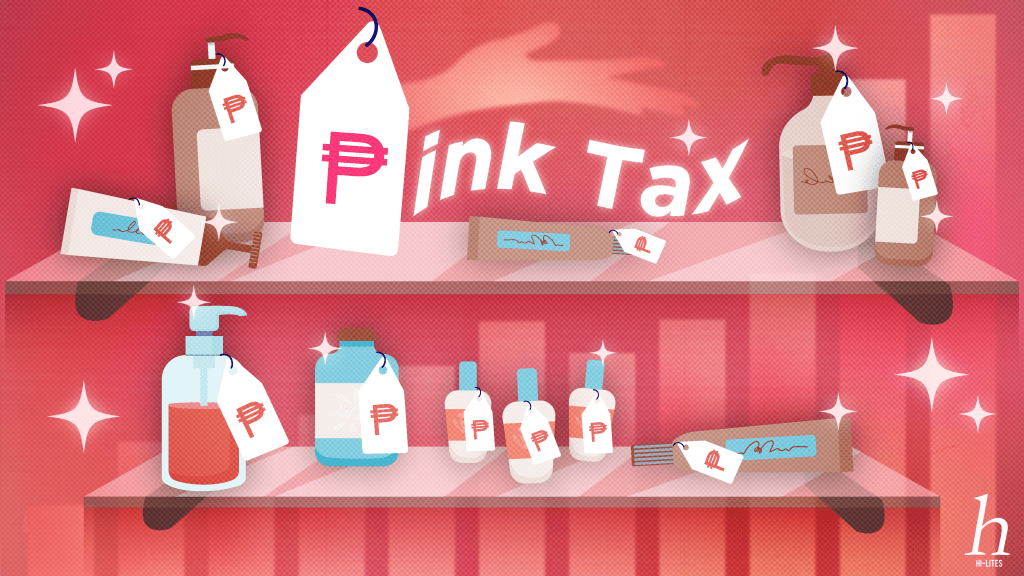
In this 21st Century, it is hard to believe that archaic ideologies and practices could still happen in broad daylight. From gender roles to stereotypes, these displays of discrimination should have been figments of the past. Yet, oftentimes, it is so blatant and normalized that it is usually glossed over. The pink tax, an age-old marketing tactic, embodies just that.
The term was coined to describe the price disparity in products that are deliberately tagged to be for “women” in contrast to their male counterparts. Razors, for one, are clear reflections of this. As displayed on the Watsons website, a pack of six twin-blade razors for men retails to be around Php 83.75. The chain store also offers an identical set of razors, with its only stark difference being its pink packaging and the bold label that states “for women”. Nevertheless, with these new additions, it now sells for Php 109.00.
Clear, a relatively known shampoo brand, can be seen to curate their goods in the same way. For men, they provide an anti-dandruff formula that contains added elements of menthol, marketing it to have a “long-lasting cooling effect” for the price of Php 243.25 for 320 ml. On the other hand, its female-equivalent, menthol and all, will set one back Php 802.
It is safe to say that both of these products are of equal necessity to both men and women, so how come women have to pay more to access these? At first glance, these price gaps may seem trivial. However, one must understand that these expenses accumulate, thus inevitably inflicting a divide between men and women that simply cannot be ignored. Having women pay drastically more for products is yet another tactic that these corporations use to capitalize on women’s needs. Nevertheless, this remorseless manner of discriminating against women trickles down past just adult-geared goods, but also that of young girls as well.
Toy Kingdom, for instance, tags their selection of bikes at a relatively consistent range, from around Php 3,000 to Php 4,000. Nonetheless, this rule of thumb does not seem to apply to two specific bikes, whose sheer dissimilarity is hard to ignore. One of which is in the “masculine” color, bright blue, stands at around 12 inches, and priced to be at Php 3,699. On the other hand, the latter bike, which is almost a carbon copy of the former in terms of dimensions, is seen to fashion almost all shades of pink. With these varying features though, the “perfect bike for any girl” (as stated in Toy Kingdom’s product description), is now seen to be Php 100 more than the “boys bike”.
Of course, distinguishing whether or not these are displays of gender bias depends on a case-to-case basis. After all, there are many other considerations that play into narrowing down the price of a good. It would be fallacious to instantly assume that certain products are avenues of inequality. In spite of this, it goes without mentioning that this is still a prevalent issue that has been perpetuated by years of conformity. Likewise, what exactly has made the pink tax stand the test of time?
A journal article published by the University of Santo Tomas reported to have surveyed a group of women in varying stages of life, all of which carry standard-level knowledge on the issue. When asked about why they continue to purchase products whilst well aware of the pink tax, the majority stated that it was a result of societal norms and ideologies. One respondent, in particular, elaborated that, “it is the social/cultural norm I’ve learned to deal with. The color pink is for women, and the color blue is for men.”
Evidently, the pink tax has morphed into a normalized inequality that is willingly being adhered to. No longer is it considered the social ill that it is, as it is now seen to be yet another insignificant cause. Then again, it must be noted that this is not the only sole driving factor that leads women to unrightfully spend more than they have to. Perhaps, the following added conditions may give further reason and importance to alleviate the pink tax.
For one, at the height of the pandemic, 44% of all job losses in the country consisted of women, who had accounted for 38-39% of it the previous years. Part of this staggering number is also 60% of the nation’s workforce, in which case Filipina sales and service workers contributed to the 73% that lost their jobs in their sector. The unemployment rate easing from a whopping 10.3% to around 5.3% this year is not the consolation it seems to be, as it merely implies that even though not all women are suffering, there is still one who is.
Another aspect that must be considered is inflation, which continues to be a looming concern today. As of November, it is predicted to have peaked between 7.4% and 8.2%. This sky-high statistic is a result of unforeseen circumstances, with last month’s being the typhoon and the ongoing Ukraine war. Yet, one must not look at the future of inflation for hope either, as even if experts believe that it will stabilize next year, its never-ending state of precariousness makes it an eternal burden on women’s wallets.
With the two factors being somewhat embedded in the very flow of society, they inadvertently add an extra layer of expense towards women, excluding the pink tax. Though, despite the fact that these are problematic key players in themselves, it would be unproductive and fruitless if one attempts to mitigate the pink tax by pinpointing the blame on these. The likes of inflation and unemployment cannot be seen as “excuses” to not face the issue of pink tax head-on. Instead, they should be seen as calls to action, indications of urgency, that further emphasize the reality that women have always been victims of injustice.
The pink tax, as much as it is an infuriating and widely disregarded matter, is also an indictment, a branch, of a greater systemic issue—gender inequality. As women continue to be marginalized and oppressed, the pink tax acts as simply another propagator of this. With all of these in mind, now’s the time to speak up, and shield tomorrow’s generations from the prejudices that want to silence them.
 HiLites ASHS