
By Samantha Orprecio
5… 4… 3… 2… 1… HAPPY NEW YEAR!!!
As fireworks go off into the sky and noises such as horns tooting, pots and pans banging, celebratory cheers mark the genesis of the new year, there is one question that also begins to emerge in everybody’s minds as they hug their loved ones and smile bright for the camera: who will I be this year?
The reinvention of oneself whenever a new year comes is practically as old as time — before the modern calendar was even created by Julius Caesar. During the time of the ancient Babylonians, they commemorated the event through their 12-day festival called the Akitu, which began at the start of the spring planting season in March. During the celebrations, they would make resolutions to their gods; however, theirs were nothing like ours. Instead of promising they would save more money, lose some numbers on the scale, or make new friends, they would pledge their loyalty to the king and swear they would pay their debts and return borrowed items to their rightful owners. They believed that if they kept their word, the gods would be in their favor that year and if they failed, well… it would be safe to say their crops for the year would be rotten.
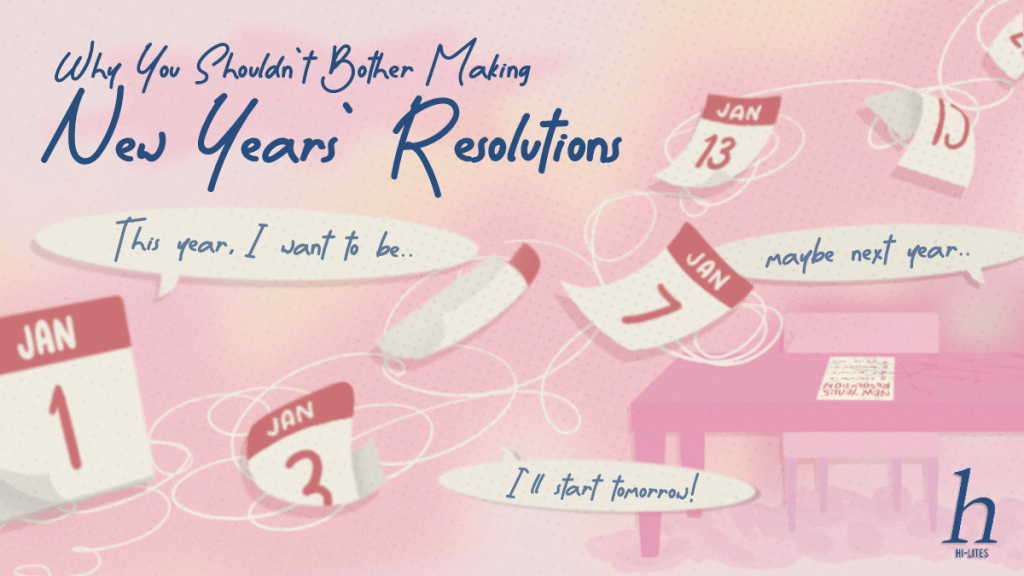
However, over the centuries, new year’s resolutions have been watered down to mere excuses to validate procrastination and remain the way one is. “I’ll just do that next year” is the common word of mouth. According to research done by Statista, the 10 most common resolutions in 2022 by New Yorkers were:
- Live healthier
- Be happier
- Lose weight
- Succeed in career
- Save more money
- Improve relationships
- Travel more
- Exercise more often
- Stop smoking
- Reduce drinking
Despite these lists of oaths to become better people, they often become empty promises by Day 2. It does not take long into the first month before #resolutionfail begins to trend on social media. A quarter of hopefuls fail in the first week. A third do not even make it past the first month while fewer than half are persistent six months in. Only 16% actually succeed.
There are many reasons why the remaining 84% are futile in their attempts. First, most people set incredibly unrealistic resolutions that are unreachable by their means at the moment, making them feel overwhelmed and defeated by the lengths they would have to go through. It is critical for the success that one reviews their resolutions to see if they are achievable; are they time-constrained? Are they specific enough? Is it possible to break it down into smaller steps for easier completion? Most importantly, is it reasonable?
Another reason is most individuals do not track or review their progress, making them think their efforts have been useless. What gets appraised gets done, and what gets done can be made into a habit with the help of a good tracking system. Several of the obstacles in one’s resolution course are based on assumptions, overthinking, and far-off judgments that make it a continuous uphill battle.
And the most damnatory reason is that the whys behind one’s whats have never been clarified to the self. It is not enough to know what you want — you need to figure out why you want it because unless you do, you will never really be motivated enough to go out there and do what needs to be done to make the grade. Any and all excuses and self-made loopholes go away when one’s purpose is strong, and one naturally evolves from a growing mindset to a fixed, determined attitude.
When thinking of one’s health, family, and goals, one should not put them on the line and entrust them to a faulty system like new years’ resolutions. Instead, there should be a genuine determination and desire to be better. Unless you truly, sincerely believe in your heart of hearts that you can reach your goals, there is no use in writing that list. As unfortunate as it may seem, you are going to encounter a great number of setbacks, and if your belief in yourself is superficial, you are going to point-blank fail.
Bringing past failures with resolutions is going to drag you down as well. Attain closure on the past, and you will be freed from the shackles of wallowing in despair. Be honest about what you wanted to happen, what actually happened, what you could have done, and what you could do better this time. As mentioned earlier, you must become specific and measurable about your objectives as well. Writing down “lose weight” or “spend less” is not enough; it leaves too much on the table. Write down your plans as well on how to achieve them so you have a steady foundation. Remember: goals poorly formulated are goals easily disregarded.
There is no scientifically proven reason why you need to wait 365 days to improve your life. You can begin right now, right where you are. While the end of a year may create the illusion of shedding one’s old self, the truth is, it is always going to be there. You just learn how to round off those sharp edges and embellish those scales.
Here’s to a happy new year, Ateneans! Let’s strive to become better persons not only for ourselves, but for others as well.
 HiLites ASHS