by Franscesca Ote
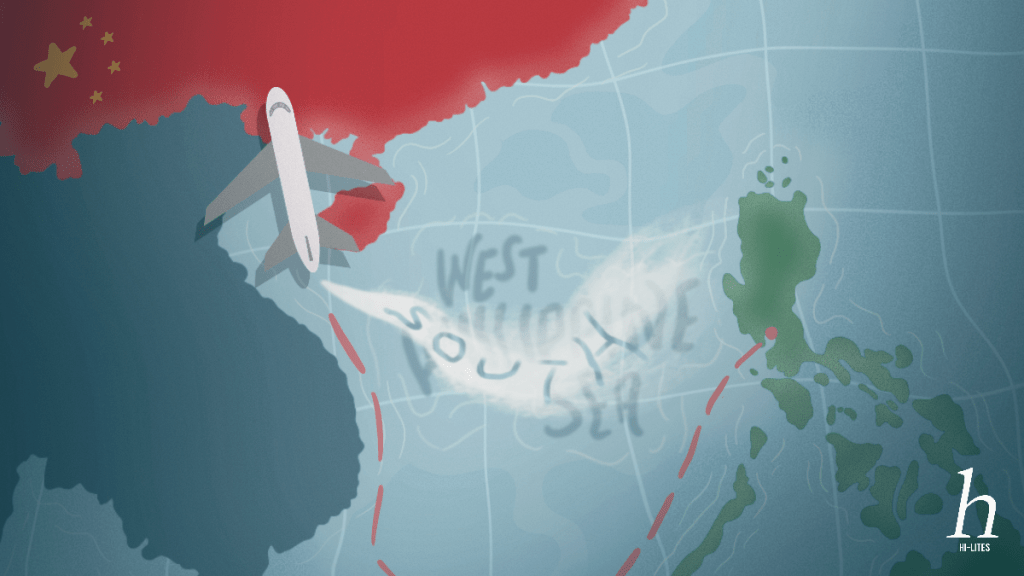
This 2023 was opened with a historical encounter—President Ferdinand “Bongbong” Marcos Jr. embarking to Beijing for a sit-down with China’s President Xi Jinping. Many promises and arrangements were on the agenda, with conversations jumping from durian exports to bridge constructions. Yet, there was one matter looming through everyone’s minds—the long-disputed West Philippine Sea. This “elephant in the room” has been a recurring topic for over eleven years; yet, it is continuously left in its static state. It begs the question: will it always remain unaddressed?
As much as diplomatic conversations with China regarding our territory are essential, it is nothing unprecedented. Ever since word got out of the concept of the “nine-dash line”, Philippine presidents have been scrambling to ease our powerful adversary from exploiting any more than they already have. The fruits of these efforts were seemingly reflected when former President Rodrigo Duterte, who was known for establishing “warmer” ties with the global superpower, was reassured by them that our two nations will continue to have a “principled friendship”. His predecessor, then-President Benigno Aquino III, in spite of a fairly tumultuous and tense relationship with China, only had uplifting words when describing China and the country’s mutual goal to “develop areas of cooperation”.
On paper, these words seem to entail a bright future for the West Philippine Sea. Both stakeholders appear to be on the same page as they bilaterally agree that for relations to become more sustainable—but unfortunately, looks can be deceiving. Three administrations and over a decade later, Philippine fisherfolk are still being intimidated by lurking Chinese Coast Guard Ships. Instead of fostering hope, the prospect of a joint effort is looking all the more superficial as time passes.
In tackling the delicate trade that is global affairs and relations, the Philippines is almost always reduced to a smaller role as its fate is typically left in the hands of our powerful allies. Likewise, in a time where the nation’s rights continue to be trivialized and trampled upon, it is only right to wonder where they stood this entire time.
The United States, amongst all our other allies, has been the most vocal throughout this entire process. Following the recent swarming of Chinese vessels in the Iroquois Reef and Sabina Shoal, the U.S. did not hesitate to reinforce the fact that China’s display of behavior “interfere(s) with the livelihoods of Philippine fishing communities, and also reflect(s) (the) continuing disregard for other South China Sea claimants and states lawfully operating in the region.”
As for our ASEAN counterparts, sentiments vary. The likes of Indonesia, Malaysia, and Brunei, for one, have gone through the lengths to make their stances heard, as they push for the South China Sea Code of Conduct to be passed in hopes of finally setting the well-deserved boundaries China fails to see. Others, such as the likes of Cambodia, Thailand, and Laos air on the side of caution knowing how much they depend on China and its immense power.
To see other nations steer clear of this discussion entirely is merely an indictment of the grasp China has on the rest of the world. With incessant pleas constantly being ignored, China has a privilege that few have— the ability to ignore. Unfortunately, their hold on trade, investment, and the overall flow of global events makes it to be that pleasing them is a necessity. This somewhat monopoly deprives the rest of any effective retaliation, thus making them puppets to China’s game.
For there to be any progress on this long-standing impasse, our connections with other countries are paramount, especially if we set our sights on the aforementioned South China Sea Code of Conduct. For context, the South China Sea Code of Conduct, otherwise abbreviated as COC, was drafted last 2002 following China’s illegal occupation of Mischief Reef, located within the Spratly islands. Its peace-seeking intentions, however, were met with continuous non-compliance and enhanced military activities from China’s side.
Though the COC remains untouched and unimplemented, it is the solution that carries the most promise. Then again, this dream of harmony will not be able to blossom unless certain aspects of the COC are put to rest. For their ultimate goal to come to fruition, the ASEAN must negotiate whether or not this motion is legally binding, whether it will apply to all states that pass through the West Philippine Sea, its geographic scope, and accountability and transparency measures, all of which are cornerstones into making a sustainable agreement.
It goes without saying that the resolution to all of this can only be found through true unity. It is essential that as one ASEAN community, we speak out using a singular, holistic voice, and not with a dissonance of contrasting ones. If we expect change from the opposing side, we must first emulate it ourselves by bringing clarity to our wants and priorities on this matter. After all, doing so is only fair and just, should we want full compliance. Time is of the essence, and the more we prolong the inevitable conversation, the higher tensions rise.
That being said, unity cannot be established without trust and confidence— something that is in short supply when confronting China’s formidable front. Nevertheless, change only starts when we recognize that succumbing to China’s intimidation tactics is the prime way we fail.
The conversation of the West Philippine Sea is one brought about by years of ignorance, fear, and hesitation. Over this time, the Philippines has morphed into a pawn, simply to be left underestimated and subverted in this prolonged battle of chess. It is for this reason, through dialogue and perseverance, that the fight must continue, so as to prove that our country’s size is not an invitation for its rights to be undermined and by doing so, have the term “South China Sea” ultimately be a figment of the past.
 HiLites ASHS