
by Luis Sinangote
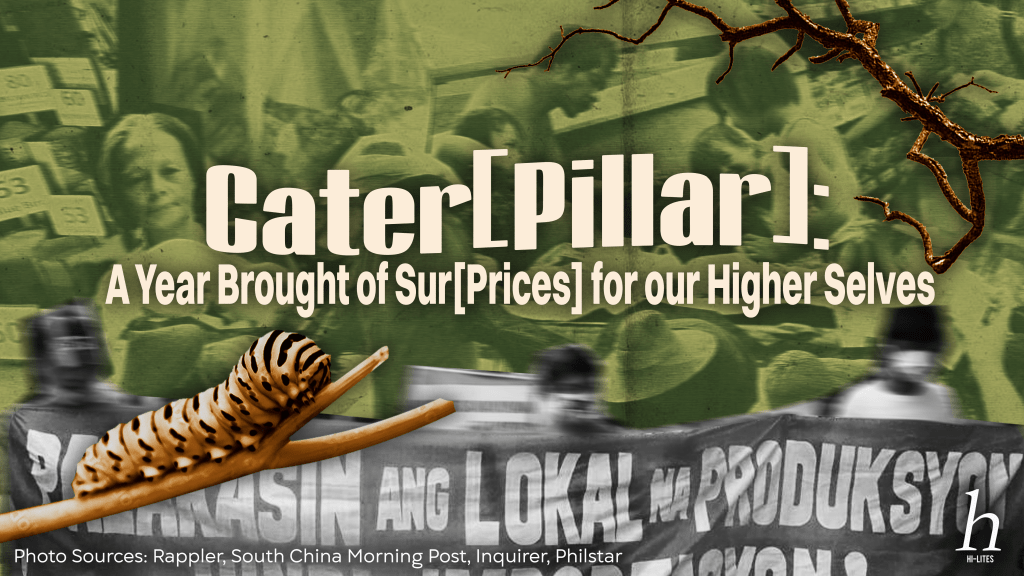
Charles Darwin theorized that humans are capable of evolving depending on their adaptation to their environment; accounting the evolution from primates to civilized beings now. It is also believed that humans can rapidly overcome change despite adversities, and persistently, develop a response against it. Moreover, whether it is a mammal or an insect, all go through a biological change for genetic progression like a butterfly that undergoes metamorphosis. Though with rapid evolution, can humans cope and change despite the inaccessibility to resources due to spiked prices? Or would they remain a caterpillar that has never yet seen its utmost self?
In an article, it is evident that butterflies take shorter or even longer to emerge from their cocoon depending on their genus and even the environment they settle in. Humans, in this context, also adapt and evolve with varied intervals like resources, shelter, and support. Furthermore, butterflies transform in different complexities like their size and color. Though these changes can be altered when they are placed in a harsh environment, limiting them to perform metamorphosis. The same can be said for humans when exposed to inconvenience and deprivation.
Consequently, with economic problems that remain stagnant in the Philippines along with programs and policies that are futile in providing a systematic approach opposed to inflation, numerous Filipinos still suffer. As of the January 2023 report of the PSA, inflation has hit its highest annual rate recorded since November 2008 and about 8.7 percent increase in basic commodities and stapled bills. The inflation rate took a curve to a substantial number of individuals, hindering them to accommodate basic needs that meet their quota. Moreover, it is revealed that the price of red and white onions surged exponentially; sold for as high as 600 pesos and are three times as expensive as chicken and various types of meat. Not only was it more expensive than other average meat, but the cost of a kilogram of onion was also greater than the minimum wage for a day’s work in the Philippines. With the increase in prices and stagnant salaries, it is apparent that the economy is pedaling backward.
A Worn-Out Tree Filled With Caterpillars
How can a caterpillar undergo metamorphosis when the environment it lives in is not thriving? And what can it do when its miniature-multiplex legs are not swift enough to bypass its surroundings? In its moment of desperation and course of survival, it is analogous to how humans nurture themselves depending on the environment they are inhabiting; harsh environments require people to adapt to unhealthy habits, while on the other hand, people living comfortably tend to have an abundance of growth opportunities. In the Philippines, many Filipinos cannot afford to buy and consume healthy food—some lack nutrient-adequate diets that lead to malnutrition, while others have no choice but to consume stale food from cans or instant goods with little to no nutritional value.
As a preventive approach, Ordinario mentioned that by boosting agricultural production, it will relatively improve dietary diversity and food production in the Philippines. Though dietary diversity and food production are unlikely to be executed given that the government still remains unfazed by the decline of agriculture. In addition, with overall food production being low—less food diversity, nutritional diets, and high-cost options entraps Filipinos from eating beyond their customary intake. Much to this decline, vegetables enriched with nutritional value have become a second-rate choice among Filipinos due to their inflated cost.
Needless to say, as fewer options for people pile up, the opportunities for growth become scarce, and choosing health would cost them more than their hard-earned money. Given this, it is apparent that evolution or overcoming change is more likely to be an illusion and the issue itself was a translucent window that most blindly see because, in a matter of conventionality, there are people who cannot nurture themselves due to the environment they live in. More so, as the trees begin to wear out, what is left for the caterpillars are none and their only hope dies out as their miniature-multiplex legs are not fast enough to flee from its brutal environment. In the same way, as the economy flunks, Filipinos in the lower bracket then are stuck living the life of a caterpillar whose needs are finite due to reckless upheavals perpetuated by the nation’s lack of responsibility.
Although be that as it may, it is not an impossible task for the country to foster and to outlive people’s unlit struggles. One may do otherwise by stimulating everyone into voicing their concerns, whipping those in higher authority to implement strategic approaches in response to inflation, and promoting a driving change for people to foster with sufficient nutrition in their plates.
With that, the same question is asked: would one opt to remain a caterpillar, or would they do something to reach their full potential as they take action on alleviating economic disparity, even if it were the smallest and faintest change to fulfilling a large-scale opportunity for all?
Action is the foundational key for changes and fulfillment. Once responsibility is accounted for, all will soon bloom just like a butterfly whose wings represent their ugly struggles and dirty truths of life that turned into something beautiful and worth seeing in others’ eyes.
 HiLites ASHS