
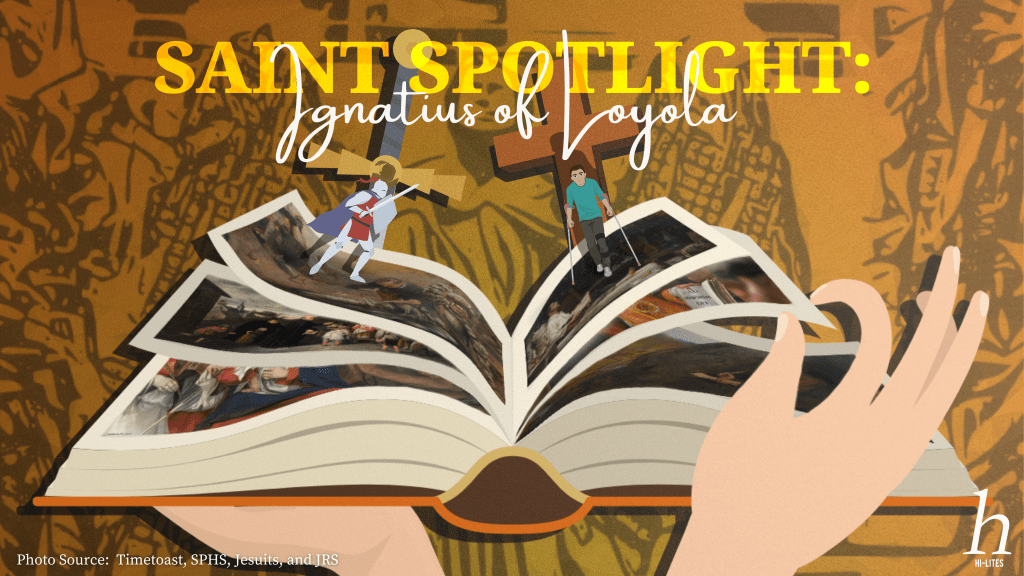
By Alex Lauricio
As if the sound of gunpowder was enough to dissuade the soldier from moving yet another step, for Saint Ignatius this would just be the start of a journey of conversion, discernment, and self-discovery as he clamors for life and death in a war taking place in Pamplona, Spain in the 1500s. To the Atenean student, he may just be another lesson taught in school, but to the Jesuit world, he is a treasure.
We owe it to a certain Spanish soldier having a field day in the battlefields of Pamplona that the modern Jesuit order, and by extension, Ateneo, was ever established. His full name was Iñigo López de Oñaz y Loyola, belonging to a clan of minor nobility. It was unclear when or why the mention of his name slowly became “Ignatius,” with speculations that it was simply better understood in other European countries in contrast to “Iñigo.”
In Ateneo, he is sometimes lovingly referred to as “St. Iggy”, one of the many nicknames given to famous saints seen around the campus. After being canonized as a saint a mere 66 years after his death, many places around the world, especially Spain, revered his name by commonly naming streets and other places after him.
Still, little did the infant Ignatius in 1491 know that he would grow up to be one of the most influential people in the Church. To add on to that, he would witness a massive career change due to the many occupational hazards that the adult Ignatius would soon know about.
Before he turned into the St. Ignatius we know today, he was a boy who valued chivalry and knighthood and his regal life in the days of early Spain.
St. Ignatius was born the youngest of an army of 13 children, in the small, humble province of Gipuzkoa. His father performed knightly duties, and so, it was natural for the son to follow in the footsteps of the father. Ignatius’ early knighthood was a result of his familial and wealthy connections to other esteemed nobility, thus earning him a position in one of the duke’s armies in Basque. This inevitably resulted in a blessing in disguise for Ignatius.
A Blessing in Disguise
You might find yourself thankful for the little things in life; the food on your plate, a roof over your head, and a cannonball to face—thank God for that. While grave injuries were certainly not on St. Ignatius’ wishlist, somewhere through all of that, pain was in his direction. Little did he know that this was the start of what we’d now call a ‘cannonball story.’
During the fateful Battle of Pamplona, a French cannonball came crashing down on St Iggy in the midst of the chaos. Whether or not he saw God in the split second his life flashed before his eyes when the cannonball hit, many saw this as a second chance in St. Iggy’s life because he was relieved from his duties in the fields of war and was resigned to a fairly comfortable, bedridden life.
However, that cannonball didn’t only dislocate his leg, but also his life. The silence that pervaded the room during his recovery was a sharp contrast to the sound of gunpowder and the slashing of blades in Pamplona, the site of all his grievous injuries.
Of course being confined in the four corners of your room isn’t exactly the best feeling in the world, and the medieval ages didn’t have the best at-home entertainment services. Luckily for him, his access to royalty and possession of royal blood allowed him to request particularly exquisite collections of books…
Reading Between the Lines
The thirst for glory chased him from the battlefield back to this new bedridden life of his. Knightly stories of chivalry, romance, and power were a shortlist of the genres he’d normally request from his family. Daydreams of saving damsels in distress, tearing through the scales of ancient dragons, and winding tales of women and romance ran through his everyday thoughts.
It’s exciting for a day. Maybe two.
At the end of it all, it was the same story rehashed in different names and different colors. It was the same tower that got rebuilt and destroyed. The same dragon that attacked the city, and the same knight that put the creature back in its place. These stories were starting to get short in supply, and St. Ignatius wasn’t having the most fun time reading it over and over again.
As a result, the family started supplying him with a set of holy books as a reasonable substitute. While he certainly was picky at first, he slowly opened up to the idea of reading them. Little did he know that he was soon going to be hooked into the world of Christianity’s sacred texts, and that a life of reverence was soon waiting for him.
As if a message was laid down between the lines of the books he had read, ranging from the De Vita Christi and extending towards other autobiographical accounts of Jesus and other saints, he was hooked.
He dropped by Montserrat to visit a shrine of Our Lady, and surrendered his sword to her, seemingly giving up earthly attachments in favor of his new life He resigned from a life of violence and converted himself into a religious pilgrim, where he slowly followed through the footsteps of Jesus Christ himself.
After recovering from his injuries, he started his journey by going to Jerusalem, meeting a Muslim along the way. He overheard some offensive remarks aimed at Mama Mary, but just as he was about to reach for his dagger, he remembered that he resigned to not use violence again. Small self-realization moments like these came naturally to Ignatius, as he was treading through unfamiliar holy territory.
He then decided to allow his donkey to decide where to go, as if he was expecting God to guide his journey somewhere. This led him to Manresa, where he spent prolonged amounts of time fasting in caves, kneeling in reverence, and clasping his hands together in prayer, with the primary aim of sacrificing himself in the ways he had read in the lives of saints. If the saints in his books didn’t eat for three days, Ignatius would push himself to not ead for four days. If they spent an entire afternoon kneeling, Ignatius would double that.
Unfortunately, the lengths that he was willing to go to not only imitate but actually one-up the sacrificial feats of the saints brought him great unhappiness. Well, what do you expect from not eating for days at a time?
At some point, he was simply conflicted with his actions and decided that faith isn’t about surpassing other followers of Christ in a competition to see who suffers the most, or how much you can deprive yourself of food, water, and shelter. No, Ignatius thrusted himself one step forward and two steps back from a life of martyrdom, and decided that sacrifice is best in moderation.
To Ignatius, this unhappiness meant that his method of honoring God was not what God asked him to do. Martyrdom was incompatible with what Ignatius could offer to God. Lost and confused yet again, he decided to seek God in more personal ways, offering flexibility from scriptures, holy books, and other stereotypical ideas such as martyrdom. It was also in Manresa that the ‘examen’, as he called it, was born.
Armed with a new set of experiences and realizations, he resumed his journey onwards to Jerusalem, where a new set of challenges awaited. Stories of Jesus’ life were slowly brought to reality as Ignatius swooned at the idea of going through the same motions as Jesus had—from the places he set foot upon, to the sacrifices that Jesus had made.
He was fascinated to walk on holy grounds, to sift through the sands as if Jesus’ feet imbued the sites with reverence and glory. Well, his fascination was abruptly met with the angry stares of guards who thought he was trespassing. While he saw himself as a holy man as the guards took him away, the city saw him as yet another criminal.
With all the experiences he had garnered in the past years of his life, and treading through the thick and thin of Pamplona, Manresa, and even Jerusalem, he offered a fresh, new take on Christianity at that time. Heading into Paris, he met up with a couple of holy friends, soon establishing the Society of Jesus alongside a couple of familiar names you’ll hear within the Ateneo Senior High School (ASHS), such as the likes of Saint Peter Faber and Saint Francis Xavier, among others.
Today, a statue of him stands in the ASHS grounds in his memory, in hopes of encouraging the students to follow in his footsteps. It’s a popular backdrop for post-org sessions, and you’ve probably had a couple of photos with Saint Ignatius’ statue as well.
Be it across stony caves atop mountainous crags, or through bloodied fields of war, or even within the deep introspective depths of self-realization and spirituality, Saint Ignatius has weathered through the thick and thin God’s call, and has exemplified a life of excellence through helping others, and helping one’s self.
 HiLites ASHS