
By Alex Lauricio
Katipunan is home to some of the biggest college giants in the country, namely: Ateneo and the University of the Philippines (UP). Before later being carried over to Katipunan, their ancient rivalry found its historical roots within the basketball courts of Intramuros. Let’s take a closer look at their long history of friendly competition and glimpse into the culture of their modern student population to find out more.
From The Ground Up
UP was established in 1908 as the forefront of Philippine education, though unlike Ateneo, it was initiated by the Americans during their colonial rule in order to form an “advanced institution” for budding students in the Philippines. It was first opened in Manila, with the construction of other UP campuses beginning in the following years. Katipunan would not see UP until 40 years later in 1948, where most of UP was transferred to Katipunan after the events of World War II.
Although UP Diliman (UPD) is its flagship university, the UP system is composed of seven more universities sprinkled all around the country. Each UP school often specializes in a certain area of study — for instance, UP Manila is known for its medical courses, while UP Los Baños is known for its science and forestry courses.
Ateneo, on the other hand, started out as a much older institution, albeit located in Intramuros rather than the Katipunan landscape it knows in the present. After being established by Jesuit missionaries in 1859, it was moved to Loyola Heights in Katipunan after its destruction during World War II. In between world wars and shifts in Philippine politics, Ateneo has stood tall for 163 years, and will greet its 164th in December of 2023.
The Society of Jesus (SoJ) operates other Ateneo schools in the Philippines, totalling seven institutions in the country. The Ateneo in its entirety sits behind UPD’s campus for being the first in terms of land size, though much of UPD’s land is forested and not intended for use.
You would often see restaurants and establishments in Katipunan flocked with students from UP and Ateneo, as the proximity between these two institutions means that they share a lot of space and encounter each other rather frequently. UP Town Center may have been named after UP, but it is more common to encounter an Atenean within its premises on a regular day.
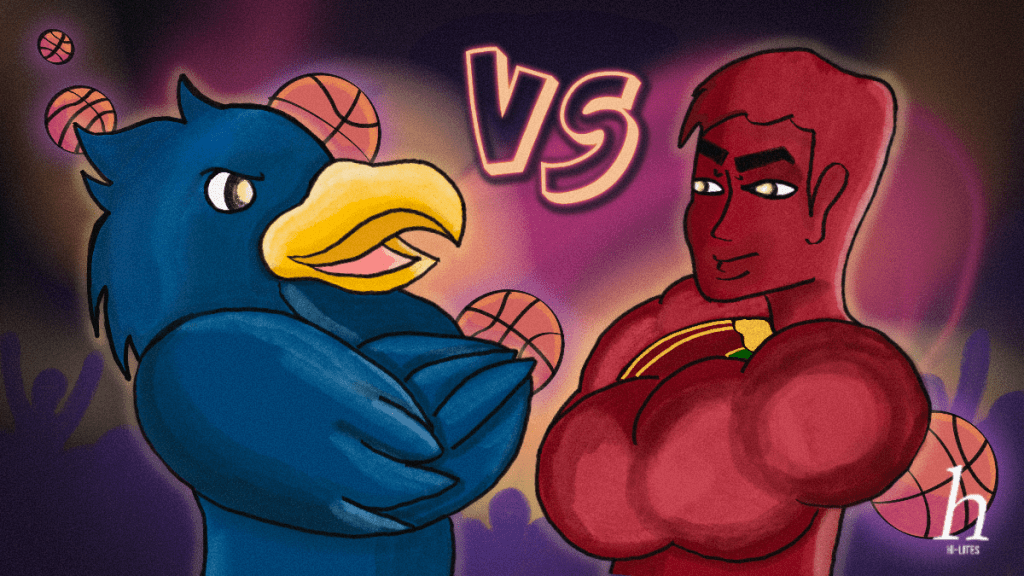
The Battle of Katipunan
Both of these universities often reach news headlines for their academic achievement and rigor, and they are better known for the rigid rivalry between the two colleges, especially in basketball and volleyball. Their long, historical rivalry started within the Intramuros basketball courts and were carried over when both campuses transferred to Katipunan.
The phrase “Battle of Katipunan” refers to the famous long-standing UP-Ateneo rivalry, which originated in the basketball street courts of the 1920s, when unofficial cross-campus competition would pit the students of UP and Ateneo against each other. Two of some of the oldest universities in the Philippines, the origins of their rivalry predate Katipunan, and first started out in the streets of Intramuros.
Fast forward to 1924, when the inception of the National Collegiate Athletic Association (NCAA) would finally formalize the “Battle of Katipunan” in their school’s courts, as basketball matches between the college circuit would take place in the host school’s campus. UP finished the first three seasons by bagging the championship in both the Juniors and Seniors category, finding success in the Philippines’ early basketball scene.
Their hunt for championship wins hits a blue brick wall, with Ateneo upsetting the NCAA champions by winning against UP in the finals in season five. Their rivalry might have begun in the streets of Intramuros, but it soon slowly crept into the college culture of UP and Ateneo. The lively sports scene gave birth to cheerleading squads, and formed the first iteration of what we now know as the Blue Babble Battalion.
UP would clinch yet another championship before leaving the NCAA in 1936, which, together with Far Eastern University (FEU), National University (NU), and University of Santo Tomas (UST) would form another sports circuit in 1938: the University Athletic Association of the Philippines (UAAP). Ateneo would never meet UP again for the next 40 years in any organized collegiate sports circuit until the school withdrew from the NCAA in 1978 to join the UAAP, encouraging other schools to do the same.
Ateneo would go for about ten basketball championship matches with De La Salle — forging the more recognizable UAAP rivalry in the Philippine sports scene. UP would not face off Ateneo in a championship match a mere 88 years from NCAA season five, losing to Ateneo 2-0 in UAAP season 81 Men’s Finals.
Beyond Rivalries
While people fawn over the more established blue-and-green rivalry present in TV screens and UAAP arenas nationwide, the UP-Ateneo dynamic is one that commands mutual respect from opposite ends of Katipunan. Outside the courts, the two institutions are commonly seen collaborating in research studies and other educational programs for the benefit of their students.
Though it goes unspoken, the shared history makes the crowded streets of Katipunan livelier, and whether you’re entering the Sunken Gardens of UP or the gates of Ateneo, the story of an age-old friendly-competition is well and alive. While it may take a long time to see the two behemoths face each other again in any UAAP finals match-up, the wait and hype to back it up will certainly make it worthwhile.
 HiLites ASHS