
By Alex Lauricio
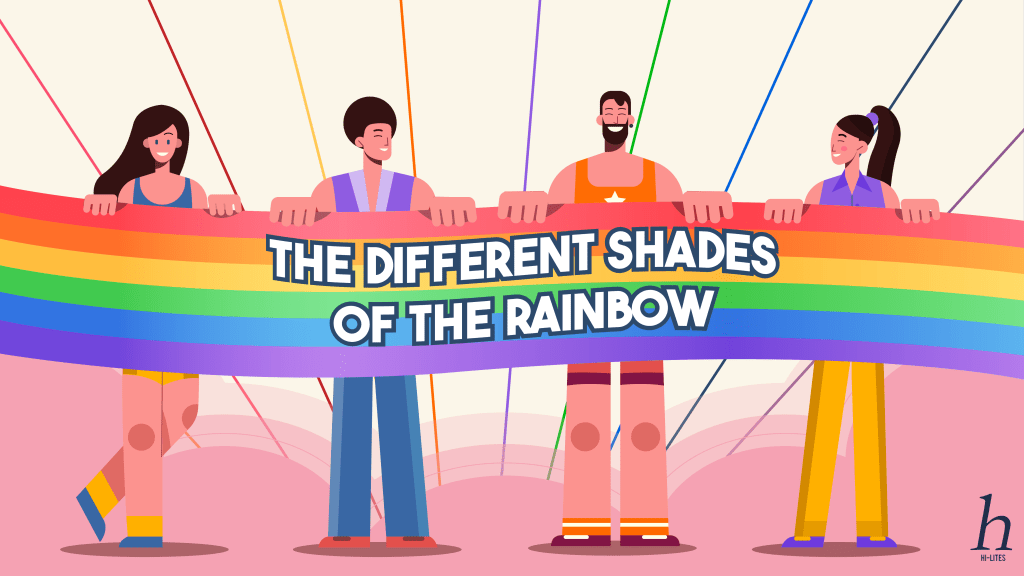
Inside the umbrella of the LGBTQIA+ community is a world full of diverse individuals, each with their own way of self expression and sexuality. While many of us are still trying to establish a foothold of our identity, our journey of self-discovery will get easier knowing that there are different words and labels that seek to understand what we feel — plus, it wouldn’t hurt knowing a few words to stop us from accidentally hurting others.
While these terms attempt to categorize the individual experiences to one that is more broad and seeks to unite people of similar fashion, one has to recognize that personal experiences require more than a dictionary definition, and need not to be narrowly defined to the experiences and categories shown below. As such, self-discovery and self-understanding remain key instruments in setting foot towards the uncharted territory of gender, identity, and sexuality.
A – Aro/Ace
The aromantic and asexual spectrum represents the people who do not have any romantic and/or sexual attraction towards people; it is worth noting that one can occur independently of the other, and having one is not a prerequisite for getting the other. Throughout the years, members of the aro/ace community have been largely underrepresented in popular media.
People will often say that being aro/ace is “fixable,” a gross statement commonly followed by a suggestion to have a romantic or sexual relationship, thereby invalidating the person’s entire identity. Our aro/ace friends are perfectly fine and capable of managing themselves, and simply see the world in a different lens than we do.
B – Bisexual
While the “B” in LGBTQIA+ refers to bisexuality, people also often associate it with biromantic, the romantic counterpart to bisexuality. This refers to the attraction of someone to two distinct genders, of which the genders in question are not necessarily conforming to the gender binary of male and female.
Many people think of bisexuality as being attracted to men and women, but more recent and modern definitions of orientation makes it not necessarily locked into the gender binary. Older perceptions of bisexuality saw bisexuals be maltreated by LGBTQIA+ and straight people alike, because many saw them as being “on the fence” about their sexuality, when in reality, this was not the case.
Bisexuality is commonly associated with pansexuality, although while pansexuality may refer to being attracted to all forms of gender expression, bisexuality revolves around the idea of being attracted to more than one distinct gender.
C – Closeted/“Coming Out”
Closeted people are those that hide their gender/sexual identities for a myriad of reasons — from government persecution in some nations, to societal expectations that limit a person’s way of expressing themselves.
“Coming out” is another expression used when referring to members of the LGBTQIA+ community who are “coming out” of the closet — that is to say, the process of accepting one’s sexual orientation and letting their parents, friends, and loved ones know. It is an act that demands risk and bravery, and is a pivotal moment in the life of any openly queer person.
It is worth noting that each person has a different way of coming out, and it is gravely disrespectful to force a person out of the closet, especially if they are not ready for the rest of the world to see them in a brand new perspective — one that is possibly open to violent, discriminatory, and hateful scrutiny.
G – Gay
Those who are attracted to the same sex often identify as being gay, though it is most commonly attributed to male-loving-male relationships. Because discrimination is rampant across many different places in the world, isolated gay communities have formed their own way of speaking as a response and protest to the persecution; and as such, the term gay lingo was created.
Gay lingo, locally known as “Beki Slang” refers to a set of vocabulary that evolved or largely originated from the local Filipino gay scene, including the popular “charot” and “eme.” Its usage has reached mainstream popularity, and has become a hit with the youth due to how creative some of the words can be. Kimmy lang!
Unfortunately, gay people have an infamous history of being persecuted; one such example is that of Alan Turing, a genius mathematician that helped decipher Nazi codes during World War II, and a programmer that established the well-known Turing test. Despite his massive contributions in the fields of mathematics and computer science, he was persecuted in Britain for being gay due to it being a crime back then. In the midst of his breakthroughs, he would be found dead in his apartment with cyanide in his hands years later.
Unfortunately, isolated cases of people using the word as an insult can still be seen even in contemporary society, thus earning it a niche negative connotation to some groups.
H – Homosexual
You may have encountered the prefix homo- from your science classes, meaning uniform and the same. Thus, to be a homosexual means to be romantically and/or sexually attracted to someone from the same sex.
The derogatory use of the term — or variants of it such as “homo” — can be seen as offensive to some. The term was historically used under clinical settings, back when homosexuality was still diagnosed as a disease. As such, one must be mindful of the proper words to use. Ultimately, however, it is up to the individual to decide whether they are okay to be referred to as such, and we still see the word in popular use in contemporary society.
I – Intersex
Being intersex is different because it deals with the basic structure of human anatomy; whereas other people have defined and rigid sex organs and sex characteristics, intersex people are those that fall in the gray area, having some, incomplete, or extra set of organs that belong to one or both sexes. Because of this, it was historically seen as a medical condition, and in the present is still looked down upon in some cases, though recognition of their community has grown in recent times.
Despite the historical lens of it being designated as a problem, there is no reason to believe that intersex people are unable to lead normal and healthy lives. In fact, most “corrective” surgeries that occurred in the 1950s to the 2000s were largely cosmetic and had nothing to do with the person’s health.
People who choose to remain intersex may express themselves solidly as one sex or the other, depending on how comfortable they are. Other times, people will simply not identify as either, and some countries recognize this and in official documents state the sex of a person as “X.”
L – Lesbian
Lesbians are women that are attracted to the same sex. Their attraction towards another person ranges from being emotional or romantic, down to being sexually attracted. Lesbians also share a harsh history of persecution — having also suffered economic and political backlash from the intersectionality of being both a woman and a member of the LGBTQIA+ community.
Brushing up on ancient Greek history yields us the first ever recorded lesbian — poet Sappho — originating from an island with a similar name: Lesbos. Her poems are rich artifacts that survived history for so many centuries during a time where the works of women were largely not recognized nor held to great importance. While many dispute the claim that she was a lesbian, Greek scholars would generally agree that some of her poetry was affectionately and romantically directed towards mortal women, and at times, to the goddess Aphrodite.
You might’ve also heard of one being “sapphic” and you’ve got Sappho to thank for that. For instance, a sapphic relationship is a broader term for any woman-loving-woman relationship; sapphic relationships can be used to refer to any relationships that include a pansexual or bisexual woman, and not necessarily individuals who are all lesbian.
N – Nonbinary
Nonbinary people are those whose identities reject the gender binary of man and woman, as their way of self-expression doesn’t fall between any of those categories — and that’s okay! Their style and way of expressing themselves reflect their identity, and you most often see them wearing some of the best drip in public, or in gay slang, awra, bhie.
Generally, they do not conform to strict and limiting gender norms, and are seen as gender nonconforming.
The gender binary is the understanding of the concept of gender as being narrowed down to only being “man” or “woman,” and provides little breathing room to those that identify as neither. A largely western concept, other cultures recognize and accept a third or even a fourth gender. In the gender binary model, individuals are trapped to choose to express themselves in two opposite ways — femininity or masculinity.
While individuals do have the choice of self-expression, it is commonly tied to sexual characteristics, such as gametes and genitalia, as to how they show themselves to the world. This was seen as incredibly limiting, and forces those who were born with a specific set of characteristics to express themselves in ways that they may not choose to do so.
Many people would use NB as a shorthand when referring to non-binary folk, but it may also cause confusion as NB may also mean “non-black.” As such, it is heavily preferred to use “enby” when referring to a non-binary crowd.
P – Pansexual
The prefix pan- refers to being all-encompassing, meaning that a person who identifies as pansexual would be attracted to people regardless of their gender or identity. Their attraction has nothing to do with a person’s identity, and some may even describe themselves as being blind to gender and sex.
Q – Queer/Questioning
Queer is an umbrella and all-encompassing term that is used to refer to anything but being heterosexual or cisgender. It is an expression and a manifestation that sexuality and self-expression isn’t as simple as being man or woman, and welcomes a community of people who face difficulty in identifying how they want to show themselves to the rest of the world.
Questioning is the term for the people who are still unsure about their sexual orientation or gender identity. These are commonly used to refer to people who are still trying to discover or establish a foothold on what to feel; they may still be exploring the world or themselves.
T – Transgender
The transgender community is an umbrella term for the people whose gender identity is different from what is assigned to them at birth. While most people are quick to jump the gun and think that someone who is transgender immediately falls under the gender binary of man and woman, although this can be true in most cases, there are plenty of people who identify as transgender but end up being non-binary — the definition doesn’t really limit what gender identity you have, and only dictates it as being different from what you were born with.
These terms are but a select few of the many different sexualities and orientations that are present within the walls of the LGBTQIA+ community. There are many different groups of people that we have yet to discuss and learn about, but do not let the sheer number of identities dissuade you from learning more about the culture and lifestyle of even more niche people in the LGBTQIA+ community.
 HiLites ASHS