
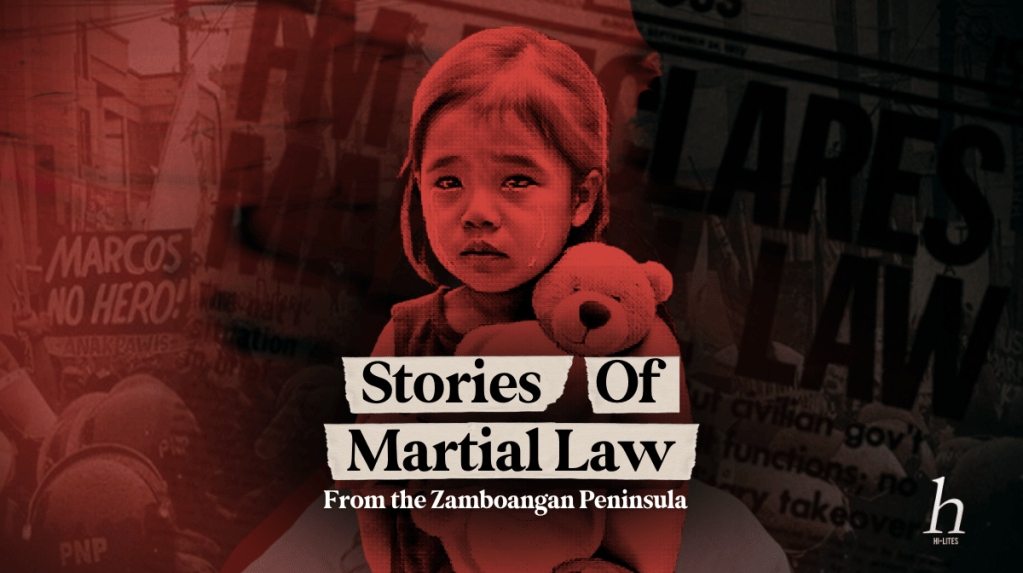
By Leklek
They shoved silence down their throats, and labeled critical thinking as dissent. There was a simple dichotomy—you’re either loyal to the regime, or a rebel working the graveyard shift.
While we usually localize the stories of Martial Law around the lockdown-ridden streets of Metro Manila, filled with its rich and vast underground networks of activists, rebels, and protesters, in other parts of the country, this picture looks quite different—and although we all shared the same struggle, the manifestations of injustice vary.
Jerlie’s story is one of many cautionary tales that seek to remind us of the brutalities that ravaged Filipinos during Martial Law. In remembering the past, may we carry their stories forward today.
The rain pelts the dirt roads that lead into a military camp nested deep within the heart of Zamboanga. Muddy and entrenched in militant activist territory, the camp was a stranglehold in the region—silencing dissent and rebel activity.
In the sprawling ranks of the infantrymen, some have come to make the camp their home—and a lot of these homes housed the family of soldiers. Jerlie was around a toddler when she had realized she was in a military camp, and around four years old when she realized that her lullaby was the sound of rain masking the gunshots in the background.
“Ako’y isang anak ng sundalo. So ‘yung aking ama ay isang sundalo—sa loob ng kampo kami nakatira. Nakikita ko ‘yung mga nangyayari,” Jerlie recounted.
Guards would come and watch over the children of these soldiers, and children were free to play in the muddy dredges of the military camp. While being the daughter of a soldier provided immense safety, benefits, as well as privileges, Jerlie would soon come to open her eyes to the stark reality of the then-Marcos regime.
The Bagong Lipunan
Martial Law represents an era where children born in that time would struggle to comprehend the harrowing realities that it offered. The population was divided—polarized into thinking that Martial Law provides the safety the country needs after the Plaza Miranda bombings, or is simply another tactic of Marcos to retain power.
In order to curb the movement of activists across the country, many restrictions took place—the most evident of which is the 12AM to 4AM curfew. As the writ of habeas corpus was suspended, people who showed signs of dissent, however the government deems it, abruptly went missing. Media companies were shut down, and there was radio silence—with certain exceptions.
“Isang estasyon lang ang naalala kong pwede. Kontrolado siya ng gobyerno. Kontrolado rin kung ano ang pwedeng panoorin,” Jerlie added.
Radio and TV static became common, and interruptions were routine. What little content state-controlled media had to offer that time were plastered with Marcos’ face, sprinkled in with tunes of “Bagong Lipunan.”
“Bagong bansa, bagong galaw
Sa bagong lipunan,”
The tune would get stuck in the heads of future children who would come to echo the sentiments of the age-old song. The song would come to define an era of revisionism, coming back to the 2020s with a modern version.
“Maingay ang kampo. Maya’t maya may lalabas na 6×6. Maya’t maya… may lalabas na tanke. Naranasan ko rin ang curfew, kahit nasa loob kami ng kampo,” Jerlie said. “Naririnig lang namin, ‘o, may raid! May nahuli!’” She added.
As much as the curfew did curb activist movements, it wasn’t the peaceful imagery commonly brought up in Marcos’ Martial Law discussions. The sound of military vehicles on the narrow city streets, or the gunshots that followed after knocking a door that didn’t open—there were a myriad of voices and sounds that pierced the silence.
“Since nasa loob ako ng kampo nakatira,although napag-usapan na ng pamilya namin na magsisimba kami… tapos biglang hindi makakadalo ang tatay ko.”
After going to Church, civilians would line up in KADIWA centers to buy a limited stock of food, with a maximum limit per civilian.
The reverence offered to in the churches that soldiers didn’t deem as rebel-infested is a sharp contrast to their practice. Citizens were treated as if they were just handed out rations of food: “Sa kada punta may nakatakdang limitasyon sa mga produkto na mabibili mo.”
“Ingat ka sa labas.”
Despite many claiming that Martial Law was safe—that the streets were clean of activism and rebels, that there was complete silence past 12AM—there was always the stray sound of someone knocking at doors, or the sound of gunshots in the Zamboangan peninsula. The use of violence was less permitted in the National Capital Region, but in other, rebel-infested areas, the soldiers were more lenient with their rules.
“Maraming hinuhuli noon. Dahil nasa kampo ako, kapag naglalaro kaming magkaibigan, nakikita namin yung mga nahuli. Nakasakay mga 6×6, iba’t ibang klaseng sasakyan ng militar, may tali sa likod. Paminsan, isang jeep na puno ng mga patay.”
Pulling on the reins of military power, Marcos Sr. would come to polarize the population of the Philippines even more, as many disagreed with his usurping of the presidential position. To silence dissent, he offered soldiers money in exchange for loyalty.
“Dahil sa layo ng siudad namin, paalala sa’kin lagi ng nanay ko, ‘wag magpagabi’ kasi nga, delikado—and yet Martial Law ‘yun. Delikado. Sabihin rin ng tatay ko, ‘delikado ‘wag kang magpagabi sa labas.’”
Spotting armed guards outside of civilian grounds such as schools were common—and class suspensions even more so. As rebels fought with the military beside key civilian centers such as schools, hospitals, and town halls, students would go home earlier, or not—if they were caught in the crossfire.
“Talamak ang pag-aabuso dahil they can freely do what they want. Fear is there. As a kid, that fear—I really felt,” Jerlie said.
Jerlie’s high school years proved to be formative and important as she opened her eyes to the reality of Martial Law—away from the rose-tinted lens of the National Capital Region’s supposed silent streets. Between Luzon and Mindanao are many stories that don’t fit the traditional Martial Law narrative.
—
“Martial Law is real. Tayo pa lang sa mga kabataan, huwag tamarin na halukayin ang katotohanan. Huwag magbulag-bulagan sa katotohanan na nakaapekto sa buhay ng marami,” Jerlie said in a closing message given to the youth of today, reminding us of the interplay of history and our role in shaping the future.
 HiLites ASHS