
By LekLek
Education is the hallmark of any nation’s development, enriching the future leaders of the country with invaluable knowledge as they slowly become the leaders of tomorrow. Countries allot huge budgets for their education sector, and the Philippines is no different—except for that Php 150 million budget in confidential funds.
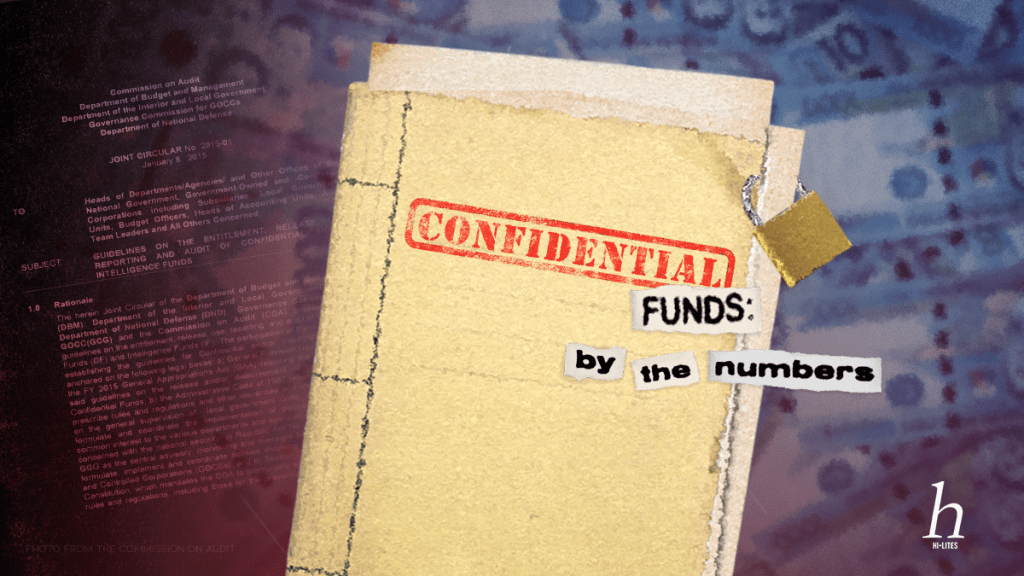
Confidential funds are budget allocations of departments that are not subject to the audits from the Commission on Audit (COA). This would mean that one won’t be able to track how, when, and where these funds are spent—as such, these are mostly used in intelligence or surveillance operations that are highly classified, not your classroom experience.
While confidential funds for the Office of the Vice President (OVP) and the Department of Education (DepEd) in 2024 look to be nonexistent, 2022 and 2023 saw DepEd allocate Php 150 million for confidential funds. Instead, those assets will be refocused or realigned to other agencies that are in charge of defending the West Philippine Sea.
Outside of the current Marcos regime, there were virtually no accounts of DepEd allocating any amount of the department’s budget into confidential funds. According to data from the 2024 National Expenditures Program, this is the second consecutive year that Sara H. Duterte, the DepEd Secretary, spent Php 150 million in confidential funds.
In an ambush interview by Rappler, Sara noted that “education is intertwined with national security.”
Where that money goes—nobody knows exactly. It could be a bullet shot in a crossfire outside of a school in some neglected, rural area of instability; and on the other hand, it could also be cash that slid into the pockets of some politician. On the off chance that they used it to seal the wall cracks of a public school in some distant province, here’s what that money would look like.
By the Numbers
* values were calculated by the author.
60*. Complete with a washroom, stairs and the engineering to back it all up, data from DepEd back in November 2012 suggests that Php 150 million can be utilized to construct at least 60 two-story buildings, with each one being outfitted with at least two classrooms. While that number will certainly go down due to inflation and price changes from the past decade, there is Php 150 million that does not go into sealing the floor cracks and broken fans of the public school system in the Philippines.
462*. While teachers’ wages vary depending on salary grade that they have, the minimum wage of a Teacher I is P27,000, and are commonly the ones employed in public schools. With Php 150 million, DepEd can hire 462 more teachers and still manage to pay them for a year.
4286. To many, the pandemic era seems like a bygone already, but it has left crucial marks in the education sector in our country, calling for a need to integrate technology into modern teaching practices. Gadgets became a necessity, and with 150 million pesos, DepEd could supply 4286 laptops worth Php 35,000 to needy students.
Reversing budget slashes. The 2024 budget for State Universities and Colleges (SUCs) has a budget of P100.8-billion decreased by 5.75 percent compared to its 2023 budget of P107 billion. While the Php 150 million accounts for less than a percent of the budget change, it can still contribute to improving the educational infrastructure of SUCs.
3.75 million*. While the average prices of textbooks vary, DepEd provided a price list per unit for many of its textbooks that it offers to its students. Taking the price of one of the more relatively expensive books at Php 40, then with Php 150 million, DepEd can bridge the gap between the lack of educational resources by providing at least 3.75 million textbooks.
With Php 150 million, one can fill in many of the gaps that are present in the education sector—be it that old window that never got fixed, or the classroom that the pupils have been promised will be made available by the end of their elementary years. The list of numbers goes on, and the longer this list becomes, the more glaring the gaps in the education sector become—gaps that could have been filled with proper use of budget and resource allocation.
 HiLites ASHS