
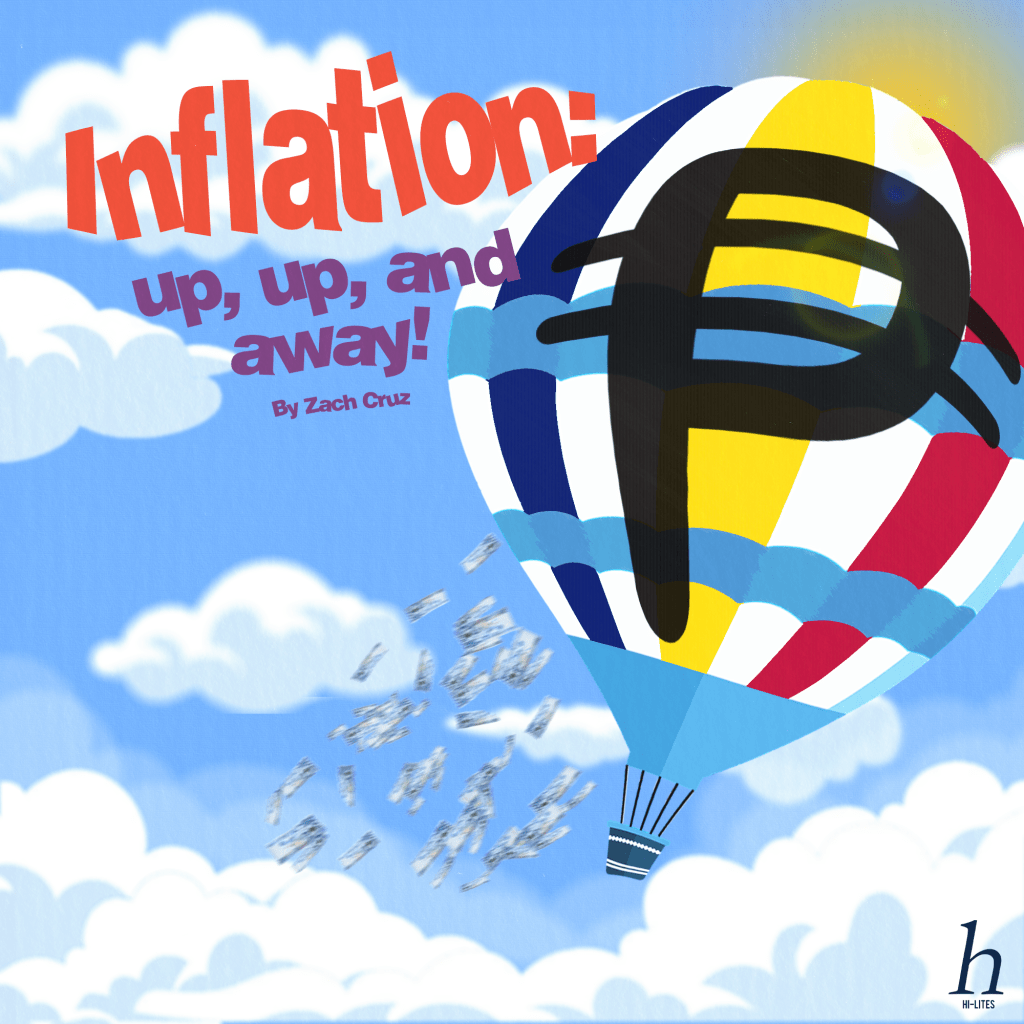
By Zach Cruz
It’s one fine day in the town market—until your parent or guardian starts mumbling, “Grabe, ang mahal na ng mga bilihin ngayon,” and proceeds to drop the kilo of onions they were planning to buy. Perhaps, on a more personal level, you notice that you somehow spent almost 200 pesos just to feed yourself at Jollibee, which recently abolished its mix-and-match combos (a tragedy for some). When you were just about to load up your mobile phone, you were surprised to see that GoSURF50 transformed into the more expensive GoSURF59—a shocking 20 percent increase.
As the years go by and as we grow older and older, it seems as if the prices of goods grow with us as well—and this is all thanks to inflation.
A lot of us are familiar with the term already as we hear it all the time, be it through our parents’ conversations, in social media, or on television. To make things clear, inflation refers to the rate of which prices increase over time. It often is a natural economic phenomenon—one that countries and economies face regularly. In the Philippine context though, prices have recently begun to rise to uncomfortable levels. Based on a report from the Philippine Statistics Authority, the year-to-date inflation rate stands at a high and mighty 6.4 percent—a figure that might seem “so small” or “not that high” to some, but still nonetheless large when talking about ideal inflation rates, especially if you consider that the country’s target rate lies somewhere between 2.0 to 4.0 percent.
Inflating Inflation
Inflation encompasses a variety of factors, some of which may be just out of our control. It may be determined by the status of certain influential nations, which go on to affect many other nations with it. Issues with politics and economies can go hand-in-hand among countries; some remarkable events such as wars, conflicts, and tensions, even go on to change the whole world.
Take the COVID-19 pandemic—a biological crisis that destabilized most nations—as an example. It was a time when virtually everyone was not allowed to go anywhere else aside from the comfort of their own homes. As such, as society slowed down, so did economies around the world. Supply chain disruptions, wherein suppliers had difficulty transporting and selling their materials to producers, are one of the primary reasons for inflation during the pandemic. Moreover, given the rise in demand for essential supplies such as alcohol and face masks, the prices of these products went up as well. Maybe you’d recall a time when face masks were being sold for 15 pesos each, which is almost a 300% markup from its usual price.
From the aforementioned factors, supply and demand play important roles in determining inflation. In one case, inflation may occur if citizens of a country have too much supply of money in circulation. If you’ve heard of the “more money equals more inflation” explanation and understood it, you’ve probably gotten the gist of the concept already.
To further explain, if all individuals have so much money, then its value would naturally decline and eventually be worthless. After all, what is the value of money if everyone has it already? People would just bid and bid to purchase goods and services, and this competition would eventually create inflating prices. This inflation brought by the rise in demand for goods and services is called demand-pull inflation in economics.
Lastly—and ironically—inflation may cause more inflation. This is brought about by the rise in the prices of raw materials needed to produce products. Oil, metals, and energy are among the resources most affected by inflation. In economics, this phenomenon is called cost-push inflation, wherein production costs cause prices to rise.
Suppose a company uses oil-operating machinery to produce its products. If the global supply of oil lowers or if the demand for oil rises, naturally, its purchasing price would increase as well to balance both supply and demand. For companies that are dependent on oil, it would mean that they would have to spend more to produce their products. To make up for these losses, they increase the prices of their products.
Nowhere to Go But Up
As these factors boil down to the very concept and consequences of inflation, it makes life’s challenges a little bit harder to bear for many of us Filipinos. You may recall certain inflation-related issues that have arisen in the past year. Consider the rising prices of rice (which is still not 20 pesos per kilo, as promised) and onions, both of which are related to local production and importation issues. Both of these ingredients serve as vital elements of most Filipino dishes and meals; it’s no good that some people already find them expensive and inaccessible.
There’s also the issue of rising prices in electrical services as the country remains dependent on energy imports, making it prone to inflation brought upon by shifts in the global economy. The same principle applies to oil and gasoline as well, rendering the transportation sector expensive and inaccessible for many already.
Inflation is present even in the small things, like what was stated earlier on fast food meals and even mobile load promotions from telecommunications companies. If you’re an avid watcher of films online or a proud streamer of music, perhaps you’ve also noticed that the prices of certain subscriptions have risen by a set percentage. All-in-all, this economic phenomenon affects most, if not all of the products and services we purchase.
In the end, what’s in store for us is the continuing skyrocketing of these prices. Pair this with the fact that somehow, minimum wage remains low, which is another headache for many. You never know—maybe soon, you’ll be buying onions for 1,200 pesos a kilo. Or maybe a one-month subscription to Netflix would someday cost 400 pesos.
Unless prompt action is taken by concerned authorities such as government and economic institutions, inflation will only continue to strangle the lives of Filipinos, especially as our country is still developing. As we grow in age and height, so too will the prices of every product we know.
 HiLites ASHS