
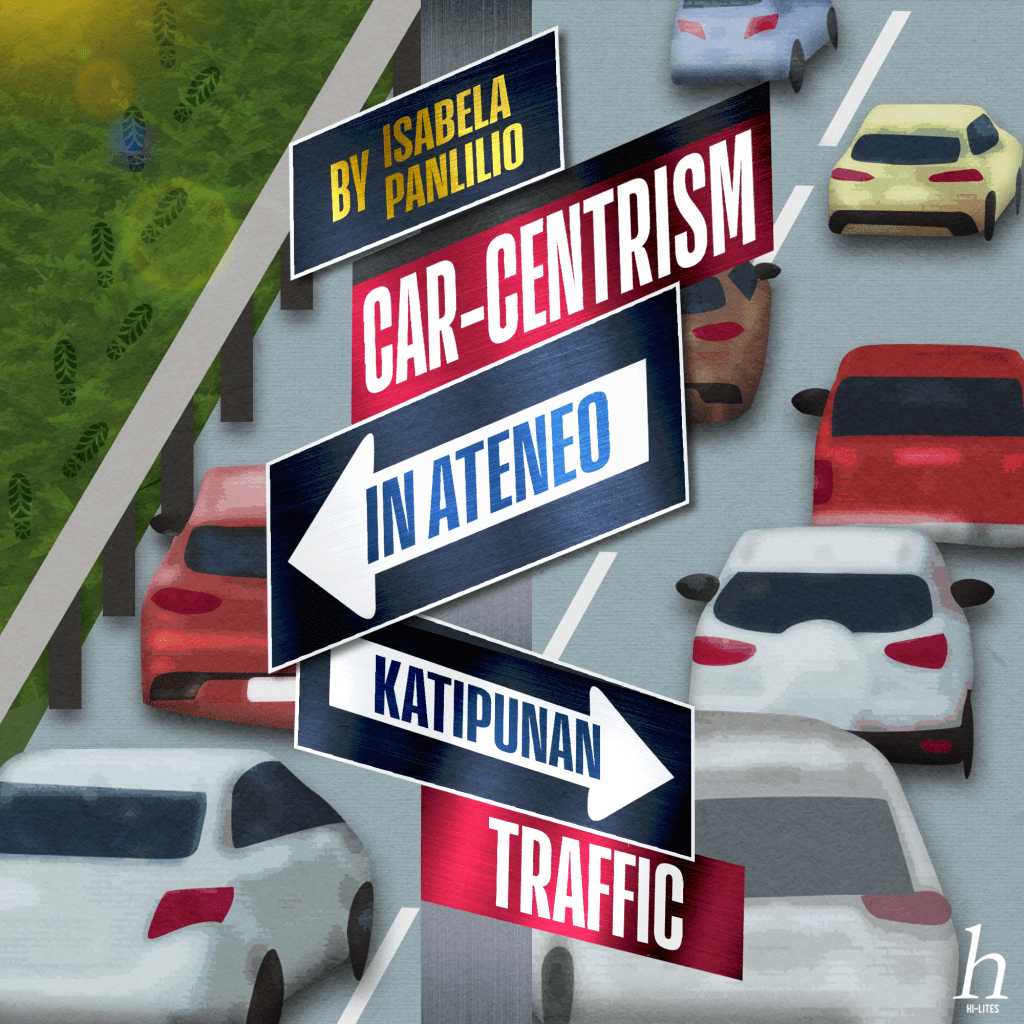
By Isabela Panlilio
With the conduction of full face-to-face classes for all grade levels, most of whom have similar class schedules, traffic congestion has proliferated in Ateneo and its surrounding areas. Everyday from 7-8AM, around 2,757 vehicles go northbound going to Commonwealth, while 6,636 are going to Aurora Boulevard. Meanwhile, during the evening, around 4,854 vehicles were traveling northbound and 5,697 going southbound. The C-5 corridor is the third most congested thoroughfare in the region, with an average daily traffic of 122,968 private cars plying C-5 from 2017 to 2020. Even the Ateneo Traffic Group recognized that the Ateneo contributed to 20% of the traffic in Katipunan Avenue. Today, a single week sees around 6,800 cars in campus premises, according to the Campus Safety and Mobility Office.
This increase of traffic congestion has affected Ateneo students, teachers, and employees alike. In an interview, one Senior High School teacher mentioned that the current traffic situation in Ateneo has been the worst, compared to traffic pre-pandemic. For him, he could get to school in 5 to 7 minutes without traffic. Now with traffic, however, it takes him more than 5 times longer, from 30 minutes to an hour.
With the lack of concrete and efficient solutions to this traffic congestion, many students, teachers, and other employees have taken matters into their own hands. Every day, hundreds of students and staff force themselves to rise early only to find themselves late and exhausted, their academic endeavors hindered by unmoving cars. Students and teachers alike have preferred to wake up early, with some waking up at 4am, just to arrive at 6am. In an interview, another teacher also noted that he would rather leave school at 6pm, rather than 4:30 because the traffic around this time is so bad. He considers it as a waste of gas, energy, and time—time that could have still been used for both students and teachers, most of whom are sleep deprived and tired from an ever-increasing academic workload.
It’s important we know the effects of increased traffic congestion on the environment. Increased time in traffic means increased engine and fuel use, which in turn, increases engine emissions. These engine emissions, consisting of nitrogen oxides, carbon monoxide, unburned hydrocarbons, sulfur oxides, solid particles, aerosols, as well as carbon dioxide or carbon dioxide (СО2), account for 50% of dangerous substances in the atmosphere.
Why is there so much traffic?
The Philippines had the highest growth rate in motor vehicle sales at 29.8 percent, selling a total of 276,215 units, higher than the 212,872 units sold in the same period a year ago. This could be attributed to how cars are advertised as more affordable, as compared to other countries where cars cost more. Cars are often advertised on billboards with the words “low down payment” or “20k per month payment.” These are marketing strategies that have prompted more and more people to rely on cars. People are encouraged to buy more and more cars, instead of taking the more sustainable and efficient long-term solution—public transport. This heavy dependence on cars has marginalized other modes of transportation. According to Riva Comia, a Blue Mobility member, this reliance is a reflection of a systemic bias towards car-centristic initiatives.
Yet, people heavily rely on cars because we lack a decent and efficient public transport system. Even a non-commuter SHS teacher said “I’ve observed countries like Singapore, where people don’t feel the need to own a car because their train system is so efficient. You can almost get to any place in Singapore using the train system. That’s not the experience here.” This same sentiment is shared by a Grade 11 student commuter, who said “Umaga palang, pagod na ako. Kailangan kong gumising ng sobrang aga, or aabot ako sa rush hour. Pag rush hour is its maximum capacity, plus more.” Moreover, the Social Weather Station conducted a survey that showed that 42% of workers who commute found commuting to be “very much harder” now.
With so many people relying on cars, we also have to look whether our campus is enough to accommodate for the sheer amount of students coming in and out of Ateneo. An increase of student population is one of the factors to traffic in Ateneo. From being virtually unchanged from 2013 to 2014 at about 68%, the enrollment rate of 16 to 17- year-olds shot up to 76% in 2016, when the first batch of Grade 11 students came in, and rose further to 83% in 2017. Moreover, the Loyola Schools also experienced an increase in enrollment within the range of 2017 to 2022. In SY 2017-2018, they had an enrollment rate of 12,916, while in SY 2021-2022 on the other hand, enrollment increased by 2,607, with 15,523 undergraduate and graduate student-enrollees. Moreover, enrollment rates in the basic education units are bound to increase as well, as the Grade School and Junior High School are now opening their doors to a co-ed set-up. This increase in the student population was also observed by one SHS teacher, who said “The student population is big, which is why I’m guessing that’s one of the culprits” (of the increased traffic congestion in campus). The campus isn’t getting any bigger, nor are they implementing more sustainable and long-term initiatives, so with this increase of students every year, the traffic situation may only get worse.
Car-centric Infrastructure
The infrastructure in Metro Manila is extremely car-centric, as our government and private companies implement projects like highways. Our infrastructure is not people-friendly. In an interview, one student commuter said that “There is a lack of proper sidewalks,” which is why she is often forced to walk on the sides of main roads. This decrease in sidewalk space and raised footbridges are a result of the prioritization of cars. Cars are given more importance, which marginalizes the majority of Filipinos who commute.
Blue Mobility, an Atenean organization that advocates for sustainable mobility, mentioned that “in a recent consultation with the MMDA, though initially promising, brought solutions that, disappointingly, remain skewed toward prioritizing vehicular movement.” Once again, these proposed initiatives are car-centric, leaving the feelings and needs of the masses— of commuters, cyclists and pedestrians, in the gutter. Moreover, these proposed measures by those in authority also further marginalize vulnerable groups, like people with disabilities.
Fully onsite classes across all grade levels have been going on for more than 4 months already, yet the traffic congestion inside Ateneo has not been improving. With this, there have been numerous proposals that aim to address this imperative issue. So, what is our administration doing?
There have been proposals to change the schedule of Grade School. However, last October 12, the Ateneo Senior High School Sanggunian conducted an interest check with the student body regarding a change in our schedule. In the survey, students were given three option of which they were to choose one. These were (1) to retain the current schedule, (2) have a later MIP, same break times, later dismissal, or (3) have a later MIP, no/shorter break times, and same dismissal.
The administration has been in consultation with MMDA, local government units, and other schools along Katipunan to solve the traffic. However, we have yet to see any real and concrete actions to address this issue, which is why Blue Mobility has implemented their own projects to address the increased traffic congestion within campus.
Blue Mobility
This organization is geared towards more practical and sustainable measures to address the worsening traffic situation in Katipunan, whether that be through their flagship project, the Mobility March, to the creation of new policies. Riva Comia, a member of the organization, stated that, “we draft and co-sign statements to influence policy decisions and create a broader impact beyond immediate physical changes, aiming for long-term improvements in traffic conditions, among other things.” Moreover, they also helped create new pedestrian lanes along Katipunan, specifically the ones at the corner of Rosa Alvero and F. Dela Rosa, in just a week. Just last October 24, Blue Mobility hosted Moving Forward, a talk on sustainable transportation and efficient mobility. They also created Biyaheng Ateneo, a Facebook group dedicated to Atenean commuters.
Blue Mobility calls on the administration to prioritize pedestrians, cyclists, and commuters, through the creation of sidewalks, bike lanes, and the reimplementation of point-to-point buses or other school approved shuttles. These shuttles or Katipunan jeepneys are desperately needed by student commuters. Up until the pandemic, Ateneo had point-to-point buses, which brought students to different drop off points. Moreover, they ask for the creation of a task force in Katipunan, in coordination with other neighboring schools and LGUs.
However, in spite of the many efforts the administration could take now, when we look further deeper into the problem, we see life-long issues that Ateneo alone cannot solve. Factors outside Ateneo’s control, such as the inefficient transportation system we have, negatively affects traffic congestion both in and out Ateneo. With the recent jeepney strike, we must realize how unfairly treated commuters and public transport workers are by those in power— by those who prioritize profit over people. Advocating for a less car-centric society is a lifelong commitment that Blue Mobility advocates for— and this is an endeavor that we as a community must work for together— in solidarity for a transport system that serves the masses, and not the few.
 HiLites ASHS