By Ace Dizon
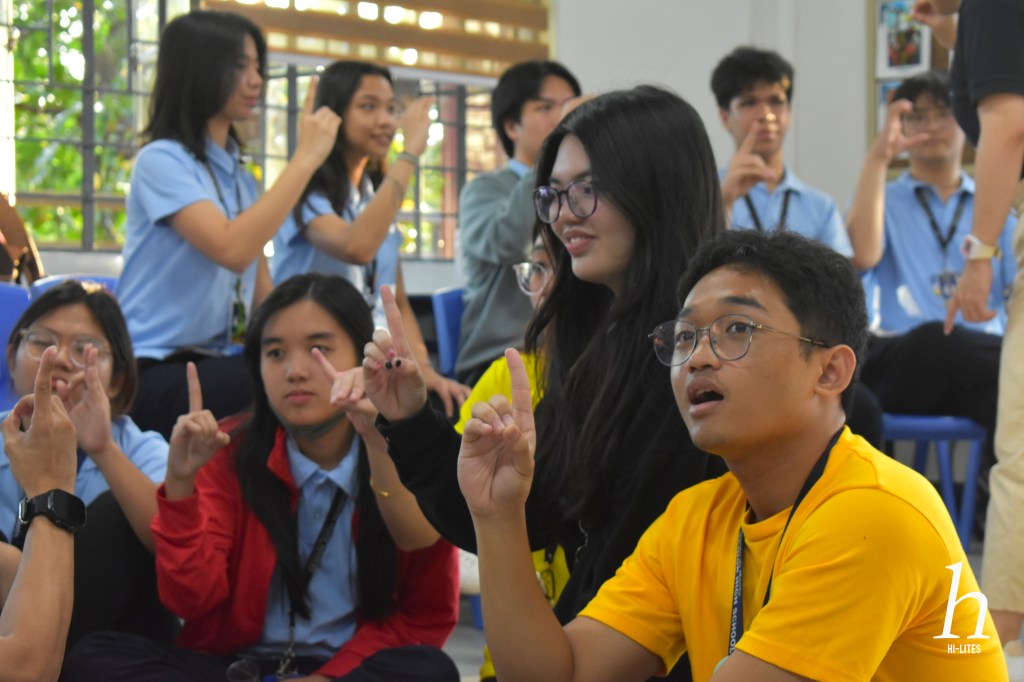
The Humanities and Social Sciences (HumSS) Council concluded its project, “LIKHA,” with a Filipino Sign Language (FSL) Workshop last Friday, January 26, at Room 319 of the Ateneo Senior High School (ASHS) Building.
The event entailed a series of workshops in Mixed Media, FSL, Music Production, and Character Design, which aimed to help students explore their creative side through proactive mentorship and collaboration.
Deaf and Terp, an organization that promotes inclusivity by providing FSL courses and news interpreters, was invited by the HumSS Council as speakers for the event. Students were also tapped to lead the other workshops.
Rebuilding the deaf Identity
In their talk, Deaf and Terp addressed the common stereotypes and myths about deaf people through a fun game entitled, “Bawal Judgemental: True or False.”
Deaf and Terp mentioned terms that were “unacceptable” to call a deaf person with, such as “hearing-impaired,” “hearing-disabled,” and “hearing-handicapped.”
Naty Natividad, the proprietor of Deaf and Terp and a hearing interpreter, stated that deaf people view themselves not as handicapped individuals, but rather as a group of people who use a different language like that of Filipino and English.
The term, “Deaf,” means that an individual is a part of a community of deaf people, while “deaf” with a small letter ‘d’ refers to people who cannot hear.
Deaf and Terp emphasized that there are different levels of hearing for deaf people. There are those who can partially hear, those who cannot hear anything, those who were born deaf, and those who have become deaf due to age.
Thus, vibrations are used by deaf people to feel music and to see when someone is trying to catch their attention.
Contrary to popular belief, there are deaf people who do not wish to gain the ability to hear. This is because they embrace their being deaf as a part of their identity. On the other hand, there are also those who try to gain or regain it through surgery and other devices.
Natividad clarified that lipreading is a skill and not acquired by birth. However, it is seen as unreliable since many sounds have the same lip movement, which is why sign language is preferred since it lessens miscommunication.
Embracing the FSL
In a video presentation, it was shown that FSL is different from American Sign Language (ASL), although there are similarities between the two as FSL was influenced by ASL due to Americans being the first teachers of the deaf in the Philippines.
FSL is a language that has its own syntax, grammar, vocabulary, linguistic features, and cultural ties to Filipino heritage.
Natividad highlighted that made up gestures and signs by the hearing people are not FSL.
FSL is recognized by the government as the national sign language of the Filipino deaf as enacted in Republic Act 11106. People who were not trained to do FSL use Visual-Gestural Communication.
“New Language is Caught”
The participants were divided into groups with their respective mentors from Deaf and Terp to learn the basics of FSL like alphabet sign language, greetings, survival signs, common phrases, and slang.
After learning the fundamentals of sign language, the groups did a skit together using only sign language as their way of communicating.
The participants had a sharing of their takeaways, which mostly revolved around improving accessibility and inclusivity by keeping the concerns of those who have disabilities in mind.
“New language is not taught, new language is caught,” Natividad said as she ended the workshop, inviting the participants to interact more with deaf people.
LIKHA: Explore in Retrospect
Looking back at the workshops done during the duration of the event, the speakers recounted positive memories from their talks.
Character Design speakers Bianca Roxas and Oceana Pastrana, as well as Music Production speaker Johann Paclibar of the ASHS Music Industry Organization (MIO), shared that “LIKHA” was a fun experience that allowed them to bond with other Ateneans who share their interests.
The Character Design workshop included drawing the characters and formulating a plot with the created characters which was then shared to other participants.
On the other hand, the Music Production workshop focused on dissecting the artistic process in making a song, as well as featuring the personal artistic endeavors of MIO.
“Push yourself to keep creating…keep making stuff, and don’t be afraid to share your work,” Paclibar advised to those who want to further explore music production.
As for those who wish to get started on character design, Roxas states, “The best thing to do is to start simple. It’s okay to reference really good works, but never put yourself immediately up to their level. You will develop, it’s not a linear process.”
Furthermore, Pastrana urges those interested in the craft to not be afraid to try. “If you’re passionate in the art of character design, then why not take a leap of faith?” she added.
The Character Design speakers and MIO upheld that in the pursuit of artistic excellence, learning should always be sought after in the process of creation.
 HiLites ASHS