
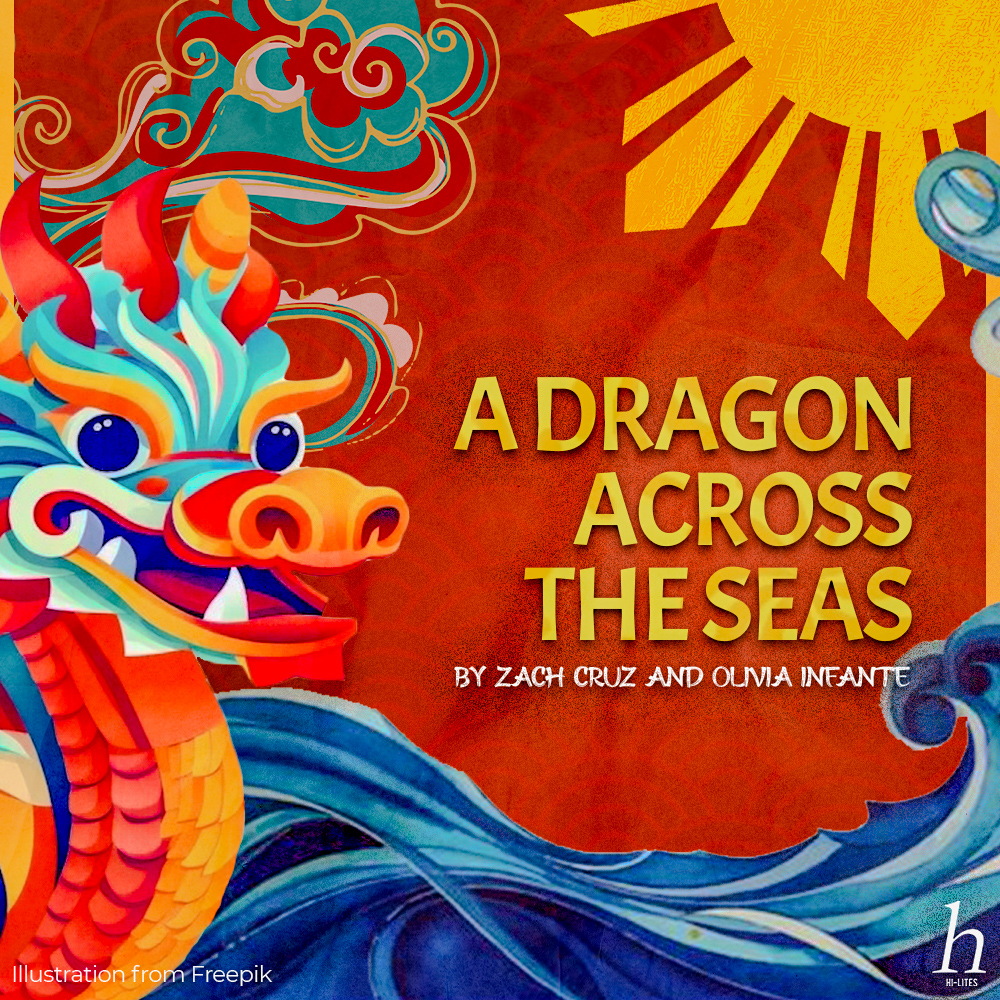
By Zach Cruz and Olivia Infante
“Kung hei fat choi!”
You would usually encounter this specific greeting during the month of February—often before the day of love, Valentine’s Day. You may even recall another greeting, “Gōng xǐ fā cái!”, that is used interchangeably with the greeting above. Aside from hearing these phrases, your eyes would be bombarded with the color red—from the tapestries hanging around your local shopping malls, to the paper lanterns that illuminate the surroundings with an oriental touch, to—probably one of your favorites—the ang paos that (hopefully) contain crisp blue or yellow bills. It’s Chinese New Year!
Dressed in Red, Up to the Nines!
Just like how New Year is celebrated, Chinese New Year does not fall short with its rich and vibrant festivities. According to tradition, it falls on the first day of the lunisolar Chinese calendar, which when translated into the Gregorian calendar, is the first full moon between January 21 and February 20. It is regarded as one of the—if not the most—important holidays in Chinese culture where families seize the day to celebrate the new year together and pay respects to their departed relatives and ancestors. This 2024 would be the Year of the Wooden Dragon!
One fun origin story of Chinese New Year is based on a legend where a village would be attacked by a monster named Nian at the beginning of the year. However, Nian turned out to be afraid of loud sounds, lights, and the color red, which the villagers used to their advantage to fend off the monster. This would eventually lead to the modern celebration of Chinese New Year, wherein the new year would be greeted with eruptions of cheers and noises, explosions and exhibitions of fireworks, coupled with the adornment of almost everything with the color red—all of which were done to ward off bad luck.
As such, people in China celebrate their new year with great enthusiasm and reverence. Even before the actual celebration itself, they already start preparing to welcome the new year! Days before, some Chinese people celebrate the Laba Festival, where they pray to their ancestors and gods for good fortune. There is also the Little Year celebration where they pray to the kitchen god, clean up their houses, and set up a few things to maximize their luck in the coming year. Generally, preparation for the new year involves a lot of cleaning and decorating, as sweeping away dust rids their surroundings of bad luck while decorating their spaces ushers in good luck and positive energy.
Across the Seas
In many parts of the world, Chinese New Year is also celebrated with the same amount of fervent and red glitz. Such is the case here in the Philippines, where the celebration started to become a special non-working day last 2012. It gives the Filipino-Chinese community—which comprises around 20 percent of the country’s population—an opportunity to celebrate one of their most important holidays in the year with their loved ones. Ever since then, even those who do not possess a single hint of Chinese blood celebrate Chinese New Year, be it in simple or equally extravagant ways—it has, in a way, become part of the country’s festivities!
Many of traditions and practices within the Filipino-Chinese community are passed down from generation to generation. With that, a beautiful combination of ideals and traditions starts. “The giving of ang pao to the younger generation is always there. Praying (in Buddhism) is also a little extra with offers to the Gods, as well as late relatives. Not only do we pray at the altar in our homes, but we also go ‘temple hopping,’ going to many buddhist temples on the day of CNY itself. We also light fireworks as soon as the clock strikes midnight,” Josh Lee from 12-Miki, a third-generation Filipino-Chinese, recalls the aspects of Chinese culture that were taught to him after his great-grandparents immigrated from China to the Philippines.
Similar to how the Chinese greet the new year with cheerful spirits, Filipinos also never fail to welcome it with a bang. Fireworks and firecrackers are typically ignited in celebration of Chinese New Year, bringing noise and light to the skies and the neighborhoods below. People would greet each other “happy new year” once again, and even jump in hopes of maybe reaching their dream height.
The Filipino Touch
Alexa Olivan, a student from 12-Sullivan, also shares the customs of her Filipino-Chinese family. “On my mother’s side, we take a more traditional food course by ordering some fresh lumpia and making some seaweed soup. On the other hand, my father’s side celebrates it with more modern food of differing cultures. Although my dad’s side allows for more games like sungkit, I’m always happy to chat with relatives I haven’t seen in a while and receive ang paos from both sides!” As Chinese New Year unites the cultures of two countries, a blend is found—just like how a dish such as lumpia has become a regular viand for Filipino culture. It becomes fascinating to see the interplay of two cultures as they become an ombré in the lifestyles of many.
At dinnertime, families who celebrate the new year would flock to Chinese restaurants all dressed in red to get a taste of the lucky dishes previously mentioned. Additionally, some would even opt to add a few Filipino dishes to the mix—such as the mighty lechon, which is a mainstay at every Filipino party. And during this time, a crowd-favorite Chinese dish resurfaces: tikoy!
While many countries celebrate Chinese New Year in their own unique ways, there is one value that colors itself more prominently among Chinese-Filipinos—family. “In China, while it still is common for families to gather to celebrate CNY, the Filipinos and Filipino-Chinese’s great importance of ‘having’ to spend it with family is much, much greater than that in China,” Lee explains. This cultural integration greatly reflects the rich beauty and culture of our country.
Down the Road
Down the red brick road of the ASHS lies a Filipino-Chinese organization that builds bridges between cultural divides—Silk Road. Headed by Josh Lee this school year, Silk Road’s purpose is to foster rapport and camaraderie among students whilst encouraging a joint appreciation for the two cultures.
A little inside scoop of the organization is that they have also been busy commemorating the holiday through their org sessions. Lee and Olivan shared that a lantern-making contest had transpired along with a brief lecture regarding the history of Chinese New Year last week. The members were even lucky enough to receive ang paos that contained Silk Road stickers and pins!
Bridges Constructed, Bridges Misconstrued
When asked whether or not they think the Chinese community is well-represented in the ASHS, though, Lee responds with both a yes and a no. “Yes, because, though a small percentage, there is still a fair amount of Filipino-Chinese students in the ASHS… and no, because beyond this, I feel as if a majority of the school population only knows such culture and people on a shallow level.” He takes his point to the “Chinito Haven” stereotype that shows no obscurity among the ASHS.
Lee continues, “Oftentimes, I’ve dwelled on whether or not this is what the Filipino-Chinese culture has boiled down to in the eyes of the ASHS community. Whether this part of our identity boils down to merely a group of people with to-be-desired appearances and odd cultures regarding relationships.” Though Valentine’s day may be right around the corner, the satin red of silk reflects more than ever—even more than red hand-drawn hearts. Everyone may be entitled to their preferences, but it must not overshadow important things that lie beyond someone’s specific type.
Whether you are full, partly, or not Chinese at all, a safe space can always be found in Silk Road. It is one thing to be seen, but with Silk Road, one can be heard. They take the beauty of the nuances of culture and everything in between and form it into an opportunity for students to further find and appreciate their identity. Similarly, let us stay tuned for what’s in store for the organization this Lunar New Year and in the coming months.
It is undeniable that Chinese New Year has transformed into more than a non-working holiday and has found a special place in the households of many. It is through these long-standing traditions, rich memories, and beautiful cultural practices that the dragon continues to reach us across the seas.
 HiLites ASHS