
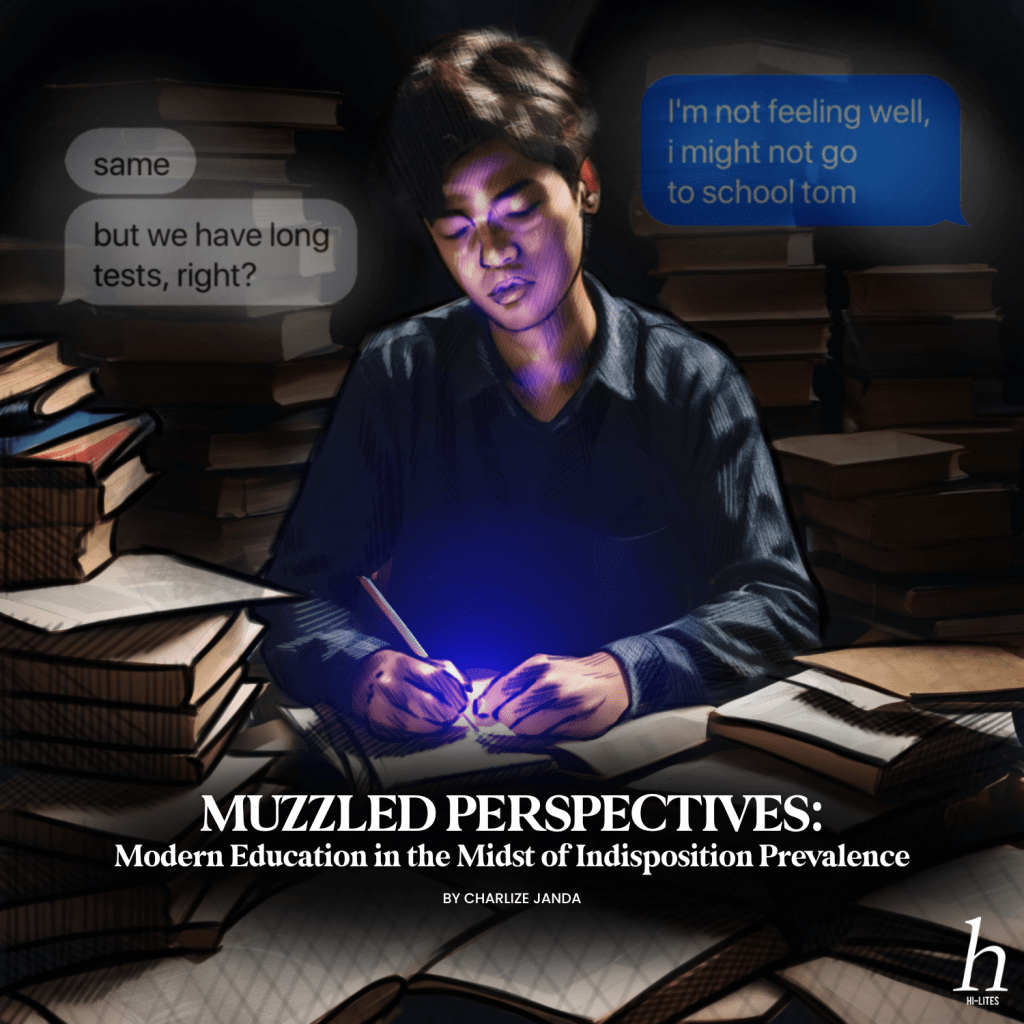
By Charlize Janda
As another semester dawns upon the Ateneo Senior High School, the institution, committed to the refining and improvement of its policies in accordance with the demands of the current time, is continuously challenged to learn from the experiences and events of the past—especially those, in particular, that have notably affected the community.
Like many other nations, the Philippines is still battling difficult problems brought about by growing health issues and an incidence of illnesses. Some of these may include continuing reverberations of the COVID-19 pandemic, while others are more novel difficulties concerned with one’s well-being. One of the areas most severely impacted by these occurrences is education. Last year, flu-like illness cases peaked at 45% higher compared to 2022, and Ateneo is not an exception to these occurrences. Previously, various students and staff were greatly affected by these outbreaks, from grade school to college areas. In light of the increasing incidence of indisposition and the reverberations that may possibly occur due to changing weather patterns, educational systems across the country are undergoing thorough scrutiny, exposing both deficiencies and transformational prospects.
Grasping the State of Affairs
Students are frequently considered as those who are the heart and soul of educational institutions in the hectic world of academia. Yet, notwithstanding their significant role, there has been a worrisome lack of attention paid to students’ health issues. The current emphasis on academic success and the demands of contemporary education has put students’ physical and mental health on the backburner.
Academic pressure has grown into a fundamental component of contemporary schooling. In order to ensure a bright future, students are constantly pressured to excel in tests, assignments, and extracurricular activities. Students routinely make health-related compromises in the name of academic performance. Irregular sleep schedules, poor diets, and little exercise become the norm in the domain of learning. Consequently, they become more susceptible to illnesses that could have been prevalent in their environment as a result. It is concerning that mental health problems, including stress, anxiety, and depression, are becoming more common among students.
The academic race, on the other hand, frequently trivializes these worries, branding them as a sign of weakness rather than recognizing them as significant medical conditions. Students have little time to focus on their well-being due to the mounting pile of assignments, projects, and examinations. Their health problems are made worse by their inability to unwind and take care of themselves.
From a Vantage Point: The Ateneo Senior High School amidst Impediments
The Ateneo Senior High School (ASHS) has been navigating the turbulent waters of education despite ongoing health issues. Last October 2023, the school specifically faced a tremendous hurdle as it necessitated a switch to online learning on certain school days. Aside from health-related issues, weather disturbances and societal movements such as the local transport strike necessitated a redesign of support services, assessments, and curriculum delivery. However, maintaining the caliber of instruction and making sure that learning outcomes were not harmed while switching to hybrid modalities continued to be both essential as well as challenging for the administration.
During the prevalence of diseases, there were still some cases wherein the students’ welfare was neglected. For instance, despite efforts to thoroughly examine the students’ health-related concerns through school-wide surveys and constituency checks, the administration still pushed through with regular classes onsite last October. This is in spite of the fact that the majority of classes in the ASHS faced a tremendous amount of concerns regarding health, ranging from mental to physical aspects. Due to this, a number of students forced themselves to attend their classes despite their conditions in order to avoid missing out on lessons, quizzes, and even long tests.
Despite the fact that more than half of the ASHS population felt unwell, special arrangements were made for a selected group of students only, particularly for the class of 12 – Pro under the STEM Strand. This is due to the fact that not even half of the class was able to attend their classes during the prevalence of illnesses, forcing the administration to shift their class’ mode of learning to an online setting.
Mr. Javy M. Fabello, Assistant Principal for Academics of the ASHS, expressed the admins’ perspective on the matter. “We have a protocol regarding suspension of classes or shifting the classes to online modality if there are cases,” Mr. Fabello says. He also emphasized that there is a certain threshold that signifies if we need to shift to online modality, but it did not exceed and therefore does not necessitate the need to shift to online or suspend classes. “It just so happened that the Grade School and Junior High School went online at that time. I’m not sure if that should be our mentality since we are different schools. That’s the mentality that I also want to emphasize, that we have our own schools, and we decide based on the data that we collect,” Mr. Fabello adds. “Naririnig naman din talaga namin ‘yung mga students, and we are looking at the situation.” In light of this, the administrators, along with the recommendation of the Council of Academic Supervisors (CAS) and approval of our Principal, Mr. Noel Miranda, previously analyzed the situation in light of the past report shared by the Department of Health about the increase in cases of influenza-like illnesses since August 2023 through a new memorandum.
With the release of the memo last November 9, 2023 regarding absences due to illness, students with absences due to illness will be excused from their quizzes and will be treated similarly to absences for official reasons. Therefore, students who missed or will be missing a quiz due to illness will have a lower Highest Possible Score (HPS) for quizzes compared to the class. However, if a student misses more than 50% of the number of quizzes, the case will be referred to the Office of the Assistant Principal for Academics. The higher-ups also emphasized that this decision is to acknowledge that the community may still be adjusting to the rigor of a full in-person teaching-learning set-up.
Aside from that, Mr. Fabello encourages the community to approach the administrators should there be urgent concerns, expressing: “It’s important that we hear the students, the parents. It’s very important to communicate.” The administrators are taking action about concerns that they receive, and Mr. Fabello recognizes this importance for them to resolve any worries.
Moreover, he acknowledges the growing competitiveness of students in the academic field, yet affirms that this should not reach the extent of neglecting their well-being. “Students are very competitive, and I like that since that means they want to make sure that they learn. But, I hope students will not sacrifice their own health just to get a certain mark,” Mr. Fabello highlights.
On the contrary, Marco Escalona, current grade 11 student in the ASHS, expressed his take on the issue. “Academic pressure, in my case, stems from my difficulty to render an output due to writer’s block, bombardment of information or coinciding deadlines. As such, it becomes a conscious effort to perform a paradigm shift—rather than abhorring academic pressure, it must somehow encourage you to become more studious, grounded, and resilient,” Marco shares with regards to experiencing academic pressure.
At the onset of the current academic year, Marco explains that the then-implemented correction factor had impacted his decisions with respect to attendance in school, particularly by avoiding absences during days when he has quizzes and long tests. He said that he would not settle for an automatic passing score unless the excuse is absolutely indicative of an absence. Whatever the subject may be, he makes sure to prioritize it by reviewing for the next test diligently and efficiently in order to pull up his final mark. Hence, he is glad that they considered lowering the cumulative HPS instead of grading a student with the passing score on the quiz they missed by default.
Regardless of these challenges, Marco still commends the coordination of the ASHS administrators to ensure that students are heard and validated. He also emphasized the need to prioritize oneself over academia, stating, “During instances wherein I have not finished an assignment due the following morning, I do go past my usual bedtime but I do not push myself beyond my limits. Oftentimes I already have a proper framework or outline of what I am about to do, paired with an optimistic mindset. These effective habits go a long way!”
Repercussions of The Lay of the Land
The protracted health crisis last October had a negative impact not only on the physical, but also on the mental health of staff and students. Consistently switching to hybrid modalities could be both demanding and exhausting given the uncertainties. This emphasizes the crucial need for strong mental health support, made evident by the impacts of isolation, uncertainty, and increased screen time. Thus, although hybrid modalities may seem like a viable option when compromising, they still have negative repercussions on the students. In turn, a more robust and distinct system, specifically addressing health-related concerns, may be the best resort for the higher-ups to administer.
Disregard for students’ health issues has far-reaching effects in addition to having an influence on the individual. This might have a negative effect on academic achievement. Burnout, memory loss, and impaired attention are all effects of poor mental and physical health. Chronic health problems that linger into adulthood as a result of untreated health conditions can have a negative impact on a person’s quality of life as well as the healthcare system and the economy.
A society that struggles with increasing healthcare expenditures, less productivity, and an increase in stress-related illnesses might result from an entire generation of learners who are still failing to put their health at the forefront.
Revamping the System
Though there have been several revisions made in the system such as the implementation of the memorandum during the remainder of the first semester, the prioritization of this issue still seems to remain in the periphery, specifically in the eyes of the students. As the coolest months of the year fall in January, in contrast with the usual climate in the nation, changing weather patterns may increase the chances of people catching varying degrees of illnesses. Thus, a multifaceted strategy is necessary to avert this concerning trend. The adoption of a holistic approach towards learning by educational institutions, which prioritizes students’ physical and mental health, deserves to be promoted. This entails offering tools for dietary instruction, wellness initiatives, and assistance for mental health. The system may also benefit from implementing ways to lessen academic pressure by examining curriculum structures, changing assessment procedures, and encouraging a balanced workload.
Along with teaching students the benefits of maintaining a healthy lifestyle and stress management skills, mandatory well-being programs can also be incorporated into the curriculum. A crucial advancement in resolving this issue is creating a space free from stigma where students may express their health-related worries. This may only be effective if the institution actually listens and translates action to address their concerns. Institutions should set up counseling programs and make student-accessible mental health resources available.
To Lend an Ear
There will always be flaws in the systemic implementation of different programs or initiatives. However, it is also necessary to take into account that there is an urgent need to address the fact that students’ health problems are usually not taken into account in contemporary education. Students shouldn’t have to give up their physical and emotional health in order to attain academic success. In addition to being morally required, putting students’ health first is crucial for raising a generation that is both academically competent and physically and emotionally fit. It is high time for institutions of learning to acknowledge this need and act to give the students they serve access to a more balanced and encouraging atmosphere. The prevalence of indisposition is truly inevitable, thus, it is up to the higher-ups to implement attentive responses to the students’ prevailing concerns.
 HiLites ASHS