
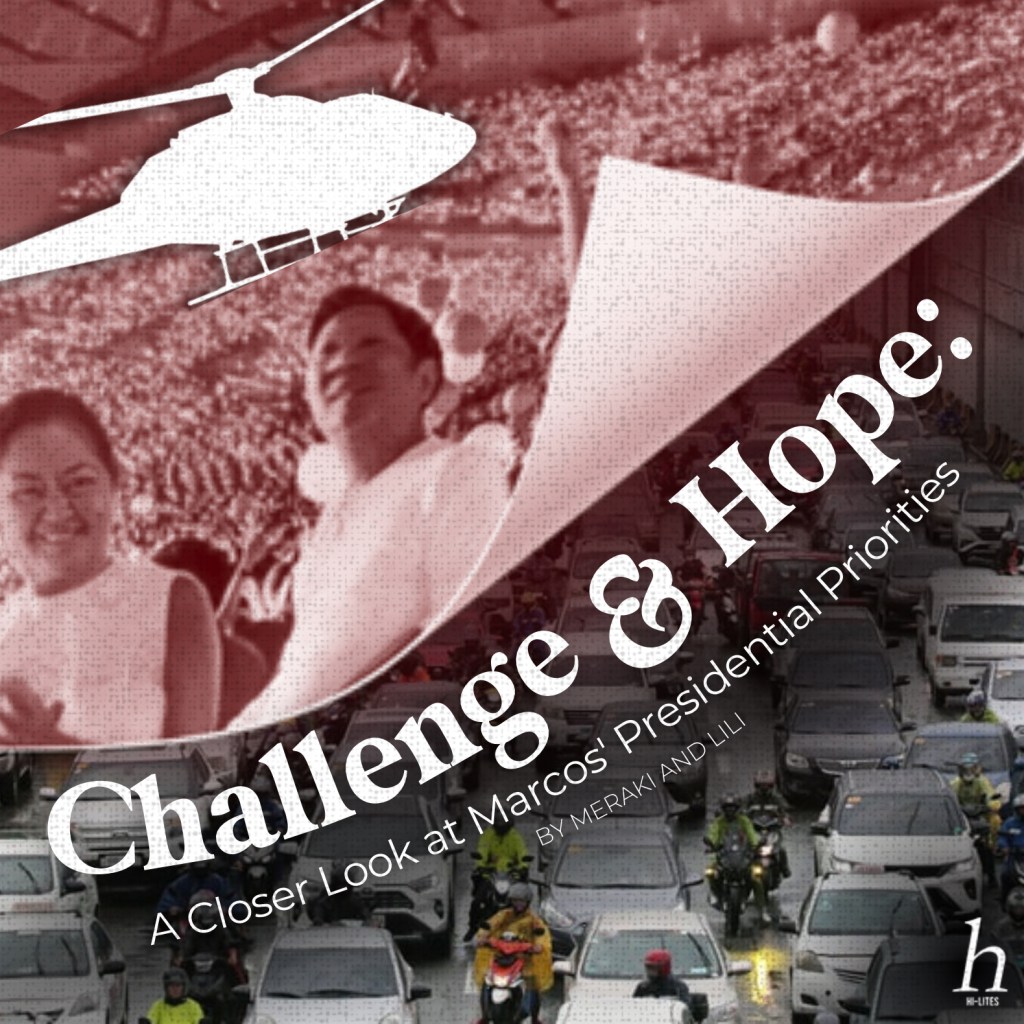
By Meraki and Lili
It was definitely a night to remember as the British rock band Coldplay kicked off their Music of the Spheres World Tour in the Philippines almost seven years after their first concert in the country. “Where better to start 2024 than the Philippine Arena…We are so happy to be back in Metro Manila, can’t wait to get going,” the band shared on ‘X’ before the aforementioned event.
The concert was held from January 19 to 20 at the Philippine Arena, where local bands such as Lola Amour and Dilaw shared the stage with Coldplay’s frontman, Chris Martin, as they sang Lola Amour’s “Raining in Manila” on the first day, and played Dilaw’s “Uhaw” on the second day.
On the other hand, Filipino celebrities also flocked to the two-day concert, including the likes of Shaina Magdayao, Alexa Ilacad, Arjo Atayde and Maine Mendoza, Sarah Lahbati, and more.
Yet, another ‘celebrity’ was present during the triumphant concert. President Ferdinand “Bongbong” Marcos and his wife were seen comfortably arriving at the venue on a helicopter amidst the traffic caused by 40,000 concert-goers. Critics and social media users did not react favorably to the President’s unique choice in transportation, with some pointing out his misuse of government funds and taxpayers’ money, as well as his failure to address the country’s ongoing transportation issues.
While President Marcos was busy attending and rocking out to Coldplay, he failed to attend to the current and significant issues of the Philippines at hand.
The PH Transport System on the Backseat
The Philippines’ transportation system lags behind much of its foreign counterparts, particularly when it comes to public transit and urban mobility. Among the 60 global cities analyzed worldwide with the weakest public transportation systems, the Philippines ranked 58th in terms of “urban mobility readiness” according to the results of the 2022 Urban Mobility Readiness Index. Manila was also placed 56th for public transit and 48th for sustainable mobility.
This complicates transportation and, perhaps more importantly, commuting. The Philippines’ public transportation system is in desperate need of improvement because of its antiquated machinery, a prevalence in financial instability among its operators, and a lack of proper funding for its advancement. For many people who depend on trains to travel to work, school, or other locations, commuting is a daily challenge for them. A significant number of Filipinos, particularly those residing in Metro Manila, rely heavily on these railway systems despite the inconvenience that comes with the sheer volume of people using them—often because they are a cheaper and more practical choice.
Even though the nation’s railway networks have seen recent advancements such as additional trains and renovated station facilities, there are still numerous issues that make traveling an uphill battle for commuters. The Manila Metro Rail Transit System (MRT) and the Manila Light Rail Transit System (LRT) still face difficulties despite these improvements. The persistent overcrowding in trains, for instance, is among the most pressing of these problems. Daily scenes of commuters packed into trains result from the LRT and MRT lines being constructed to handle only a small portion of the current passenger flow. This issue has been exacerbated by both the insufficient expansion of the current lines as well as the lack of additional trains. Due to these factors and the constant lack of accessible and affordable transport options, many Filipinos continue to resort to this dysfunctional system.
In light of the recent demand for jeepney modernization, many Filipinos have been significantly affected by the changes and challenges that have come as a result. This includes not only the operators, but notably the commuters as well. While these detrimental effects may not be fully observable to date, it is projected that the nation could potentially face not just a transportation crisis, but also skyrocketing levels of unemployment, inflation, poverty, and even crime rates, which in turn could damage the nation’s current economic status.
Filipino Time, Delayed?: The Reality of ‘Traffic’ within Filipino context
Besides being the most densely populated city in the world, Metro Manila also remains among the top 10 slowest metro areas to drive in across the globe, as reported by the 2023 TomTom Traffic Index. In Metro Manila, ten kilometers take, on average, twenty-five minutes and thirty seconds to complete. However, rush hour throughout the workweek might exacerbate traffic conditions even further.
According to TomTom data, rush hour traffic bottlenecks have worsened; in 2023, Filipinos lost up to 117 hours annually due to traffic. This data alone encapsulates the growing problem of traffic in the nation, which heavily affects the daily lives of millions of Filipinos.
Given the overwhelming number of people attending the Coldplay concert, it is indisputable that traffic congestion worsened within the premises of the Philippine Arena and even extended beyond the North Luzon Expressway (NLEX), the main route taken by the concertgoers toward the venue. Additionally, the first concert day was held on a Friday evening, fueling the already jam-packed traffic due to typical rush hours in the country.
In fact, the notorious traffic in Manila was even highlighted by the band itself, Coldplay, during the actual concert. Singer Chris Martin addressed the traffic issue in Manila and thanked concertgoers for “coming through the traffic.” He remarked, “We’ve seen some traffic, but I think you have the number one [worst traffic] in the world.” Martin even sang an improvised song about it the following night, stating, “There is only really one thing that remains. The traffic here in Manila is completely insane.” He jested further, “If you wanna drive somewhere then I’m warning you. A two-mile drive will take a week or two. If you wanna get back home in time for your bath, well, allow yourself about a year and a half.”
As netizens questioned Marcos’ easy trip to the concert venue, PSG chief Nelson Morales responded that President Ferdinand Marcos Jr.’s Presidential helicopter was used because of “an unprecedented influx of 40,000 individuals” who attended the event combined with “unforeseen traffic complications.” Morales adds that “this traffic situation posed a potential threat to the security of our President, [so] the PSG took decisive action by opting for the presidential chopper.”
Additionally, Morales stated that “[this] decision not only ensured the safety of our leader but also exemplified our commitment to prioritizing security in the face of unexpected challenges,” which was described as “a grave insult to millions of Filipino commuters” amid the lack of a “progressive and pro-people” mass transportation system in the country by Bagong Alyansang Makabayan president Renato Reyes.
He concluded, “A president who takes a chopper to watch a concert amid terrible traffic and a mass transport crisis, will not sympathize with jeepney drivers, operators and commuters. This is the state of transportation in the Philippines today.” Many netizens seemed to have supported this remark, expressing that the use of the helicopter as the trip would come from the pockets of ordinary taxpayers.
Beyond the Arena: One Step at a Time
Even long before the Coldplay-related issue, Marcos’ approach to addressing the nation’s concerns has been questioned by many. One of the most notorious issues has been the escalating allocation of travel funds. In 2023 alone, Marcos spent P893.57 million just for travel funds as he embarked on 11 foreign trips in 9 countries since assuming office last June 30, 2022.
President Marcos’ 2024 travel budget, both domestic and international, would total P1.408 billion owing to Republic Act No. 11975, also known as the General Appropriations Act of 2024, which he signed in Malacañang on December 20. Compared to his previous P893.57 million trip budget for 2023, this represents a staggering 58% increase. This alone speaks volumes about the President’s apparent priorities, despite the country facing significant internal political and economic challenges, coupled with its escalating debt crisis. The World Bank’s annual report for 2023 reveals that the Philippines has risen to fifth place from seventh in its list of greatest debtors. According to the said report, the Philippines has $2.336 billion in authorized loans from the International Bank for Reconstruction and Development (IBRD), a division of the World Bank Group.
Yet, there remains a prevalence of corruption and lack of transparency within the government, as evidenced by the recent release of the 2023 Corruption Perceptions Index (CPI). The corruption ranking was released by Transparency International, a global organization that ranks countries and territories based on their perceived levels of corruption, with 0 being “highly corrupt” and 100 indicating “very clean.” According to this global group, the Philippines achieved a score of 34 out of 100, marking a one-point increase from last year’s score of 33 out of 100. On Saturday, February 3, 2024, the Malacañang revealed this standing, asserting that the corruption ranking had improved, with the Philippines ranked 115th in the 2023 CPI, one step up from its 116th rank in the previous year.
The Malacañang considers this one-step increase as both a challenge and a reason for hope. “The Government takes note of the slight improvement of the Philippines’ standing in the Corruption we Index of Transparency International. We consider this result as both a challenge to do better and a reason for hope that the country is headed in the right direction,” declared Executive Secretary Lucas Bersamin.
Moreover, Executive Secretary Bersamin called for optimism regarding the government’s commitment to transparent public service. “With the necessary transformational measures being put in place, let us be optimistic and assured that the Government will not fail or falter in its steadfast commitment to effectively provide efficient and transparent public service,” said Bersamin.
While the one-step improvement in the corruption ranking is a source of delight and hope, there is no denying that the Marcos administration still has a very long way to go. Unlike Marcos arriving at a concert via helicopter, the President cannot undergo as quick a process when addressing the issues of the Philippines, such as the PUV modernization leaving drivers uncertain about their future as well as bribery allegations in the People’s Initiative, among others.
A String of Hope: Is the Nation Up for Another Challenge?
Calling for optimism about the Marcos-Duterte administration will not be as easy as Secretary Bersamin hopes. How can one be optimistic about the government’s “commitment to transparent public service” when there is no transparency, accountability, and clear and direct plans of action regarding the current economic and transportation system in the Philippines? It wouldn’t be unfair to allege that the Philippine President values his comfort and convenience more than that of his citizens, if evidenced by his comfortable-journeyed attendance at a concert while current issues are seemingly left to linger at the back of his mind.
The Philippines has been susceptible to an array of changes over the past few decades, and its political aspects have surely affected its standings, functions, and conditions, both internally and externally. Compared to past administrations, Marcos’ presidency, despite the significant events and actions taken within the first two years, requires time to assess whether the nation can attain even a glimmer of hope. Despite the various issues circulating during the Marcos administration, one cannot ignore the one-step improvement of corruption within the Philippines under his leadership. A one-step increase remains a noteworthy advancement. However, Marcos should not settle for merely a one-step increase. The President must cling to this hope and challenge himself to be a more effective, efficient, and transparent servant-leader of the nation.
After all, it’s more than a hundred million Filipinos who are holding on to this thread of hope, and a truly excellent and reliable leader, above all, should be the most persistent in achieving this eagerness for progress.
 HiLites ASHS