
By Joaquin Yulo
Editor’s Note: While we jokingly say that there are spoilers ahead for a historical event as popular as GomBurZa, the movie does go into the more discreet details of our country’s history—something that you might want to discover for yourself. Yes, there are “spoilers” up ahead, so tread carefully. This movie review does not reflect the view of the organization.
Do you believe in bad luck? Naniniwala ka ba talaga sa kamalasan?
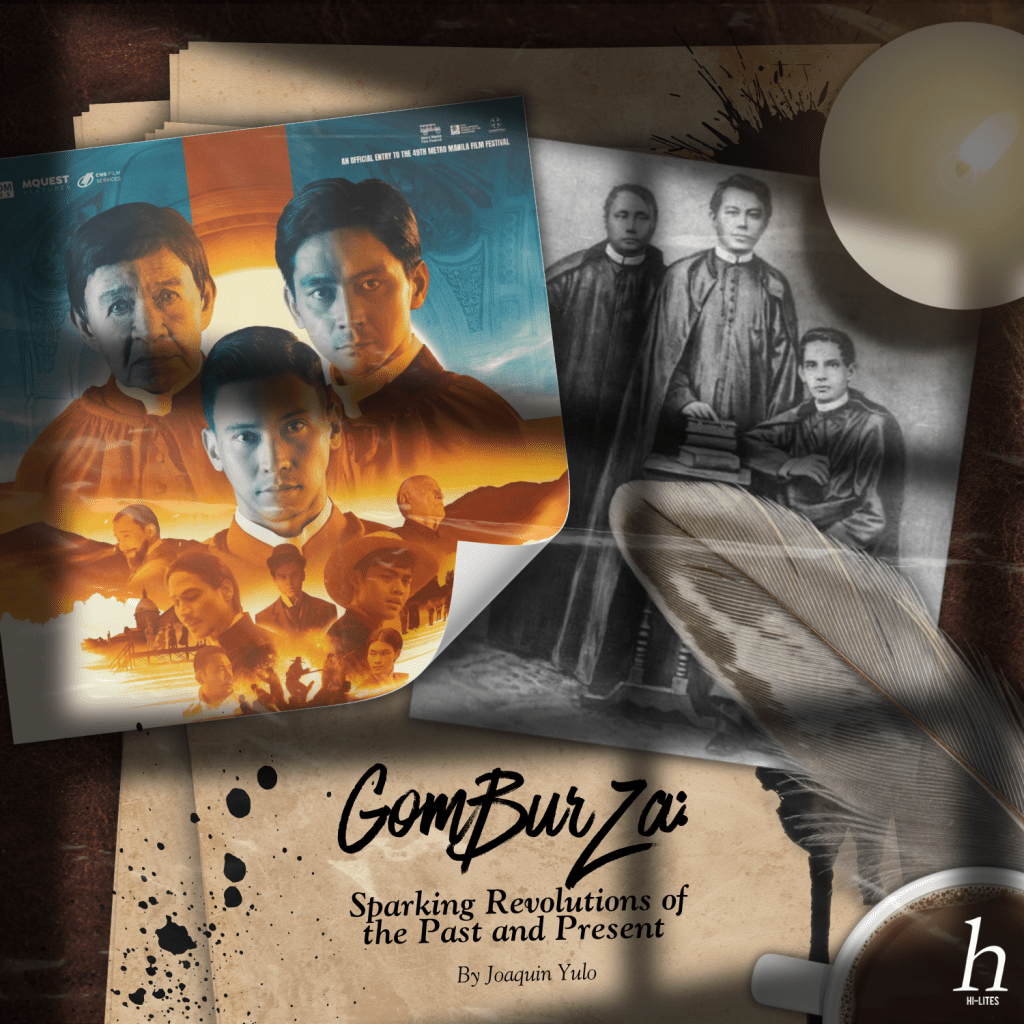
This was the burning question left by Pepe Diokno’s entry to the Metro Manila Film Festival, launched in December 2023. The movie, titled GomBurZa, follows the narratives of some of the most important names in Philippine history, including Hermano Pule, the first indio friar, Father Pedro Pelaez, who fought for equal rights for insulares and peninsulares Spanish friars, and of course, the three martyrs —Father Mariano Gomez, Jose Burgos and Jacinto Zamora—who were the centerpieces of the movie theater.
Of course, being produced by Jesuit Communications Philippines (JesCom), the project has its own share of support from the Ateneo de Manila University. On February 29, 2024, an open free-screening and talkback session with the staff, cast, and some Ateneo faculty was held at the Huyndai Hall in Areté from 5:00PM to 8:45PM.
Perfect Picture
The movie in itself was well-paced and easy to follow. Of course, with priests being the main characters, the movie drew its strength from its dialogue, scenes of “Old Manila,” and the compelling conversations, actions and events that show the influence of the Spanish on 19th Century Philippines.
One interesting storyline embroidered within the movie’s script was the formation of one of the first student associations in the country, La Juventud Liberal, founded by a young Felipe Buencamino and Paciano Mercado. The organization was the student body’s response against the cruel administration of Governor General Rafael de Iziquierdo. The La Juventud Liberal acted as a pioneering force for numerous student organizations, associations, and groups today that allow the voices of the students—the youth—to be heard.
Important events related to the martyrs and the country’s situation in the 1800s were also featured under the spotlight. A key event, the Cavite Mutiny of 1872, was featured in the movie, including its messy execution under Sergeant Fernando La Madrid, its repercussions and how it eventually led to GomBurZa’s accusations of rebellion—ultimately sentencing them to the death penalty.
Another star-striking sequence in the movie happened during the last few minutes, wherein the three priests begin to accept their fate. The young, bright Padre Burgos, who continued his mentor Pedro Pelaez’s fight for reform; the old, experienced Padre Gomez, who mentored Burgos in his ventures for reform; and Padre Zamora, who was fond of playing cards, all accepted their fates differently. Zamora suffered from a nervous breakdown after being found “guilty,” and witnesses to their execution said that he was “already dead before his execution.” Burgos, on the other hand, who was younger than the two, found solace in Padre Gomez’s mentorship. A recurring question that the young priest lamented on was “Why would we be allowed to suffer like this? Is the luck of Filipinos really that bad?” To which Gomez replied, “We must trust that God’s plan works for the good of all those who love Him.”
Different Tones
2023’s MMFF selection revealed a different perspective of Filipino cinema. While the festival is usually known for its hard-hitting love stories, soul-touching family tales, and gut-twisting comedies, this year’s batch incorporated more historical and cultural narratives, including GomBurza, Mallari, and Penduko.
Somehow, with the shift in this year’s festival, public reception of the films have also shifted with it. This year’s festival marked one of the few times wherein the festival was demanded an extension, proposing the original deadline to be moved to January 14 this year.
Profit-wise, 2023’s MMFF earned more than double the previous year, with 2022 grossing out at 500 million pesos, and 2023 peaking over 1 billion pesos. This officially made the festival the most successful of all time, surpassing 2018’s P1.060B peak.
Present Revolutions
The Philippine Revolution, sparked by the martyrdom of GomBurZa, might have been one of, if not the first-ever revolution written in the pages of Filipino history. Through the MMFF entry of Diokno, the production was able to shed light on the importance of historical events and the lives of GomBurZa.
Albeit being the first, the Philippine Revolution won’t be the last.
Even if the Philippines is free from colonial rule, largely thanks to Filipinos who have stood up against tyranny in the past, the country today faces its fair share of issues and problems—those that still hold us captive to this day.
Traffic in Metro Manila keeps people from getting to places on time, corruption in the government stops the country from facing the most pressing issues we have today, and the social division between those with power and those without echo the divisions that the indios faced against the Spanish.
However, if there’s anything Filipinos can do, it’s bouncing back from seemingly hopeless situations. From the numerous colonial revolutions, to the peaceful EDSA revolution, to the present versions of letting voices be heard, the country has always fought for what was right, regardless of its repercussions.
May we strive to be wise like Padre Gomez, intelligent like Padre Burgos, innocent like Padre Zamora, courageous as the members of the La Juventud Liberal, and as patriotic as the Filipinos who came before us.
Mabuhay ang Los Filipinos.
 HiLites ASHS