
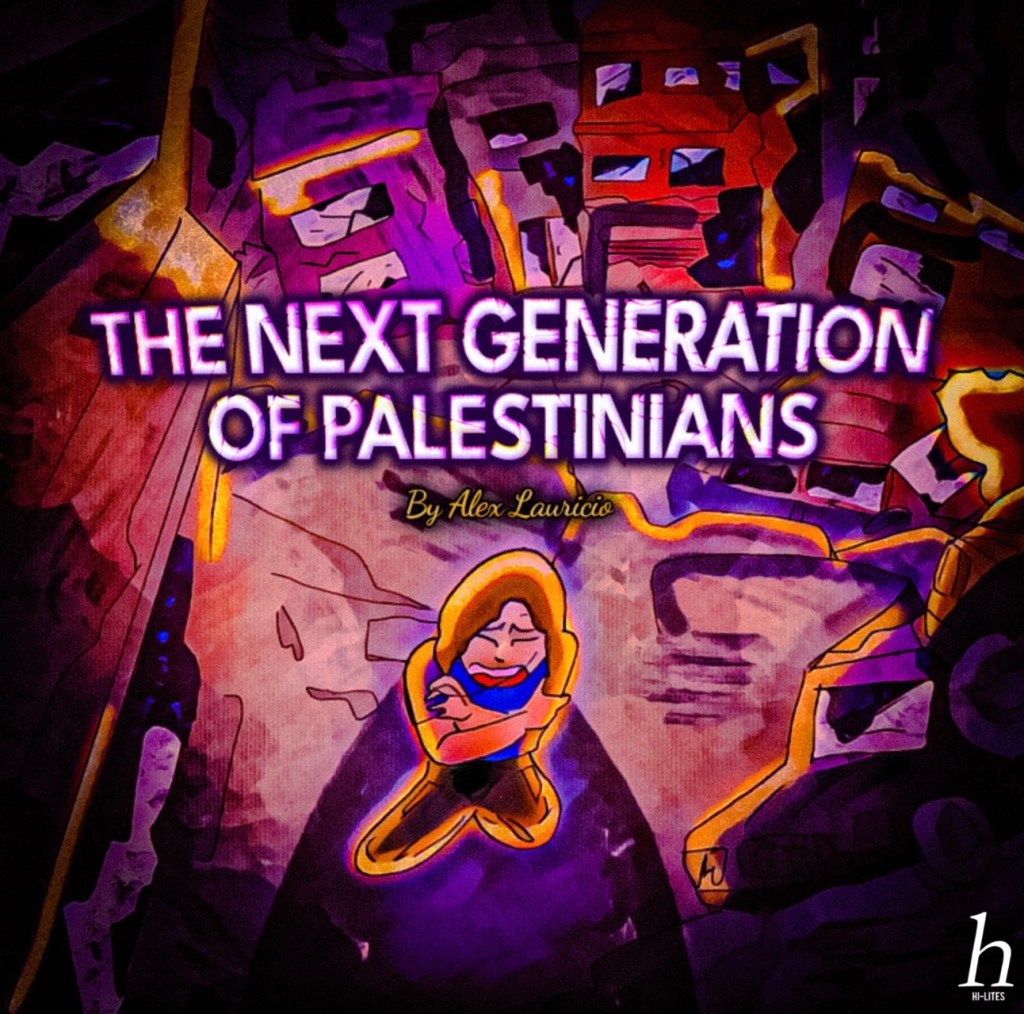
By Alex Lauricio
Previously, you might have known that the true losers in a war aren’t the countries who set it in motion, but the countless innocent lives that are ravaged by warfare. Now we go examine the lives of the Palestinian children, and how their upbringing could shape the future of their home.
If memory serves these children well, they will remember the comfort of refuge in times of war—and not the fury that comes with seeing their homes turn into rubble.
Walking among the ruins they once called home, the Palestinian children become strangers to their own lands—driven away by the Israeli military, and forced to flee while watching their homes get leveled down to the ground. Exposed at such a young age, the scenes of war continue to unfold in front of an audience of at least 1 million children, with massive social and political implications for the future of the region.
The ongoing ground invasion of Gaza by the Israel Defense Forces (IDF) have resulted in the deaths of at least 8,000 children, a staggering 41% of the total Palestinian death toll since the start of the war. The United Nations (UN) statistics show that at least 70% of the educational infrastructure in the region have been destroyed, alongside other critical infrastructure necessary for other basic needs, such as drainage systems, potable tap water, and many others.
This new generation of Palestinians wake up to a world of gunshots and airstrikes—not to say that their “open-air prison” conditions before the war were any better, but the path towards “peace,” which Israel sees as the elimination of Hamas in the region, demands a high price. In the end, if Hamas does not radicalize them, then exposing them early to the horrors of war will.
The State of Gaza
In the span of three months since October 7, at least 20000 Palestinians have been killed in the Israel-Hamas war, as reported by the Gaza Ministry of Health. The figure is widely disputed as many doubt that the Hamas-run ministry is credible. By the IDF’s own count, at least 7000 Hamas fighters were reported to be killed, with many more bodies uncounted under the rubble, which makes providing accurate body counts more difficult.
Congested refugee camps across the country are equipped with tents, tended to by humanitarian workers and what little relief goods that aid trucks deliver. December temperatures can drop to as low as 9-10°C, which presents a risk for the displaced people.
Philippe Lazzarini, the head of the UN’s Relief and Works Agency for Palestinians (UNRWA) described the situation in Gaza as a “living hell.” This comes after heavy rains drench refugee camps across Gaza, which, when combined with the cold temperatures of an Arabian winter, presents a hygienic and hypothermic risk to thousands of displaced Palestinians.
In active war zones, IDF’s ground invasion includes pummeling through important Hamas infrastructure, or places suspected of housing Hamas militants or equipment. This includes sweeping through hospitals, churches, and schools across the region. In residential areas, the IDF sends a text message or knocks on the roof days beforehand to warn that the area will soon be leveled by airstrikes.
Palestinian Christians are greeted by muzzle flash this Christmas as Israeli’s pursuit of Hamas officials have led to the destruction of at least three churches. Meanwhile, airstrikes have destroyed around 60 mosques, with many holy sites for Christians, Jews, and Muslims alike desecrated. At least 100 heritage sites were reported to have been destroyed, including the now-ruined 15th century Uthman Mosque.
Radicalizing the Youth
With half of Gaza’s population under 18, many Palestinians are exposed to the realities of war—from the deprivation of basic needs, to the smiles they wear playing games in refugee camps. The damaging physiological and psychological effects of the war can significantly affect the growth of these children and their actions long after the war and its probable chaotic aftermath.
The healthcare crisis in Gaza comes after experts describe the situation of children’s mental health to be in its “breaking point” as many become separated from their families and show serious signs of emotional distress, traumatic episodes, and symptoms of post-traumatic stress disorder (PTSD).
As more and more children are displaced, they start to learn more about the environment they are in—chaotic, desolate, and violent. The IDF’s goal of wiping out Hamas has caused unimaginable collateral damage to Palestinian youth, which Hamas can use as leverage to recruit more desperate and vengeance-hungry children, who have seen their entire lives crumble to Israeli steel.
This cycle—wiping out extremist militant groups at the cost of civilian collateral damage, leading to radicalization and extremism—is a prevalent and familiar tale in any militant and politically unstable region. Hatred becomes a natural human reaction to the injustices and damage incurred during the process of aggressive military campaigns designed to remove terrorists, which unfortunately repeats the cycle.
Global Opinion
As global support for the Israeli cause wanes, many countries across the world have voiced out several concerns with how Israel is managing its war in Gaza. European representatives from Ireland and Spain have called out the war as the “indiscriminate killing of Palestinians,” and remarked that the actions of Israel are “not acceptable.”
The United States has also shown concern over Israel’s campaign, including criticism of Israel’s Benjamin Netanyahu, the country’s prime minister.
This comes after the Jewish country’s war operations in the civilian-occupied Gaza resulted in multiple bombing campaigns and repeated warnings for Palestinians to move either southward or northward as Israeli operations level parts of the Gaza Strip down.
A more recent ceasefire vote held during the United Nations General Assembly (UNGA) last December 12 saw 153 countries, including the Philippines, vote in favor of a humanitarian truce, 23 abstentions, and 10 against. For comparison, the first UNGA vote last October 27 only had 121 in favor, and the Philippines abstained from voting. While the vote is non-binding, it is indicative of the world’s opinions regarding the war.
The war in Gaza has resulted in the absolute and total loss of not only the current population of Gaza, but also the names and dreams of hundreds if not thousands of children. Those that remain are tasked with becoming the future of Palestine, and dealing with the unstable aftermath long after the Israel-Hamas war ends.
 HiLites ASHS