
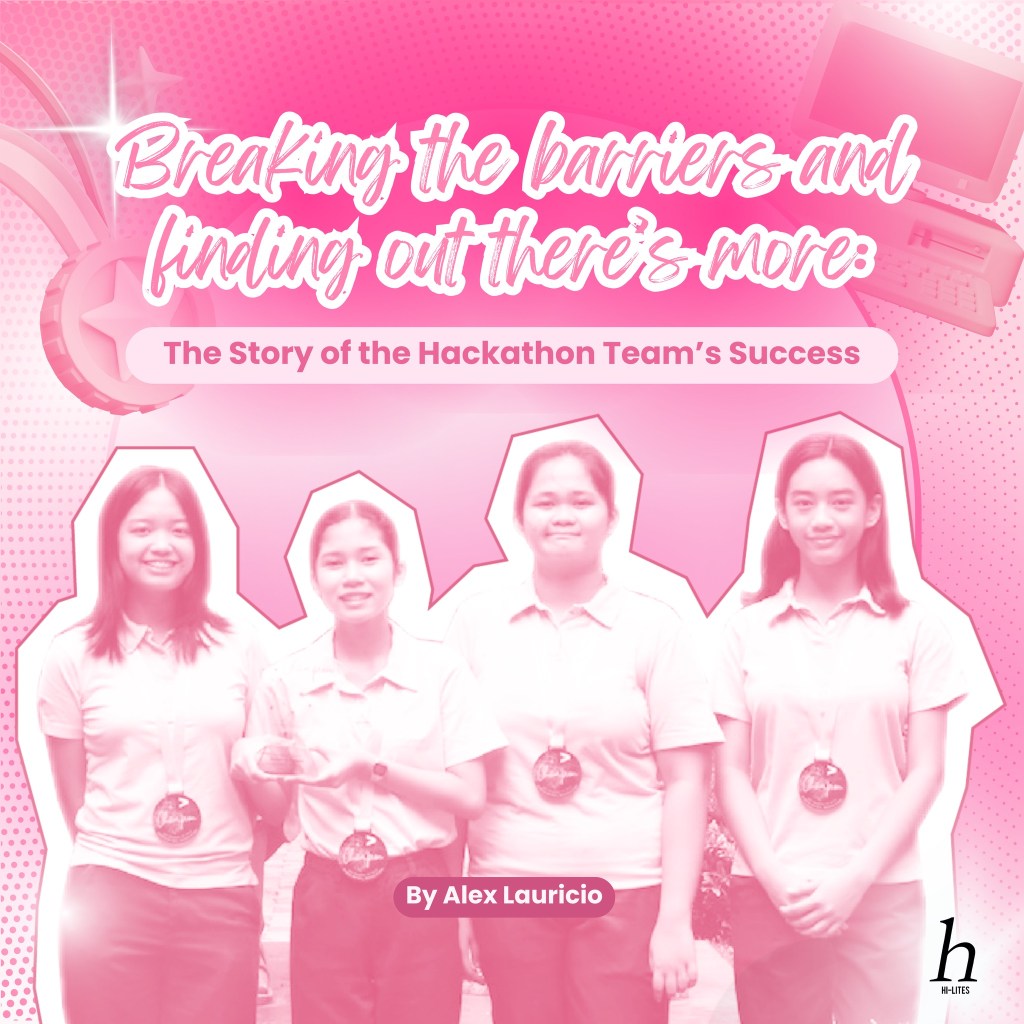
By Alex Lauricio
Recently, an all — Atenean contingent carried back home a trophy and four glittering medals; facing different teams from other prestigious schools, they’ve bested everyone and emerged as champions.
After overcoming numerous obstacles and sleepless nights, they take a picture, a thumb adequately covering a portion of the trophy that said—”hackathon for girls.”
“The moment you mention that it’s [the competition] for girls, the perception of it changes,” said Stephany.
Last March 8, the Atenean team composed of Stephany Boras, Leanne Austria, Yanni Adoptante, and Samantha Elizarde bagged several awards at the Breaking Barriers, Building Bridges Hackathon. Led by their coach, Arvin Joseph Villamil, the group emerged as champions in the competition.
Bridging the gap between the deaf community and the able, the group created an app—Abot Kamay—that can recognize sign language and teach its users the basics of Filipino Sign Language (FSL).
While the team’s podium finish is hard-fought, the notion of an all-girls competition makes them feel undervalued.
“At first di ko napansin, and yeah it does give an opportunity to compete. But at the same time, puro girls lang. Wala bang karapatan makipaglaban sa mga guys?” said Leanne.
Breaking Barriers?
While it has good intentions, the all-girls branding falls into a trap of being a common patronizing theme spanning chess tournaments, math olympiads, sports events, and hackathons. While there are definite pros and cons in establishing these women-only competitions, these spaces can also reinforce harmful stereotypes that can hinder women from participating or have difficulty in viewing themselves as equals.
“There’s this sense of… I feel like it’s not enough,” said Stephany.
The “all-girls” mantra becomes a sticker put into competitions designed to restrict male domination, especially in competitions related to Science, Technology, Engineering, and Mathematics (STEM) or Informations Technology (IT) fields, and to give women more opportunities exposure to areas where they are largely underrepresented.
While gender-based segregation works in fields where there is an observable difference in physique—basketball, volleyball, and football to name a few—to extend that in areas where everyone is more or less on equal footing garners mixed reactions.
“It’s empowering. It’s a good idea that there’s a hackathon for women only. But there’s this lingering sense [that]… It feels like it’s not enough,” Continued Stephany.
Take chess as an example. While historically, all competitions have been open to both men and women, the male-dominated status quo discourages many women from competing; as a response, the governing bodies of chess created women-only competitions and created variants of chess titles—men are called “grandmasters,” whereas women are specifically called “woman grandmasters.”
Others have come to see segregation as a form of special treatment that is rooted in some form of inferiority between men and women, while others celebrate the opportunity for more women to be introduced into male-dominated fields, slowly but surely equalizing these fields for future generations of girls.
“There are times when the separation of men’s and women’s games [makes sense]… but when it comes to things like hackathons… why does there have to be separation?” said Stephany.
Regardless of segregation, many would agree that competitions like these offer safe spaces as well as ample opportunities for women, which can eventually push them to do greater things in their respective fields. Apart from fostering camaraderie, it also exposes them to the inner workings of the practice, as well as technical and procedural details in how hackathons work.
Taking a step back, the bigger picture remains—a concerning gap present in male-dominated fields, particularly in STEM and IT.
“Being a Woman in STEM”
We’ve all heard of that familiar saying thrown around during biology or chemistry laboratory activities, and posted in Instagram stories in phones tucked away from the teacher during discussions. It represents the thrust that women have to make in order to leave a dent in a traditionally male-dominated field. It is empowering as it is double-edged; on one hand, they are breaking stereotypes, but on the other, why does the quote have to exist in the first place?
Every day, these women constantly have to push through different—and sometimes misogynistic— expectations that society places on them. Many have grown to think that a white lab coat won’t pair well with red stilettos, but women have consistently proven that otherwise. From the likes of Marie Curie down to our very own Stephany, Leanne, Cole, and Yanni, they have slowly but surely carved a space for themselves, for other women, and for future generations.
Their story of success hinges on a crucial factor—support. Without access to the right materials and resources, then a girl’s dream will remain just a dream. Apart from instructional materials, having a good coach and a support system is essential to build confidence and instill passion in budding woman programmers.
“We have ProgVar… We’re really grateful for it. But the thing is, not every school has a ProgVar. Not every girl has that kind of opportunity to have resources like that. That’s where the problem lies,”said Stephany.
“It’s important to find a space where you are being empowered. That may be ProgVar, or this team we’re in. It’s important for a girl to find a good support system,” she continued.
Taking small steps, and breaking stereotypes one-by-one will eventually lead to a future where men and women are equals—not only in competitions or events, but also in larger parts of society such as job distribution, gender discrimination, and justice.
“To the girls who are aspiring to pursue jobs in STEM fields… don’t let gender stereotypes hold you back. ‘wag kang sumunod sa norm. Break the norm,” said Leanne.
 HiLites ASHS