
By Kate Quiambao
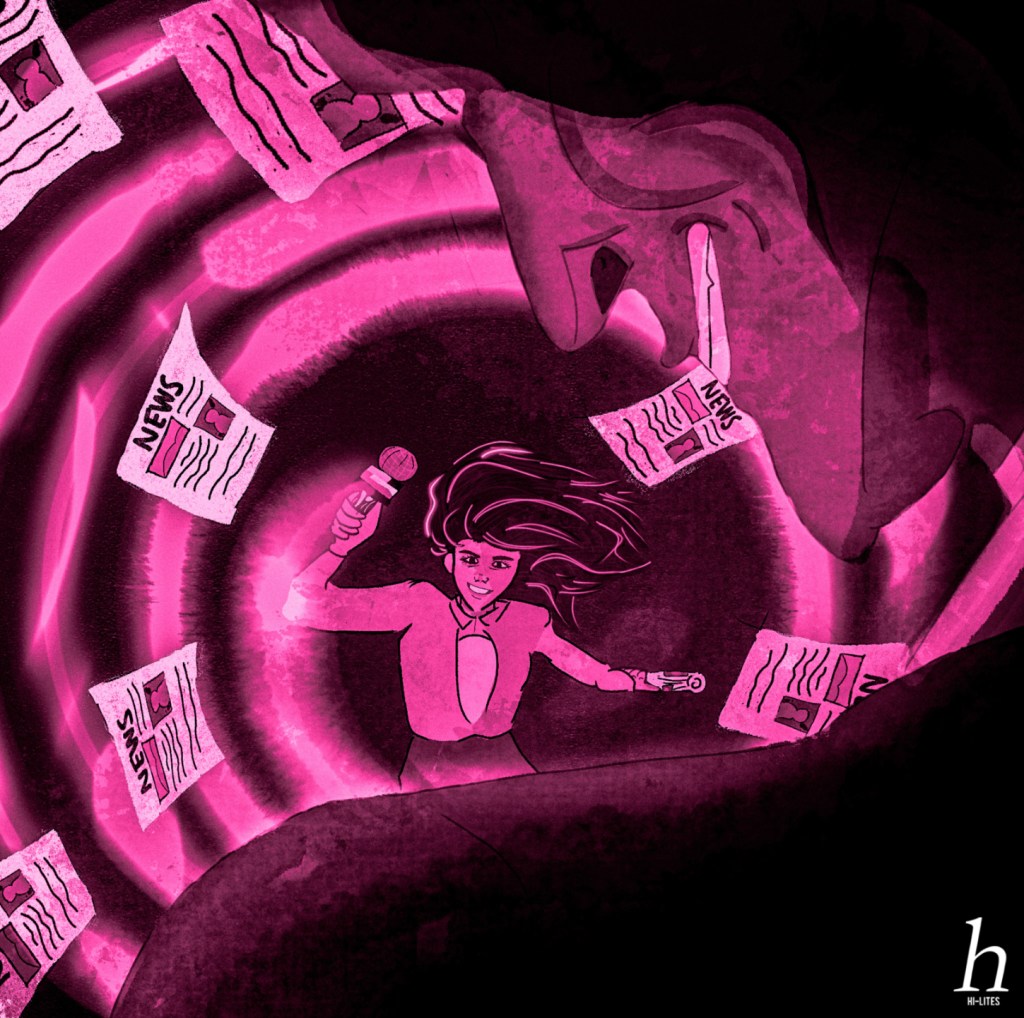
In the media industry, the pursuit and dissemination of truth in service to the public stand as the responsibility of journalists who wield the power of their voices to do so. However, this pursuit becomes a challenge for women journalists in a male-dominated country. With this in mind, we can only ask: What is it like for a woman to use her voice in amplifying the marginalized in a country where men receive more attention and are more likely to be heard?
Women in the Newsroom
While women journalists mostly rule the newsrooms across media platforms, men still dominate as owners and shareholders of the firms they work under. Every day, they face a work environment where men still take superiority and deal with sources who express misogyny, all while armoring themselves with nothing but courage and professionalism in their commitment to truth-telling. In an article by Rappler, journalist Pia Ranada described how some officials tend to compliment her appearance before answering her questions during live press conferences—an approach not seen when the officials speak to male reporters.
Athena Imperial, GMA Integrated News’ senior news correspondent, also shared that she once confronted a police chief for his inappropriate physical touches despite his numerous attempts to deflect the situation. While her fellow reporters attempted to ease the tension by moving her back to the crew cab, it failed to address the actual issue, prompting her to request the desk to not assign her to the police station involved.
These two narratives not only manifest the hurdles of being a female journalist in the country, but also highlight the persistent challenge women face in navigating their way through asserting their professional boundaries and demanding respect in male-dominated environments.
Women’s Struggle for Access
In an interview with Jing Castañeda, ABS-CBN broadcaster and Bantay Bata 163 Program Director, she shared the challenges she has faced as a woman journalist in gaining access to certain stories or sources. For instance, she mentioned that there were instances when sending women journalists to war coverages in Mindanao was “discouraged by top management.” Additionally, having access to sensitive and confidential information was sometimes more difficult for her compared to her male counterparts.
Her encounters led her to describe navigating the news landscape as a female journalist in a country where the scales of attention and credibility often tip in favor of men as highly challenging. “This environment demands not only exceptional journalistic skills but also the courage to push against ingrained biases and stereotypes, paving the way for more inclusive representation.” Castañeda said.
This courage, however, sharpens resilience and hones a unique perspective, enabling them to craft stories with greater depth and sensitivity, especially regarding the often overlooked aspects in mainstream narratives.
Women on Press Freedom (or the lack thereof)
Beyond these narratives, there are also the cases of Nobel Peace Prize winner and Rappler CEO Maria Ressa, as well as journalist and human rights defender Frenchie Mae Cumpio, who have both faced legal challenges in their attempts to speak out against government crackdowns on the media. Maria Ressa has spent several years contending with multiple charges filed during the administration of former President Rodrigo Duterte. As a vocal critic of Duterte and his drug war, it has been argued that the cases against her and the news website Rappler were politically motivated.
On the other hand, Frenchie Mae Cumpio was one of the activists arrested in 2020 during a police raid in Tacloban City. Cumpio and her companions have been detained for four years since their arrest over charges of illegal possession of firearms, a case which has continued to spark controversy regarding the impartiality of the country’s legal system. It is argued that Cumpio, a journalist, was red-tagged, with Presidential Task Force on Media Security (PTFoMS) executive director Paul Gutierrez being accused of labeling her as part of the communist armed struggle.
In a country where free expression feels like a privilege rather than a right, being a journalist is daunting enough. But for women journalists, it’s even tougher. The job goes beyond being heard; it involves reshaping the very dynamics of who gets to speak and whose stories are deemed worthy of attention. For Castañeda, “Advancing gender equality is everyone’s responsibility. There needs to be a paradigm shift by society, especially in FIlipino culture; inclusive programs by the government, private companies and NGOs; and increased investments to empower women economically and to dismantle barriers to gender equality.”
With this, as a country, we should continue to fight for gender equality consistently and relentlessly. It shouldn’t require a commemoration every March to acknowledge the achievements and systemic struggles women face, nor to remind us of the ongoing fight for equality. It entails a consistent effort as we forge ahead, giving our modern-day heroes the recognition and support that they deserve.
 HiLites ASHS