
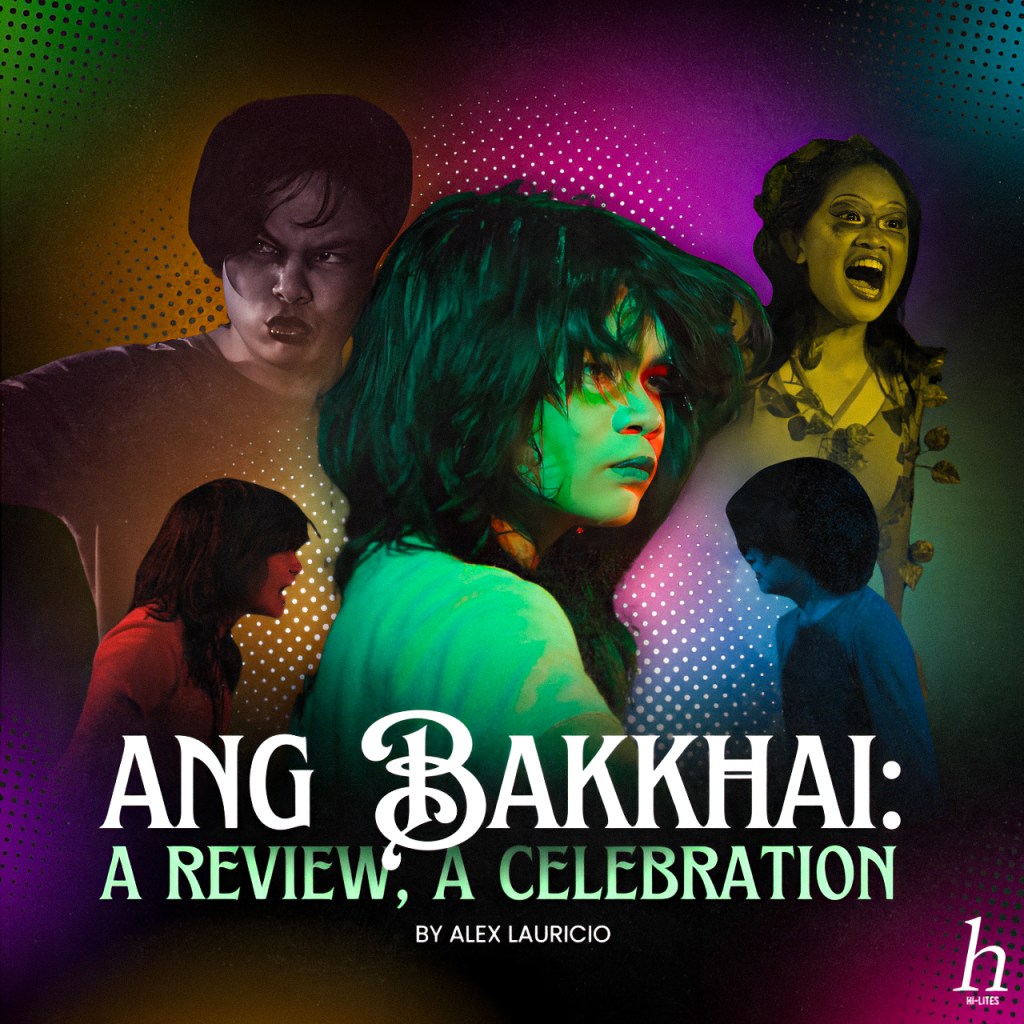
By Alex Lauricio
This article contains spoilers for the Greek tragedy The Bacchae, portrayed and appropriated by the Teatro Baguntao (TBT) in their performance held last April 18-20, at the ASHS Black Box. Although their performance is already over, non-TBT renditions of the play are available online, which you can watch. The play contains mild scenes of gore and violence; you have been warned.
Ang Bakkhai, the Filipino rendition of the Greek tragedy The Bacchae, was performed last April 18-20 in the ASHS Black Box, one of the many plays conducted by the ASHS’ Teatro Baguntao. From colorful depictions of Dionysus’ godhood, to mild depictions of gore and violence, Ang Bakkhai delivers clever storytelling combined with powerful acting.
The all-star cast featured familiar faces in the Atenean community—ranging from TBT alumni, to past generations of actors from the Ateneo Junior High School (AJHS)’s TBT and Dulaang Sibol. These include alumni, G. Ron Capinding, LS-Tanghalang Ateneo Vito de la Cruz, and second-year college student Maliana Beran!
ASHS students, meanwhile, took several major and minor roles in the production, including several TBT members and non-members—Lee Delos Santos, Yael Ledesma, Ian Beriña, Rob Bellarmino, Carylle Bartolata, Jackie Ferrer, Joaquin Delos Santos, Jamil Datudacula, Andrew Fernandez, and Karl Paloma. Opaline Santos, a consultant from De La Salle-College of Saint Benilde, also contributed to the choreography of the play.
Ang Bakkhai is a Filipino translation and adaptation of the Greek tragedy The Bacchae, originally composed by Euripedes in 405 BCE. The ASHS Black Box had rows of black monoblock chairs arranged to imitate an amphitheater, with the ceiling lined up with spotlights that change color, utilizing strobe effects during the play. The Bakkhai wielded staves made with recycled materials, and their costume was reminiscent of rave outfits that complemented the expression of the Bakkhai.
Synopsis
Dionysus, played by Yael Ledesma, is a Greek god popular for his revelry to mortals’ primal desires; fertility, alcohol (wine), orchards, and revolt are all things that the god is well-celebrated for. His Roman counterpart, Bacchus, is no different—and while many of us associate his godhood with images of primal and animalistic joy, there lies a savage counterpart to these celebrations, an element that is slowly uncovered by TBT’s Ang Bakkhai.
The aforementioned Greek god pushes human primality to its limits, sending off his insanity-driven menagerie of women to Thebes in an effort to spread awareness of Dionysus’ influence. The women, captured by King Pentheus played by Ian Beriña, converted a handful of people to be followers of what he described as a cult following of Dionysus, a deity that Thebes rejected at that time.
This comes after Dionysus hears rumors that he is not a god—rather, a mere mortal born from Semele and Zeus. The Bakkhai are Dionysus loyalists, dancers that can fight armored Greeks with bare fists and the savagery blessed upon them by their deity. It is known that they were all women, and the play contains feminist undertones of subjugating male authority—particularly, in the case of the Bakkhai defying the male-dominated rule of Thebes.
After the guards capture Dionysus, they take them to Pentheus. Dionysus breaks free from his shackles and sends forth a fire and an earthquake that ravages Pentheus’ palace. Afterwards, reports of the Bakkhai came after the guards, who were pursuing them in the mountains, fled back to Thebes after the women slaughtered the cattle of shepherds in Thebes. In an effort to defeat the Bakkhai, a disguised Dionysus persuades Pentheus to dress like one of the women, and spy on them in the mountains.
Little did Pentheus know, this was part of Dionysus’ plan to kill him as after leading him into the woods, a dramatic performance from TBT’s Lee Delos Santos, Vito de la Cruz, Carylle Bartolata, and Jackie Ferrer ensued with a dazed Pentheus. A ritualistic Dionysian rite, after being intoxicated with Dionysus’ power, Pentheus was then targeted by the maddened Bakkhai, and his body was shortly torn to shreds.
It was said that no two pieces of his body were ever found together, which made the reconstruction of his body quite difficult, if not gruesome.
The play was dedicated to the late Sir Erwin “Bok” Pioquid, who was the organization moderator of TBT for at least twenty years. His contribution to the growth and formation of TBT is carried on to future generations of actors. Ang Bakkhai ends with a voiceover of Greta Thunberg’s address at the 2019 World Economic Forum, played over pictures taken by Sir Bok, where Greta talks about the urgency of climate change action and the need to move forward with a green mindset.
The TBT production showcased the remarkable talents that ASHS students have—spinning a Greek tragedy with Filipino elements, supplemented by Atenean excellence. This is but one of many works that will inspire future generations of Atenean actors, carrying the tradition and memories of TBT, and delivering them to the audience—like you and me.
 HiLites ASHS