
By Daniele Santos
When the Commission on Elections (Comelec) received a PHP12 billion budget increase under the item ‘conduct and supervision of elections, referenda, recall votes, and plebiscites,’ the issue reopened the unresolved issue of charter change this year. However, many citizens are unaware of what actually occurs during a charter change.
Charter change, or constitutional reform, refers to amendments in the 1987 Philippine Constitution. There are three methods through which the government can push for Cha-Cha. The Constitution Assembly (Con-Ass) happens by having three-fourths of Congress members convening in Con-Ass, with the body gaining the ability to propose both amendments and revisions. On the other hand, the Constitutional Convention (Con-Con) entails elected delegates and representatives proposing revisions and amendments. Lastly, the People’s Initiative (PI) requires the votes of 12% of registered voters before pushing for amendments alone.
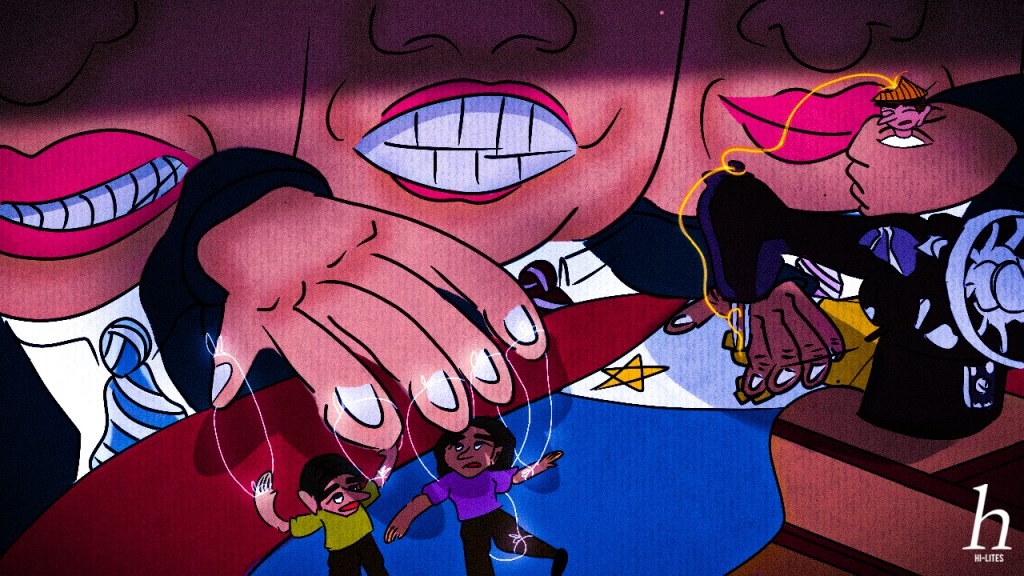
Over time, a country is bound to change and develop, including its people and citizens, particularly through their lifestyle. Moreover, it is worth noting that the Philippines’ Constitution is already 37 years old. With that, as a country evolves, its Constitution must adapt accordingly to remain relevant to the current context. It is essential to recognize that the goal of a charter change should be people-centered, with the aim of improving the entire country. However, this is not the case with the Philippines, as every attempt to push for a charter change is consistently met with resistance from its people.
The Bloody Pillars of the PH Constitution
It seems as though the saying, “history repeats itself,” rings true, as the family of Marcos, the very pillar upon which the 1987 Constitution was built, was re-elected as the President of the Philippines last May 2022.
The 1987 Constitution of the Philippines was created after the country broke free from the bloody shackles of decades-long Martial Law under the dictatorship of former President Ferdinand Marcos Sr. In 2018, Dante Gatmaytan of the University of the Philippines College of Law believed that the resistance to any charter change attempts is rooted from the Marcos dictatorship. “Our skepticism is rooted in the Marcos era where the dictator used constitutional change to duck term limits. Since that trust was betrayed, politicians have not earned our respect,” Gatmaytan asserted.
With that being said, one cannot really blame the Filipino people for distrusting every administration’s attempts at charter change, especially considering the country’s history of a President being re-elected. In fact, Filipinos must be cautious of such attempts from the government as they may potentially lead to corruption, selfish intentions, dictatorship, and changes in the 1987 Constitution that do not prioritize the people’s welfare. Yet, despite the repeated attempts at charter change in the Philippines’ history, Filipinos seem to be effectively resisting these efforts, recognizing that none of them bring benefit or greater good for the country and its citizens.
The Tales of Failed ‘Cha-Cha’ Attempts
Numerous attempts at charter change have been made since it came into full force on February 11, 1987. This means that from the Ramos Administration to the Duterte Administration, the term “charter change” has not retired from being the talk of the town.
Previous attempts at charter change varied, ranging from amendment for Presidential re-election under the Ramos Administration to the lifting of restrictions on foreign ownership of businesses under the Estrada Administration, and from pushing for federalism and liberalization of the economy under the Arroyo Administration to revising the 1987 Constitution for federalism under the Duterte Administration.
It is undeniable that every administration seems persistent in raising the issue of charter change in any way they can. However, the question lies in whether or not these proposed amendments and revisions are truly people-centered. For instance, allowing the President to be eligible for re-election creates breeding ground for corruption, akin to how the dictatorship of Marcos Sr. proliferated and adversely affected the lives of many Filipinos.
On the other hand, lifting the restrictions on foreign ownership of businesses and liberalizing the economy presents opportunities for foreign investors and their businesses to flourish, potentially overshadowing the development of local businesses, especially small and medium-sized enterprises. This act might result in Filipino businesses lagging behind those of large foreign enterprises. Additionally, introducing federalism, a concept unfamiliar to many Filipinos, might receive significant pushback. Transitioning to a federal system requires revising the entire 1987 Constitution, impacting not only the overall governmental system of the country but also its economy and societal processes.
The absence of people-centered intentions behind previous attempts at charter change raises questions about whether these attempts truly aim to serve the Filipino people or merely serve the best interests of those in power. Now that the unsolved case of charter change has resurfaced—how does this latest attempt at constitutional amendment actually differ from past efforts?
The Return of ‘Cha-Cha’
On January 15, Senate Leader Juan Miguel Zubiri released a statement saying that the upper chamber of the Congress would now take charge of reviewing proposed amendments to the economic provisions of the Philippine Constitution. “The President agreed with us that the proposal was too divisive and asked the Senate to instead take the lead in reviewing the economic provisions of the Constitution. In this way, we can preserve our bicameral nature of legislation,” Zubiri added.
Moreover, Senate Leader Zubiri mentioned that the proposed amendments would focus on parts of Article 12 (National Economy and Patrimony), 14 (Education, Science, and Technology, Arts, Culture and Sports), and 16 (General Provisions). The proposed ‘economic’ amendments aim to loosen the restrictions on foreign investments in the industries under the articles mentioned.
However, the issue with this new attempt at charter change is its similarity to previous attempts: opening the country to more foreign investments. Yet, this action proves problematic as it risks overshadowing local enterprises, impeding the development of Filipino businesses.
Indeed, history seems to be repeating itself. This year’s attempt at charter change mirrors proposals from previous attempts, leaving Filipinos disillusioned by the facade of empty promises while those in authority pursue their own selfish intentions at the expense of the very people who put them in power.
A People-Centered Charter Change
It is no surprise that the government received backlash over another attempt at charter change. If the government wishes to alleviate public resistance to each attempt, they must first reform themselves and propose people-centered amendments that prioritize serving the country. This could include refining agrarian reform, prohibiting political dynasties, strengthening the rights and protections of Filipino workers, and more, all of which focused on the development of the very people they are meant to serve first and foremost: the Filipinos.
The government must realize and remind themselves of the true purpose behind changing the Constitution. Are they altering it for the benefit of the nation or for their own interests? Is this move a genuine pursuit of change, or merely a pursuit of self-serving agendas?
As long as the government cannot provide answers to these questions and propose amendments centered on the Filipino people, the issue of charter change will continue to remain unsolved.
 HiLites ASHS