
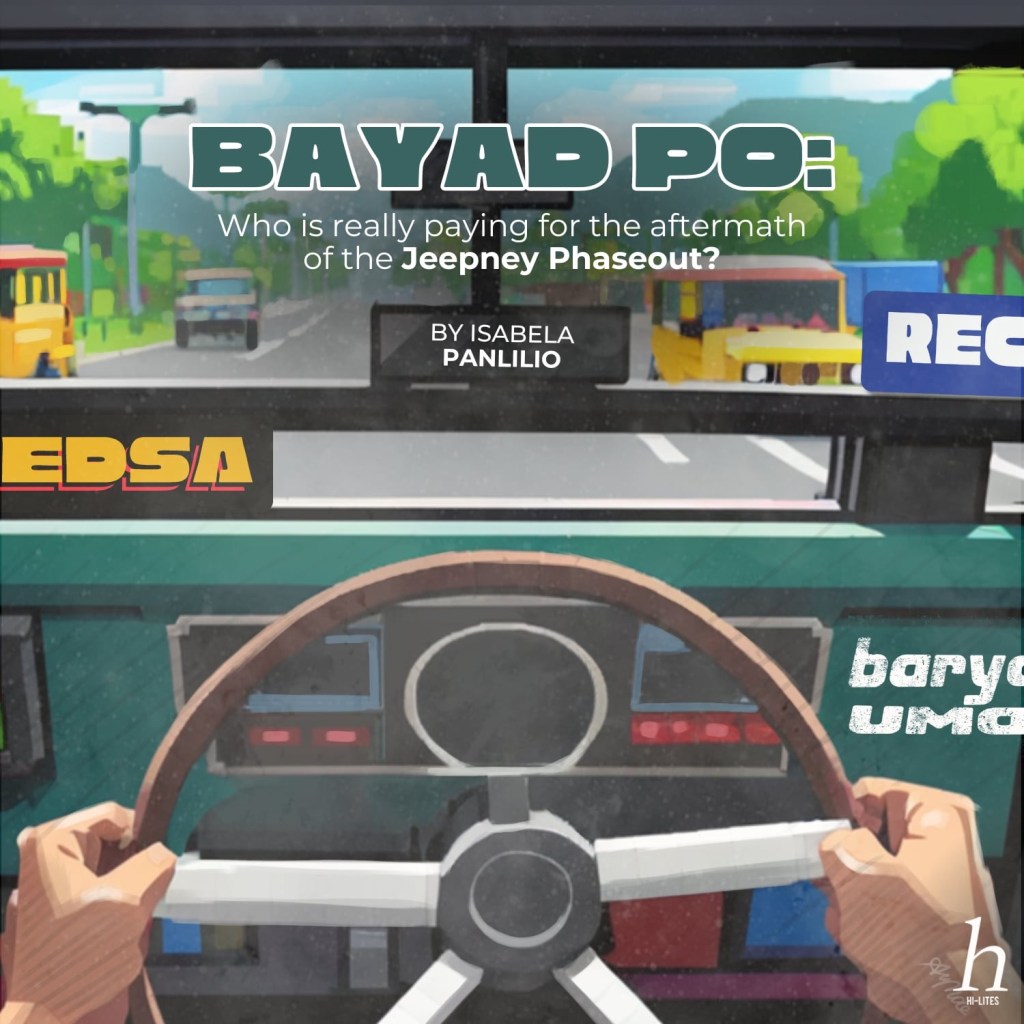
By Isabela Panlilio
With the passing of the jeepney consolidation deadline on April 30, 2024, ultimately solidifying the PUV (Public Utility Vehicle) modernization program, it is imperative that we critically evaluate the current state of the country’s public transportation system, particularly for jeepney drivers and commuters, in order to discern who will truly bear the burden of the strain this program will bring.
Kung Maganda…
In a series of interviews with various commuters, it became evident that those who acknowledged their lack of knowledge of the PUV Modernization Program were also the ones who responded with “okay lang naman” when asked about their views on the said program. Jayboy, a working commuter, mentioned that the modernization of our beloved jeepneys would lead to more comfortable, efficient, and sustainable modes of transportation. The intentions of this program were just; however, the government’s attempt at developing jeepneys, with the experiences of commuters and drivers in mind, has ironically backfired on the sectors they aimed to assist. The common commuter mindset of “kung okay” or “kung maganda” may hold us back as it lacks an element of critical thinking, something crucial for Filipinos, especially concerning programs like this. This leads us to ask, are the modernized jeepneys under this program truly beneficial for our country? Will they allow us to move forward, or are poorly planned programs such this only holding us back from progress at the expense of both commuters and jeepney drivers?
Bayad Po
Indeed, it is at the expense of Filipino commuters and drivers alike that this program is now set in stone. The jeepney modernization program will greatly impact an estimated 28.5 million commuters who rely on jeepneys as their only means of transport. One of these commuters is Mx. Asuncion, a senior citizen, who mentioned in an interview that the current change in fares has harmed his finances, as he depends solely on his pension and donations to survive. “Pero yung bayad, sana hanggang dito na lang at hindi na aakyat kasi kawawa naman yung ibang tulad ko na walang trabaho. Diba ang hirap makakuha ng pang-pamasahe, kasi nga senior na kami,” he explained.
This fare increase has not only affected the working class but also the student-commuter population. This includes the likes of Steph and Annika, who noticed the increase at the start of the year. Yet, jeepney fares will continue to skyrocket to Php 40 with the implementation of this program, further straining Filipino commuters, who already struggle with a two-peso increase. The majority of these commuters are either minimum wage workers or unemployed, and with the ever-worsening inflation rate in our country, the Php 610 they earn a day will not be enough to cover all their basic needs. On the contrary, Marco*, another working commuter, mentioned, “Okay naman. Tumataas naman talaga ang pamasahe.” However, an increase like this will greatly affect commuters, especially if the minimum wage does not increase as well.
These commuters also struggle with accessing jeepneys, especially since recent transport strikes have led to a scarcity of jeepneys. Maxine, a student commuter from UP Manila, recounts her experience, saying, “Nung nag phase out ‘yung jeep, pinilit pa rin kaming pumasok, so we had to find a way. We had classmates who were forced to use tricycles. May isa akong classmate, 300 yung singil sa kanya, kahit 2km yung distance nila.” Moreover, with the PUV Modernization Program, over 500 PUV routes are threatened by the drastic reduction of jeepneys, resulting in the unemployment of almost 10,000 jeepney drivers, as well as increased competition for commuters traveling from place to place.
Piliin Mo ang Kapwa Mo Pilipino
Mx. Casinas, a jeepney conductor, stated that many drivers are supportive of the modernization of jeepneys, understanding the necessity for more sustainable and efficient vehicles—it’s seen as a part of our growth as a country. However, Mx. Casinas pointed out an important sentiment by saying, “Ang ginawa nila, ang gusto nila ay galing China ang sasakyan, na nagkakahalaga ng 2.8 million. Bakit hindi natin gawin na gawang atin?” Such high costs severely affect small businesses, especially because most drivers are already facing financial struggles.
Adhering to the PUV modernization program is a gamble for drivers, as their success with jeepney consolidation remains uncertain. Another reason for many drivers being on strike is the difficulty of meeting the requirements to establish a legal jeepney cooperative of more than 15 jeepneys. Under this program, these cooperatives would be responsible for securing a loan from the bank to purchase modern jeepneys. However, there is a lack of clear guidelines on how these jeepney drivers would generate sufficient income to repay the loans for these Php 2 million minibuses.
Right now, being able to afford modernized jeepneys is one of the biggest concerns with the PUV Modernization Program, with jeepney drivers earning a daily salary of only Php 2,500. This is not enough to cover their debts, let alone their basic necessities. With extremely high jeepney fares, there is a huge risk of fewer commuters opting for the modern jeepneys, further straining drivers’ income, which is dependent on the number of passengers they can attract each day.
One issue for Mx. Casinas is how the government is choosing to import these modernized jeepneys from China, which somehow diminishes the Filipino essence and culture that our traditional jeepneys once represented. The phaseout of jeepneys brings a loss of our own Filipino identity and culture, especially because the jeepney has become a beloved emblem for locals and tourists alike. Mx. Casinas emphasized that, “Parang tinatanggalan mo na ng karapatan ang mga maliliit na negosyante na umangat.” These jeepney drivers are being denied the opportunity to thrive in society due to a systematic bias favoring big businesses. The PUV modernization program only gives more power to large corporations, giving them control over the country’s transportation system.
One local company offering these eco-friendly jeepneys is Francisco Motors, which offer modern jeepneys that are cheaper and studier, all while maintaining the familiar identity of traditional jeepneys. These jeeps cost Php 985,000, which is significantly less than the imported jeepneys being offered by our government. Aside from being cheaper at less than a million pesos, if the government chooses to partner with Francisco Motors, numerous job opportunities for vehicle production would also open up. This only shows that our government must choose the Filipino masses over any big corporation or foreign country. However, there is still no evident support for this more Filipino-centric way, which would allow these modernized foreign jeepneys to overtake the bright-colored ones—the vibrant Filipino culture of which these imported jeeps will never be able to encapsulate.
Empty Promises
One of the main culprits for the ongoing struggle for both commuters and drivers is the empty promises and lack of support from the government. As Mx. Asuncion says, “Where is the change our government is talking about?” Whatever our government is currently doing, concrete change is still absent for the Filipino masses. The modernization program lacks structured guidelines to address the many loopholes present in the current system. Often, this lack of concrete change is rooted in the self-prioritization of many government officials who put themselves first before the people they’re supposed to be serving. As mentioned by Minority Rep. France Castro, this modernization program will impact 28.5 million commuters and 10,000 drivers due to a lack of a proper transportation system in the country, and yet our own President uses helicopters to avoid the traffic. Quite literally, people in positions of power put themselves and their interests above ours—above the desperate cries of the Filipino masses for our government to prioritize their fellow Filipinos.
This program promises a better transportation system, yet it finds itself lacking in so many different aspects. The masses, specifically the commuters and jeepney drivers, must be the priority of the program. They should be the ones whom this program would help to thrive. A simple “okay naman” will never be enough to justify this program as this is a program, as it deals with the livelihood and well-being of millions of Filipinos. This program must be evaluated critically, with more proper and solid structures in place. The implementation of the jeepney modernization program should be better executed—taking into account the perceptions, opinions, and views of jeepney drivers and commuters alike so that this program, which has the potential to boost our transport system, benefits the Filipino masses without detriment.
 HiLites ASHS