
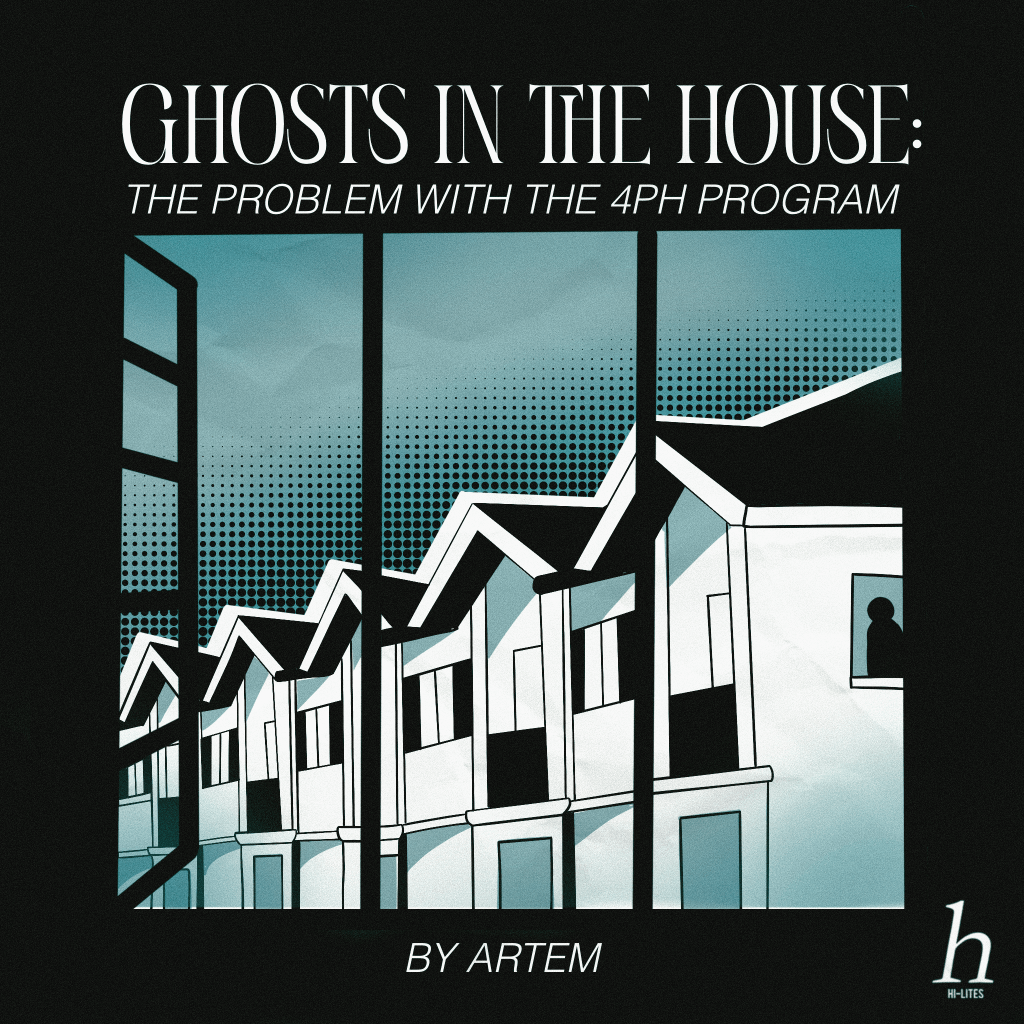
By Artem
How strong must foundations be if the grounds they are on are too unstable?
The housing crisis in the Philippines is rooted in the fact that most people cannot afford to buy proper houses or the land needed. To address this, President Bongbong Marcos’ flagship program, the Pambansang Pabahay Para sa Pilipino (4PH), aims to reduce the 6.5 million housing backlog. This will be done by building 1 million units a year. The issue with this, however, is that it is anti-poor, despite being supposedly for the impoverished, and unrealistic given the foundations of the plan.
Planned Structure
Contrary to numerous posts made by netizens, the 4PH is not free. Even as far back as 2022, the Department of Human Settlements and Urban Development (DHSUD) clarified that this program doesn’t offer housing free of charge. However, one of its goals is to provide affordable housing to Filipinos, as it is open to informal settler families (ISF) and low-income workers. The DHSUD also mentions plans to build 1 million units per year to expedite the solution process.
During the first year of the project, a total of 165,498 housing units were built. As of the end of 2023, there are 17 ongoing projects in different stages of development all around the Metro.
There are ongoing revisions to the regulations governing the program, particularly regarding price ceilings. In October 2023, the DHSUD raised the price ceilings to stimulate more deals with the private sector. Some changes include:
- Socialized subdivision projects: The price ceiling has been increased to Php 850,000 from Php 580,000, with a minimum floor area of 28 sqm and a loft of at least 32 sqm.
- Four-storey building socialized condominium projects: Prices are set at PHP 933,320 for 22 sqm, Php 1,060,591 for 25 sqm, and Php 1,145,438 for 27 sqm.
- Five to nine-storey buildings: Prices range from Php 1 million for 22 sqm, Php 1,136,364 for 25 sqm, to Php 1,227,273 for 27sqm.
- 10-storey buildings and above: Prices are approximately Php 1,320,000 for 22 sqm, Php 1,500,000 25 sqm, and Php 1,620,000 for 27 sqm.
With all of these adjustments, individuals can now avail themselves of units priced up to about 1.8 million, depending on the type of unit they choose.
Despite the seemingly slow process, Secretary Jose Rizalino “Jerry” Acuzar of DHSUD expressed optimism for the further development of 4PH in 2024. “I am confident that 2024 will be a milestone year for our President’s Pambansang Pabahay. Slowly but surely, we are now reaping the fruits of our labor,” he stated.
Cracks in the Foundations
No matter how thoughtful the 4PH program is, there are still some details that seem to have been overlooked. Socialized housing is meant to serve the underprivileged and those without a home. Knowing this, isn’t it important to consider the financial resources and capabilities of people to afford a unit?
Even with the presence of subsidies and loans, pushing through with a plan like this seems inconsiderate. This also contradicts the very goal of the program, which is to provide affordable housing while addressing the backlog. The current budget for subsidies is Php 1.5 billion. However, this isn’t sufficient to support the Filipinos hoping to avail of the units. According to Alliance of Concerned Teachers (ACT) Representative France Castro, aiming for such a large-scale project without adequate funds won’t truly assist Filipinos. “The subsidy we’re proposing is Php 1.5 billion. If you divide that into your target one million [beneficiaries], each one would only receive Php 1,500 for the interest. Isn’t that small? That is why I believe our target one million beneficiaries is wishful thinking,” she further explained. The monthly amortization is around Php 4,500, a number that isn’t necessarily small, especially during such challenging times. For most Filipinos, earning that much takes several days, and they still have other essential needs to consider, such as food and electricity.
Aside from this, the creation of these houses required the relocation of informal settler families (ISF). According to Acuzar, there is a current strategy in place for their relocation. Instead of off-city relocation, it will be in-city. He states that this approach will minimize the impact of displacement and ease the adjustment for families without jeopardizing their current livelihoods and employment.
However, this raises numerous concerns. Kalipunan ng Damayang Mahihirap (Kadamay), an urban poor group, is calling out to officials to hold consultations with ISF regarding their concerns with the 4PH program. Despite the 4PH’s goal to provide a home to those less fortunate, they mentioned that it becomes immediately ineffective given the prioritization of other projects such as “Build Better More” which still keeps them at risk for losing their current homes and displacement.
With this, it is needless to say that there are conflicts with the implementation of the 4PH and other goals the government has in place. Kadamay also points out that the current “anti-poverty” projects, including the 4PH, the government is pursuing are “merely stop-gap solutions with no real laid-out answers” in alleviating poverty. Kadamay’s Secretary-General Mimi Doringo says, “ We want to hear real solutions to poverty in the upcoming SONA, lack of sufficient income and employment, and housing insecurity. Not just rebranding and changing logos to deceive the public.”
Fixing the Backbone
As you build and build higher without bringing those on the ground with you, they end up buried underneath it all. These plans are intended for the poor and homeless – so why make them unattainably high?
Secretary Acuzar even goes so far as to suggest that Filipinos are lazy if they can’t afford a unit. However, this is not a matter of laziness; it’s about facing unrealistic expectations and goals while ignoring the hard truth. The 4PH program is designed to help Filipinos attain affordable and sustainable housing.
But like dipping a wound in salt, these prices serve as painful reminders of everything they can’t afford. Burying them under these expectations and possible debt becomes inevitable if their concerns continue to be disregarded. Considering their backgrounds, livelihoods, and capabilities is essential if this program is to fulfill its primary goals and actually succeed.
What is the point of building houses no one can live in? The 4PH program, though well-intentioned, seems to have forgotten what it is made for. Continuing in this manner, building on top of people instead of for them, will only result in empty houses filled with their ghostly pleas.
 HiLites ASHS