
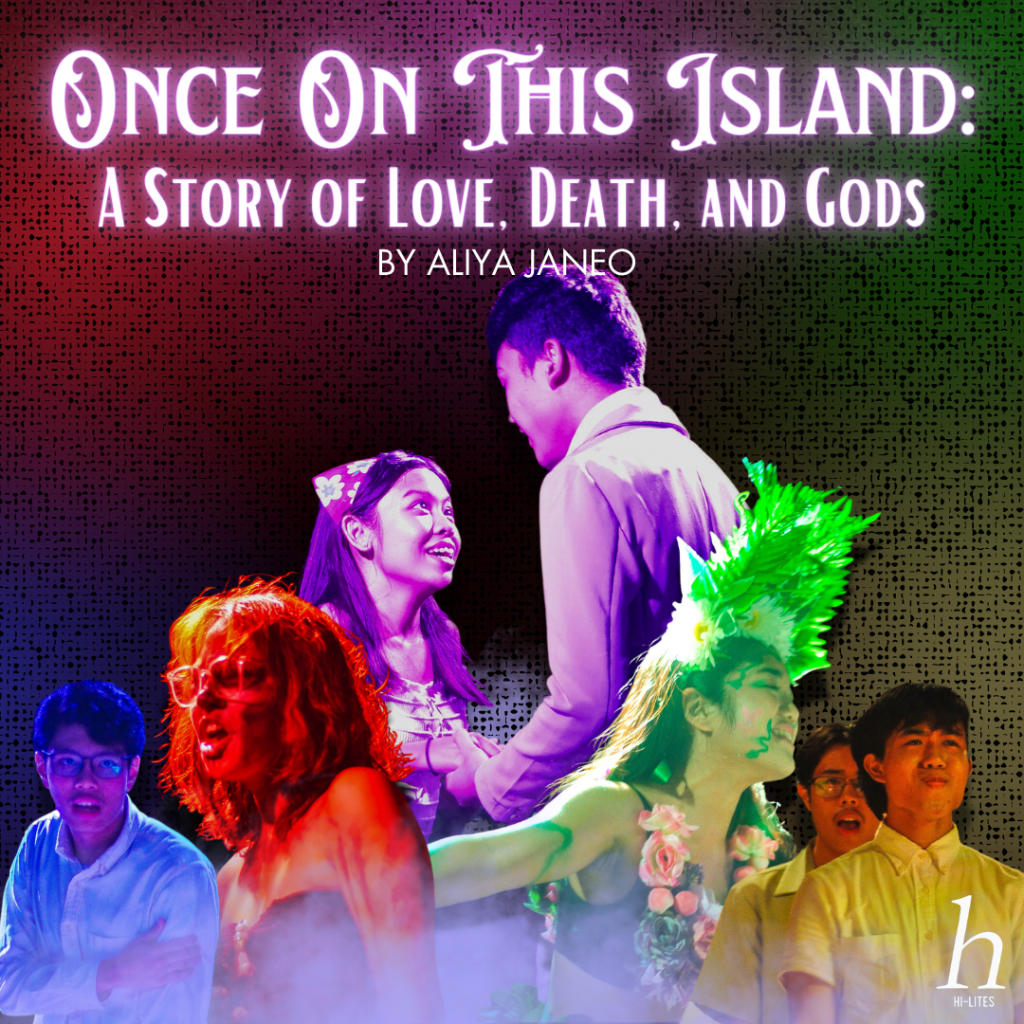
by Aliya Janeo
This play review contains major spoilers for the play, Once On This Island performed by BTTA from May 21 to 29, 2024. Although the show’s run has come to a close, you can still listen to the soundtrack on streaming platforms like Spotify, Apple Music and YouTube. The play contains themes of death— and depending on the production, may utilize loud sounds and flashing lights in their performance; as BTTA did. With that, let the show (review) go on!
An island sits in the middle of the sparkling sea, one they call The Jewel of The Antilles.
Created by Lynn Ahrens and Stephen Flaherty, Once on This Island’s story follows an orphan girl named Ti Moune (which quite literally means ‘small orphan’) as she goes on a journey influenced by the gods; the same gods wagering which one’s influence will prevail over the other. The play can be encompassed into the title seen above– a stream of love, a gamble with death, and a sprinkle of divine intervention here and there.
A Summary
The story takes place on an island divided into two completely different groups, residing on opposite sides of the island: the grand hommes, who are locked behind the iron gates of luxury of the Hotel Beauxhomme; and the peasants, who work all day in the hot, burning sun. While money and social class is what makes the world of the grand hommes turn, the island’s gods are what keeps the peasants going strong.
The four deities that rule over nature, the seas, love, and death; respectively express favor in an orphan— watching her and guiding her throughout foundational parts of her life. Together, the gods have chosen a young girl, Ti Moune, and have brought her to a peasant family to live a peasant life.
As Ti Moune grows up, she yearns to find her purpose in life; which is soon presented to her in the form of a young aristocrat, caught in a car accident amidst a heavy storm. Ti Moune nurses the boy, Daniel, back to health and is convinced that her purpose is to love and save him. But everything comes at a cost— and healing Daniel entails Ti Moune to exchange her own life for his; as she pleads to death when it appears to take Daniel’s life. Through bargaining with the demon of death themselves, the love-blind girl offers her soul, and Daniel is hers… or is he?
But as the troops of the grand hommes come to collect a healed Daniel, Ti Moune is determined to follow him and fulfill what fate has entailed for her: to love him. The gods follow Ti Moune on her journey to reunite with Daniel; and once she enters the hotel’s iron gates, and in his arms, she’s at peace.
Peace? Oh how foolish Ti Moune was.
Ti Moune may have charmed those at the Hotel Beauxhomme’s ball, and even shared a dance with Daniel; but it had not prepared her for the news that was to come. At the ball, it’s revealed that Daniel had already been betrothed to his childhood friend— and they were to marry in a matter of days. The love Ti Moune and Daniel had for each other could not trump over a several years’ long promise of marriage. Even if Ti Moune was still welcome to remain in the hotel, it would not fix her broken heart.
Although she had Daniel’s thoughts, she did not have his heart. A person of her social class was not to love someone like Daniel, who stood on top of the social hierarchy as a descendant of the island’s founder. As much as Ti Moune strived to prove her love for Daniel, it wasn’t enough to rewrite the stars that were already in place; let alone go against the agreement the demon of death and Ti Moune made to save Daniel’s life. Ti Moune ultimately pays the price of her bargain and falls before the iron gates of the Hotel Beauxhomme.
As Ti-Moune re-entered the embrace of the divine, the gods turned her body into a tree—- a tree that kept the iron gates open for eternity. The tree looked over Daniel and the kids he would have; it was a symbol that united two different worlds for a lifetime.
A Play Fit for The Gods
Directed by Arjo Mejilla and co-directed by Therese Syquia, The Broadway Theatre Troupe of Ateneo (BTTA)’s rendition of Once on This Island runs for 1 hour and 30 minutes maximum and follows a blank ticketing system, wherein the audience decides how much they pay depending on how much they enjoyed the show. There is no entrance fee, and audience members can give out a few coins and bills depending on how they would rate their experience.
The play showcases exemplary vocal prowess from each individual performer, as seen in how well they can portray the nature of their characters and roles through their voices alone. This is seen through how the deities of nature and love have more soft, yet just as powerful voices as stronger-pitched characters like the deities of death and seas.
Aside from the impactful voices, the utilization of the lights accentuates each character and amplifies the emotions in every scene and song— whether they’re flashing to display the chaos of Ti Moune roaming a market; or keep a red hue to make the deity of death seem more intimidating or unnerving.
Moreover, the costumes and set design are simple yet effective. The former shows exactly who each character is and reflects their personalities and identities— seen the deities’ more extravagant makeup compared to the mortals’; and the elegance in the grand hommes’ outfits beside the peasant’s more rural clothing. The latter sets the stage well to transport the viewer to a new place, something the leaves and rope stuck to the walls and roof of the black box can attest for.
With this, the production shows how BTTA makes the absolute most of their members’ talents, along with every opportunity and resource accessible to them. This is not only seen through how the troupe uses the space they were given and the clothing they had on-hand or made themselves— but also through how each cast member is capable of playing a different role per show.
The entire show, alongside every thought and idea put into the making of it, is a product of the versatility and multifacetedness of the organization and its members.
To bring the audience into their fantasy world, BTTA offers an immersive experience, specifically through the play’s seating. Seats are placed on all sides of the black box, which gives the cast the middle of the room as a stage. Furthermore, a small number of audience members are given the opportunity to sit in the middle of the stage (the floor) — front and center to witness all of the action, wherein they get to interact with cast members as they glide around the room to set the scene. But the interactive experience is not exclusive to those seated in the center, as cast members will still engage with those also in the front rows.
Then again, wherever you’re seated, you’ll still have a great, exciting experience nonetheless. However, if you want to enjoy the show without having to interact with cast members, they’ll respond to an audience member tapping them on the shoulder as they come to their area to interact, as a sign to not engage with you and let you sit back and watch.
Overall, the play is a showcase of theater excellence and shares the vibrance of show business to each individual audience member. BTTA’s Once on This Island is both an uplifting and grief-filled play that showcases the product of the troupe’s months-long commitment to providing entertainment to audiences and a medium for everyone to let out their inner bata.
 HiLites ASHS