
by Glaiza Salanio
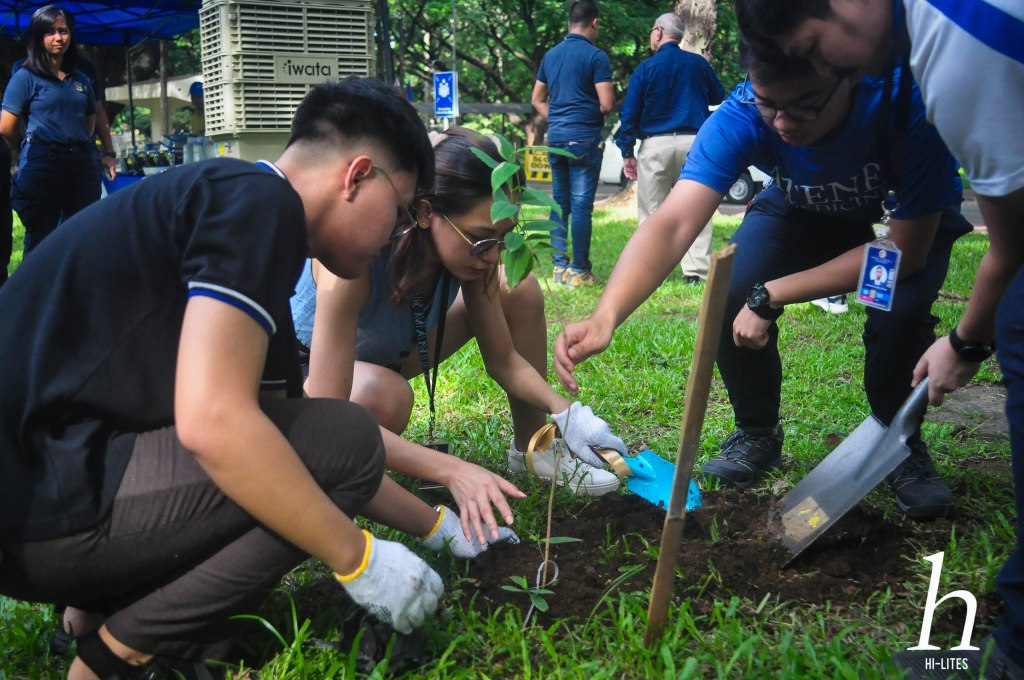
The Ateneo community; composed of students, staff, faculty, and administrators, gathered at the Ateneo de Manila University’s Cervini Field to participate in a tree-planting activity organized by the Facilities Management Office on Friday, June 28.
Joe Mari Fulgencio of the group Philippine Native Tree Enthusiasts also joined them, and he discussed in his opening speech the value of planting native Philippine trees rather than invasive ones like Mahogany and Acacia.
“First is to introduce our native trees, especially to our students. Because right now, yung panahon natin ngayon is hindi na ganoon kakilala ng mga Gen Zs or Millennials yung native trees natin. And at the same time, we are promoting it for reforestation and para makilala yung identity natin as Filipinos. So this one, usually itong 10 plants na ‘to are flowering trees. So we are promoting it para magamit siya for our landscape purposes,” he said, explaining the objectives of the event.
Ecological benefits
Arangen, Baguilumbang, Malabulak, Takulaw, Anilau, Salingogon, Tiagkot, Lipote, and Pamitoyen were among the trees planted in the Cervini Field.
These native trees are known for their nitrogen-fixing capacity, as their roots provide nitrogen to attract good bacteria that are helpful for the soil.
They also support each other through a mycorrhizal connection to provide the adequate nutrition needed by another tree, proving the importance of planting different species of native trees together.
In addition, these native trees are also fruit-bearing, which can attract native birds around the university.
Lipote, one of these trees, offers numerous benefits: it attracts birds and serves as their habitat; aids in river restoration; provides slope protection; helps prevent landslides; and its leaves can be used as medicinal herbs to lower blood pressure and alleviate pain.
On the other hand, Baguilumbang seeds are valuable for their high oil content, which can be utilized as biofuel and massage oil.
Lastly, Malabulak’s flowers are versatile for medicinal use, known to relieve headaches and stomachaches, and even used to add sweetness to dishes.
“I think it’s very important kasi tayong mga students naman mostly ang nagbebenefit,” Jezrel Bugtas, a student from the Ateneo School of Medicine and Public Health, shared.
“Biodiversity is very important kasi taga-UP Diliman ako and itong Diliman ang magagandang campus because maraming puno. So makikita mo kapag maglalakad-lakad ka rito and sa UP, malamig. It’s one of the effects or benefits of tree talaga. Secondly, yung medicinal parts. Maraming medicinal trees na puwede kang kumuha,” he concluded.
As part of the university’s tree-planting program, 205 new trees will be planted throughout campus in the upcoming months.
The Jesuit Residence Forest, the Arboretum, East Field, the Grade School Parking Lot, and other locations will be among the spaces.
 HiLites ASHS