
by Aliya Janeo
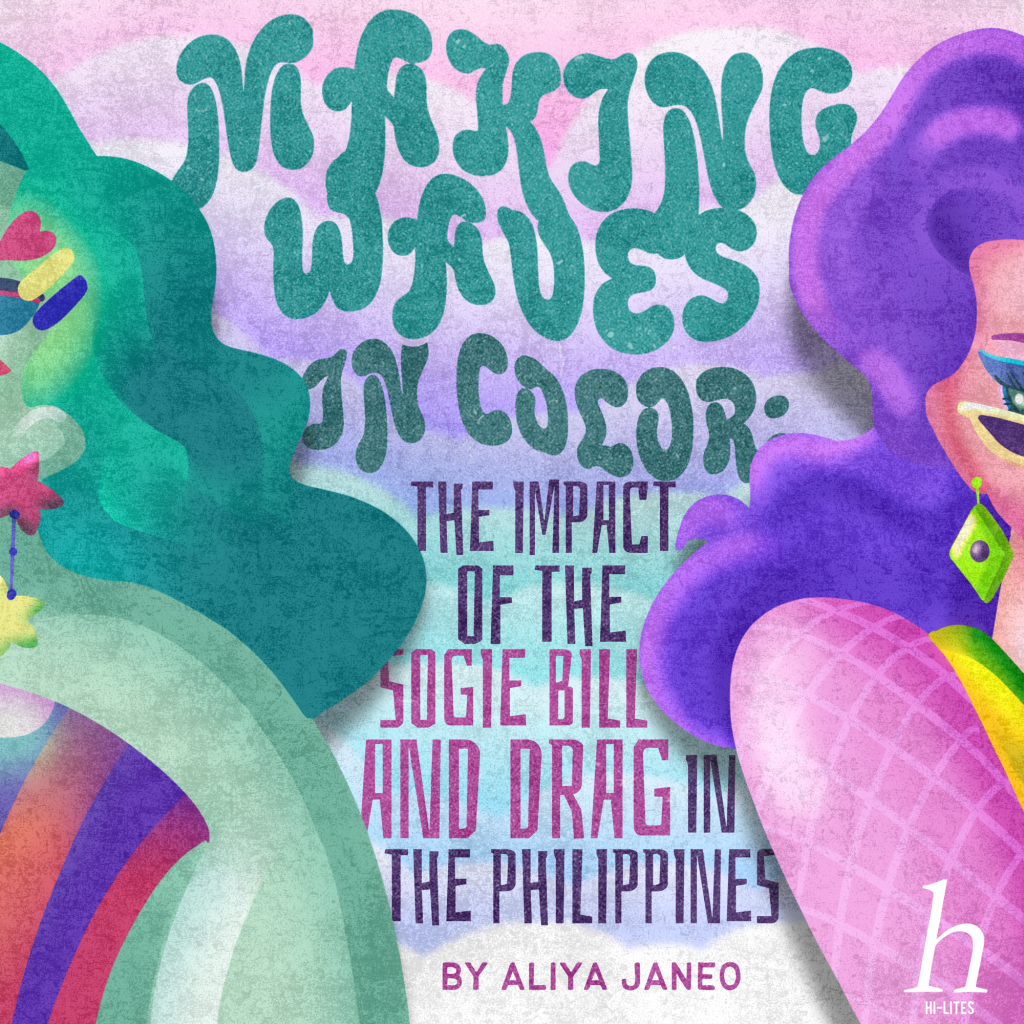
Once Pride Month ends, does this entail that the celebration of it should stop? Quite the contrary.
Pride has first and foremost, always been a protest. The celebration of one’s identity has been rooted in the fight for equality stemming from the spark in the queer rights movement— The Stonewall Riots. Since then, there have been celebrations of pride all around the globe, and it just so happens that in the 1990’s, the Philippines was the first country in Asia to celebrate pride.
Something that has also been rooted in the art of protest, is drag; as drag performers have always been at the forefront of the protest for queer rights. Drag, just as much as it is an art form, is a political statement and shows something the LGBTQIA+ community has always fought for: equality and human rights.
The queer community has always been present since before colonialism, so why is it only now that they’re seeing a bill that could protect their human rights? As the SOGIESC (Sexual Orientation, Gender Identity, or Expression, or Sex Characteristics) Bill has yet to be passed, it’s time to look into a lifesaver that has been a long time coming for the Filipino queer community; and how queer media has helped show that queer people, are just normal people.
The Delayed Remedy: An Update on the SOGIESC Bill
The SOGIESC Bill was originally filed in 2000 by the late senator Miriam Defensor-Santiago and former Akbayan representative Loretta Rosales with the intention to put a hold on discrimination based on SOGIESC. However, each time the bill was rejected and refiled; which led it to being the longest remaining bill under Senate interpellation as of 2023.
The SOGIESC Bill as we know it today was formerly known as the SOGIE Bill, and the Anti-Discrimination Bill. Additionally, according to Bataan 1st District Congresswoman, Geraldine Roman, the name was changed to the SOGIE Bill during the 17th congress. This change was enacted on the premise that some congressmen and women viewed the word ‘anti,’ as negative; and preferred something positive like ‘equality.’
For over two decades, the SOGIESC Bill has been continuously opposed despite multiple redrafts and refilings. There was a sliver of faith when House Bill 4982, An Act Prohibiting Discrimination on the Basis of Sexual Orientation or Gender Identity or Expression (SOGIE) and Providing Penalties therefore, was approved on the final reading in September 20, 2017 by The House of Representatives. But in the end, the bigger decision lies in the hands of the senate, and the counterpart bill filed by Senator Risa Hontiveros was slow-moving and had to be refiled during the 18th congress.
During a Senate session on February 8, 2023, former majority leader Joel Villanueva reverted the SOGIE to committee level, only delaying the bill’s passing further. Furthermore in May of 2023, The House Committee on Women and Gender Equality approved the SOGIESC Bill after a panel was held.
The most recent event related to the SOGIESC Bill happened on June 3, 2024, when Senate President Francis Escudero remarked that the SOGIESC Bill “will continue to face rough sailing in the senate,” differentiating it from the anti-discrimination bill but did not elaborate. It’s clear that there are forces acting to continue the bill’s delay till it eventually has to be refiled again, so we can only hope that the process to pass the bill will speed up.
On the surface, the bill seems like it’ll only serve the queer community, however this is far from correct. The bill is an act that will prohibit acts of discrimination on the basis of SOGIESC— something everyone, queer or not, has. Under Section 2 of Senate Bill No. 1600, it declares: “The State recognizes the fundamental right of every person, regardless of sex, age, class, status, ethnicity, color, disability, religious and political beliefs, sexual orientation, gender identity or expression, or sex characteristics (hereinafter referred as ‘SOGIESC’), to be free from any form of discrimination.”
Therefore, no matter who you are, the SOGIESC Bill will protect you; and by no means was it created to trample over the rights of others — quite the opposite, really. The bill was made with the intention to create a safe space all over the country; whether you’re out and about, or in your own home. Ultimately, it lives up to its original namesake— An Anti-Discrimination Bill, a glimpse of true equality.
Education Through Art
What better way is there to learn about the SOGIESC Bill, than from a minority community that will benefit greatly from it, the queer community. Over the last few years, queer media in the Philippines has been highly represented through shows like Drag Den, Drag Race Philippines; and even through queer icons like Vice Ganda and Paolo Ballesteros.
An increase in queer media is a great way to expose the community’s culture to the rest of society, showing that queer people are just like anyone else. Queer media or figures aren’t around just for a laugh, rather they have the potential to educate. Quoting alternative drag king, Inah Demons: “People knowing the history of drag, or the history of the queer community— it helps normalize our existence.” The more people see queer representation, the more they learn that minority communities like this one are around to spread love and joy
With the growing need to pass the SOGIESC Bill, the queer community remains at the forefront of calls to pass the bill as soon as possible; so with more media exposure will people see that by no means do minority communities intend to prioritize their rights, but more so achieve equal treatment.
Queer individuals, or no one at that matter, deserves to feel like they have to mask their identity. VeLore Cinco 007, a member of the Ballroom Scene (a queer subculture), expresses that the passing of the SOGIESC Bill “will help people express themselves more,” and “will make people feel safer.” The word ‘people,’ is used to continuously emphasize that it is not just the queer community that will benefit from this bill, but everyone.
Drag is a positive show of queer culture, and according to VeLore Cinco: “It’s not just expression, it’s also art.” This art translates into show-stopping performances, out of this world makeup, intricate designs, and more— it’s a versatile artform that both empowers and inspires. Drag allows one to be confident in their own identity, in and out of drag; and can even help one figure out how they want to express themselves. In the end, drag will always be about the fun that goes into performing and the communities you learn to build. After all, Queen of Drag, RuPaul Charles said that the queer community gets to choose their family.
According to Inah Demons, drag challenges people’s preconceived notions of the queer community. Without online exposure, there wouldn’t come the opportunity for beliefs to be challenged and possibly corrected. They remark: “The existence of drag performers in media, is a good starting point to challenge people’s notions on one: what gender is and the gender binary and gender stereotypes; and two: its challenging their notion of drag or queerness being against religion or morally bad.”
The queer community has always been present in our society, and just because it’s received more exposure in the media, doesn’t mean that queer people suddenly appeared out of nowhere. The passing of the SOGIESC Bill was never just for one community to begin with; but for everyone and anyone to feel safe in their own skin and beliefs.
Shifting Tides
The Philippines is still far from attaining complete inclusivity, and passing the SOGIESC Bill will only push us closer to reaching the kind of inclusivity we want and need. Amidst an ever-changing society, it’s important to look at the world through a more open-minded perspective. Luckily enough, especially with the passing of the Divorce Bill, it seems the Philippines is on the right track. With this, the SOGIESC Bill also helps the country take a step towards progress.
As the Filipino queer and drag community grows and grows, we can only hope that the country’s mindset grows with it. VeLore Cinco expresses their hopes for understanding and acceptance saying: “I just hope that in the future, queer people and other non-queer people will understand the entirety of the drag scene and the ballroom scene. because it really does help people express themselves. And I hope both scenes grow and be[come] fully accepted.”
Inah Demons on the other hand hopes for the need for more drag scenes and subcultures to be recognized— expressing that more drag scenes outside Metro Manila deserve the same attention the performers in Metro Manila are receiving. They also hope subcultures like alternative drag to be more highlighted, and more drag kings to join the scene. They reassure any future performers saying, “we will welcome you with open arms.” Additionally, Inah Demons also calls for more protection for the drag community as it grows, touching on the fact that although media exposure has helped them perform on a bigger platform; it may attract people with negative intentions, simply aiming to earn money and misdirect any fans willing to learn about or see drag in person.
Queer artists like drag performers simply show that the LGBTQIA+ has always been a community of love. Minority groups like the queer community aren’t protesting for their rights just so they can overshadow anyone else’s rights, no. They protest so they can be seen and heard, and attain the rights they shouldn’t even have to fight for. In Inah Demons’ words, “It’s not special privileges, it’s just us wanting to be treated the same way.”
It will take time before the queer community and the Philippines is fully accepted by most people; whether it’s through media or through the passing of the SOGIESC Bill, the LGBTQIA+ community will always find a way to remind people that they’re human beings as well. Inah Demons states that “It will always be a long way for the masses to actually respect or recognize the queer community and how we’ve been here all this time; but at least it’s a start.” There’s more to the SOGIESC Bill than queer rights, it’s human rights.
Protect queer art. Save lives. Pass the SOGIESC Bill now.
 HiLites ASHS