
by PJ Tiambeng
“Looking out the window during a heavy rain worries me about whether I can get home safely,”
Sai*, a grade 11 ASHS student, talked about how she felt during a storm while in school.
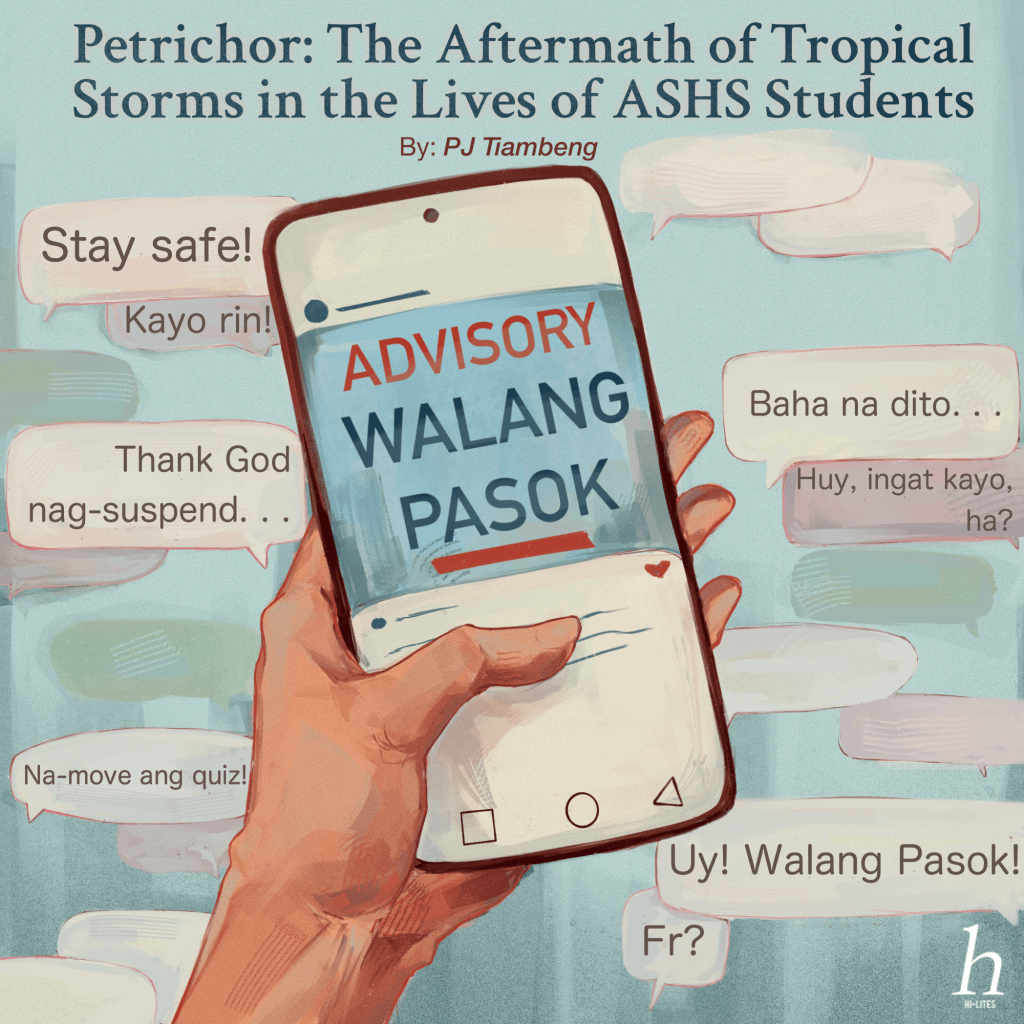
Indeed, the suspensions of classes mean different things to different ASHS Students. Some wait on the Quezon City Government’s Facebook page, refreshing every few seconds the night before a school day to check for announcements. Some take this as a time to breathe, and some, like Basti*, a Grade 12 ASHS student, take this as a time to bring their things from the first floor to the second as the floodwaters draw near.
During storms, many students also take to the AHS Freedom Wall to voice out their concerns. Earlier this September, during Typhoon Enteng, many were upset that a suspension did not take place. Some called for suspensions, and some complained that they struggled to commute to school and back home amidst the inclement weather. Whether or not their statements are genuine, we must not deny that there are real students behind these posts who experienced the destructive outcomes of the storms, and we cannot simply dismiss them.
Disasters: A Filipino Normal
In 2024, there have been 16 tropical cyclones to pass over the Philippine Area of Responsibility (PAR) so far, with the most recent being Severe Tropical Storm Kristine, which brought devastating effects to the Filipino people in 12 regions, especially those living in the Bicol Region. In response to the calamity, classes and even work in government offices across the country were suspended.
With the Philippines being the most vulnerable country to bear the brunt of climate change’s effects, it is inevitable that the nation will face more natural disasters. According to The Philippine Atmospheric, Geophysical and Astronomical Services Administration (PAGASA), “more tropical cyclones are entering the PAR than anywhere else in the world,” with an average of 20 typhoons a year. Their destructiveness is also exacerbated by strong flooding caused by overpopulation, rapid urbanization and industrial production, infrastructure on the riverbanks, improper garbage disposal into the rivers that block the drainage system, and deforestation.
With all these, tropical storms and their effects have become a natural phenomenon in the lives of the Filipinos, building their reputation of “resilience.” The Filipino people have even learned to adjust the structure of their houses to cope with flooding, from making their own fire exits to creating bridges next door. However, no matter how “used to it,” we get, we cannot deny that these calamities leave a burden on the day-to-day lives of our people. These storms heavily affect the country’s vulnerable fishermen and farmers. For instance, in 2021, Super Typhoon Odette brought P3B+ losses to the fishing industries, and recently, on October 27, 2024, the agricultural damage brought about by Tropical Storm Kristine was reported to have already reached P3.11B.
Furthermore, millions of Filipinos, especially those living in informal settlements and danger zones, are even more susceptible to these disasters as they live in risky areas with unstable materials for housing. Transportation is heavily affected as well, making it difficult for everyone to go to work or school while walking in floodwaters increases the threat of leptospirosis, a zoonotic disease caused by the leptospira bacteria found in contaminated water or soil that can enter the body through breaks in the skin, or through the eyes, nose, and mouth.
With Severe Tropical Storm Kristine, over 4.2 million Filipinos’ lives were impacted, with at least sixty-six reported injured and thirty-four reported missing. As of Sunday, October 27, 2024, the death toll has reached at least 151. One hundred fifty-one people lost their lives in this tropical storm, and it is likely that more deaths will be reported over time.
In the eyes of an ASHS Student
An ASHS student, Basti, who lives in a barangay close to the Marikina River, shared his experiences with Tropical Cyclones. Though he said that their house is usually where the flooding from the river stops rising, clogging problems with the sewage system are also one of the main causes as to why their area is flood-prone. With this, during severe typhoons, their home falls victim to flooding as well. Moreover, as their family handles a small business, they face the difficult task of protecting both their appliances as well as their livelihood by bringing the stocks up to the second floor as well. Along with this, the whole barangay is bringing up their cars and competing for parking in the higher areas, accompanied by the food vendors who have to save their livelihood as well. Basti recounted a time that a jeep failed to go up in time, and the oil spilled into the floodwaters where people were swimming to rescue others. There was no way to describe it other than “disgusting.”
On the other hand, during class suspensions, the first things Basti does are check the live stream of the river line regularly, stay at home (or get home as soon as possible if he comes from school), and simply pray for the best. If the storm is starting to appear strong, they start to bring stuff up in case as well. Yet, with storms come delays in his schoolwork and extracurricular activities. It was even more challenging during the pandemic, as all his resources were online, and his physical notes were limited. He had to wait amidst the power outage, with not much to study. Even if he did have the means to study at the time, he was too preoccupied with helping his family fix their things around the house and clean. When he finally had downtime, it was already late at night, and there was no more light. Thankfully, now that the school follows the onsite mode of learning, he has more hard copies of notes and handouts.
Sai, another ASHS student, also shared her sentiments on tropical storms and class suspensions. According to her, she and her family, who live in Parang, Marikina, are usually safe during storms. Although, they usually have to check for hazards and leaks around their house. They regularly check for updates about their area, such as the weather, the current strength of the storm and its location, the water level of the Marikina River, and the situation around them. They check and prepare their emergency supplies of food, flashlights, and fans in case of power interruptions.
Meanwhile, the rainy season often brings her discomfort during her classes. As she commutes daily, the rain catches her clothes, bags, and supplies, forcing her to arrive at school drenched and uncomfortable as her clothes take a while to dry. Similarly, Basti, who also commutes to and from school amidst a storm, recounts how difficult it is to walk on the ground filled with mud and trash as the rain pours. Class suspensions are helpful for both their convenience and safety, especially with the various hazards outside during this time. This, in turn, gives them relief and allows them to rest safely at home with their family.
Nonetheless, for Sai, studying at home during the inclement weather still proves to be challenging with their poor Wifi connection, the threat of power interruption, and the need to stay alert and be ready to evacuate. These factors distract her from not being able to study and do schoolwork. To make things worse, the weather also affects her health, making her prone to colds and even contributing to her lack of sleep.
From their experiences, we can see past the numbers: how real the 4.2 million people affected by the storm are. Furthermore, these two students are a part of our ASHS community. While for some of us students, a class suspension means rest, but for them, it can be a time of uncertainty. How can we become desensitized to these calamities when the students who go to school with us suffer as well?
Ateneo’s Response to Tropical Storms
On the other hand, the Ateneo de Manila University also has its own projects and mechanisms in response to tropical storms. The Ateneo Disaster Response and Management (DReaM) team is the university’s primary response body for disaster relief and rehabilitation work that also partners with the Tanging Yaman Foundation (TYF) and Simbahang Lingkod ng Bayan (SLB). They work on organizing relief goods, donation drives, and offering an evacuation shelter for faculty, staff, students, and their families. Within the ASHS, the student council, Sanggunian, makes sure to implement constituency checkups for each class, along with a list of emergency contacts. Yearly, the Ateneo High School takes part in the Katipunan Fund Drive (KFD), a fundraiser that also benefits calamity victims. As Ateneo students, these are examples of how our community is currently helping others.
Meanwhile, the ASHS Sandigan Kanlaon, the school’s Disaster Readiness and Risk Reduction (DRRR) committee, sends out advisory posts containing important information about the calamity and how it is moving throughout the Philippines, along with personal steps on how to respond. Fiel Torres, the Sandigan Kanlaon overall head, said, “We take immediate action on this to ensure that the ASHS community is well-aware of what actions to take.” Furthermore, the Sandigan is expected to implement a home-assessment survey called “KanlaHome,” a longstanding project of theirs, to suggest and evaluate how each student can improve their preparedness from their homes. This would also help the school focus its efforts on the aspect that is mostly lacking in each home—may this be knowing evacuation routes, having go-bags, and more.
“So far, the preventive and response measures that we have done allowed students and staff to be more cautious and alert when dealing with a disaster. We also learned that students were able to reach out to the proper authorities due to the help of our advisory posts,” Torres mentioned while talking about the outcomes of their projects. As a DRRR organization, Sandigan Kanlaon puts efforts into its actions and responses in the hopes of achieving a disaster-resilient ASHS so that its community would have the ability to prepare themselves for calamities, reduce the challenges they will face, and keep each member and their families safe.
Furthermore, according to Torres, Ateneo has progressed in taking the initiative for the needs of its community, noting how the Cervini Hall in the University Residence Halls (URH) was made into an emergency shelter during Typhoon Enteng. Ateneo’s drills, with ASHS drills being spearheaded by Kanlaon, also aid in preparing its participants by serving as simulations of what could happen during a calamity. “However, this is not to say that there is no need for improvements in their preventive and response mechanisms,” she added. Both Torres and Sai say that the university could be quicker in their decisions and announcements about the implementation of classes, especially since this is a common and urgent concern in the school’s community and to prevent students from having to travel in the strong weather.
Basti noted that the checkups are a good way to ensure the students’ well-being, although not everyone can respond immediately when facing connection issues. He also added that Ateneo’s shelter and emergency aid projects had more potential to be open to the public, especially as it is close to Marikina, specifically Barangay Barangka, which is connected to the campus by a staircase.
Though these responses and initiatives from Ateneo have been effective for its community, the university has yet to explore the possibility of allowing its emergency shelter to be open to the public as well, and thus expanding its aid’s reach to others.
The Power in Our Community’s Action
For us, students, we are called to help in whatever way we can. Let us strive to see past our own experiences. Let us acknowledge that these storms are caused by the growing climate crisis (which we have a part in as stewards of the environment) and that they affect millions of people in the Philippines, including our own ASHS students. We have to realize for ourselves the reality and severity of this issue, and not turn a blind eye to suffering.
Class suspensions and the rainy season have different sides to them, and they do not look the same for everyone. We cannot deny, however, that some do benefit from class suspensions, taking it as a break from academic work. However, there are students who are also restless and worry about the work that they cannot do during the disaster. We must become more empathetic in how we approach class suspensions and in how we portray our feelings about these, including in using social media platforms such as the freedom wall. One disappointing encounter recounted in the freedom wall was when thunder and lightning struck outside during class, and students cheered. Though there is the point that suspensions can be beneficial for some, we cannot forget that there are people who suffer during these times. We, as Ateneans, are supposed to be persons for and with others. That means we should not anticipate a storm to pass over our country simply because it can give some of us a “break” when what it truly does is bring destruction.
Let us pray for those who struggle during these times. Donate to organizations providing relief, volunteer for projects that aim to help out affected communities, support those working at the frontline, and check up on your loved ones who live in flood-prone areas.
Let us not forget to do our own part in preventing and responding to these calamities. ASHS, we, too, are a part of the whole effort to create a stronger, safer Philippines.
Names marked with an asterisk (*) are pseudonyms and were used in place for interviewees who opted to remain anonymous.
 HiLites ASHS