
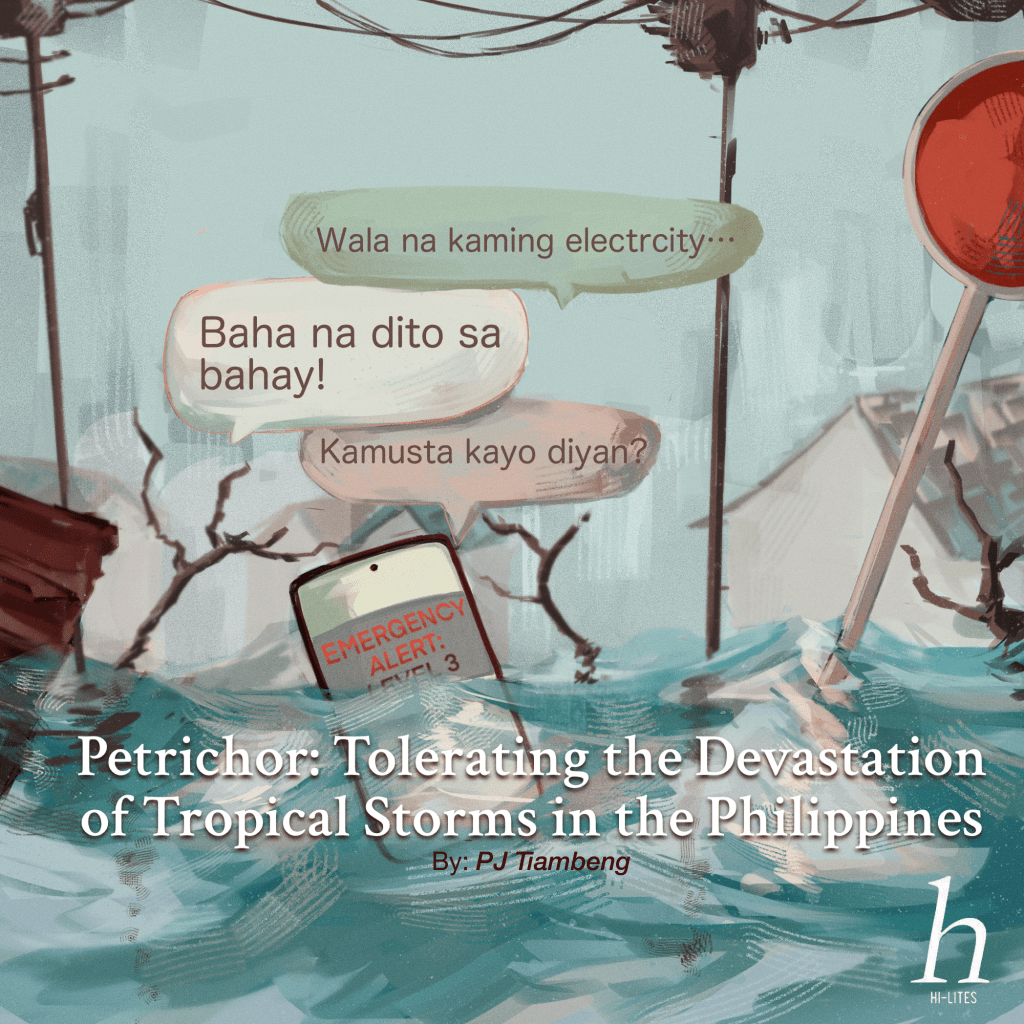
By PJ Tiambeng
P1.2 trillion down the drain?
In this year’s State of the Nation Address (SONA), President Bongbong Marcos declared that since 2022, more than 5,500 flood control projects have been completed. Yet, days after the President’s declaration, Metro Manila was devastated by Typhoon Carina. With the destruction brought about by this Typhoon, many doubted these projects and whether or not these were effective. Additionally, the Department of Public Works and Highways (DPWH) said that there are 5,000 more flood control projects across the country that are underway.
DPWH realized that the over five thousand projects reported by the President were actually more of “immediate relief flood mitigation projects.” With this comes more uncertainty as to whether or not the government is truly ready for typhoons. If these projects are only for immediate purposes during the storm, how is the government prepared before it happens to be able to lessen the devastating impacts of these typhoons?
Secretary Manny Bonoan of DPWH admitted that despite all of the funds allocated for these flood control projects (₱90 billion in 2020, ₱101 billion in 2021, and ₱182 billion in 2023, ₱225 billion in 2024, the proposed ₱257 billion for 2025 — leading up to P1.2 trillion since 2009), there is yet to be an integrated flood control master plan. After Typhoon Carina, though, a meeting was held in Malacañang wherein they discussed the P351-billion “master plan” that was approved back in 2012 under the administration of President Benigno Aquino III, which is now to be implemented. However, this plan is only 30% complete.
The recent Tropical Storm Kristine brought heavy rainfall, triggering massive flooding in the provinces of Camarines Sur, Camarines del Norte, and the Bicol region, leaving destruction in its wake. With the added collapsed detour roads, landslides, fallen trees, and rockslides, thousands were forced to evacuate to safer grounds. The government has sent out rescue operations (e.g., rubber boats, a flying team) and relief operations as well, along with moving people to evacuation centers and releasing advisory posts to online outlets. However, in some areas, it took days for certain survivors to receive aid. Some turned to drastic measures to fulfill their needs, such as boiling floodwater to drink.
“These actions have always been the go-to plan of the government…, and as effective as these policies are, it would be better if they could ensure that these people were initially aware of the situation before things got worse. Additionally, it would also be beneficial to calamity-inflicted areas if the resources and spaces available for them were more accessible,” Fiel Torres, the Ateneo Senior High School (ASHS) Sandigan Kanlaon overall head, commented. “Kanlaon aims to have each of our community members knowledgeable about disaster scenarios and to have them fully-prepared. With this in mind, I hope that the Philippines’ DRRM takes more preventative measures and steps that would ensure that every Filipino is well-prepared and well-informed about certain calamities. I also wish that the government would take the initiative to put high priority on DRRM since it is an extremely relevant subject in the context of the Philippines’ numerous typhoons and storms each year. In these times of calamity and disasters, the Filipinos must be ready for the worst so that they are not caught off-guard and that they are not led to danger.” This statement again highlighted how communities are often unprepared for calamities. For example, on October 26, 2024, a village in Talisay, Batangas, failed to evacuate in time and was hit by a landslide, leaving eighteen dead, with others reported missing.
For Sai*, a grade 11 ASHS student, the response of the government is effective and helpful for a lot of people, though she suggested that the government partner up with non-government organizations, which also reach a wide audience that help in relief operations. “I think that this could further help in reaching and helping more affected citizens, especially those in the areas that receive less help from the government and other organizations compared to other places,” she added.
Basti*, a Grade 12 ASHS student, on the other hand, has mixed feelings about the government’s preventive and response mechanisms. For one, he thinks that his barangay is handling it well. One of the Marikina projects was dredging the Marikina River to lower water levels: “If it weren’t for the dredging project, flooding would have been much worse,” he said. He noted, however, that over time, their city government has failed to provide basic commodities and offer public services to the people affected. Instead, they have used bandaid solutions, such as the river dredging. Though there have been several flood control projects in Marikina City, political disputes would cause these to not mesh well together. “Sustainability often gets overlooked. We push for progress, but don’t realize the implications that it has on a greater sum of people. While progress is a good thing and does a lot for the people, we must keep in mind the price paid for progress.”
Is resilience enough? What can we do?
In the case that you are affected by the storm, Kanlaon advises that if you still have electricity, keep rechargeable batteries, flashlights, and gadgets fully charged. “We also recommend that you elevate household belongings that cannot be wet in the case of flooding and that you prepare go-bags if you need to evacuate immediately,” Torres added.
Needless to say, our government has much more to work on in order to prepare in advance and make a proper flood control master plan for our country to be able to fully cope with the rainy season’s challenges, as the storms will inevitably continue to pile up and become more destructive while climate change escalates. With much of their funds allotted for supposed “flood response”, it is expected for flood control to progress and to be effective in coping with calamities. They must ensure that the people’s taxes are going to go to projects that keep them safe. We cannot solely rely on Filipino resilience when more and more people are suffering with each storm that comes. The government must keep themselves accountable and address the issue effectively. This cannot keep happening with every crisis that we face as a country. We cannot allow even more strife and death for our people.
Names marked with an asterisk (*) are pseudonyms and were used in place for interviewees who opted to remain anonymous.
 HiLites ASHS