
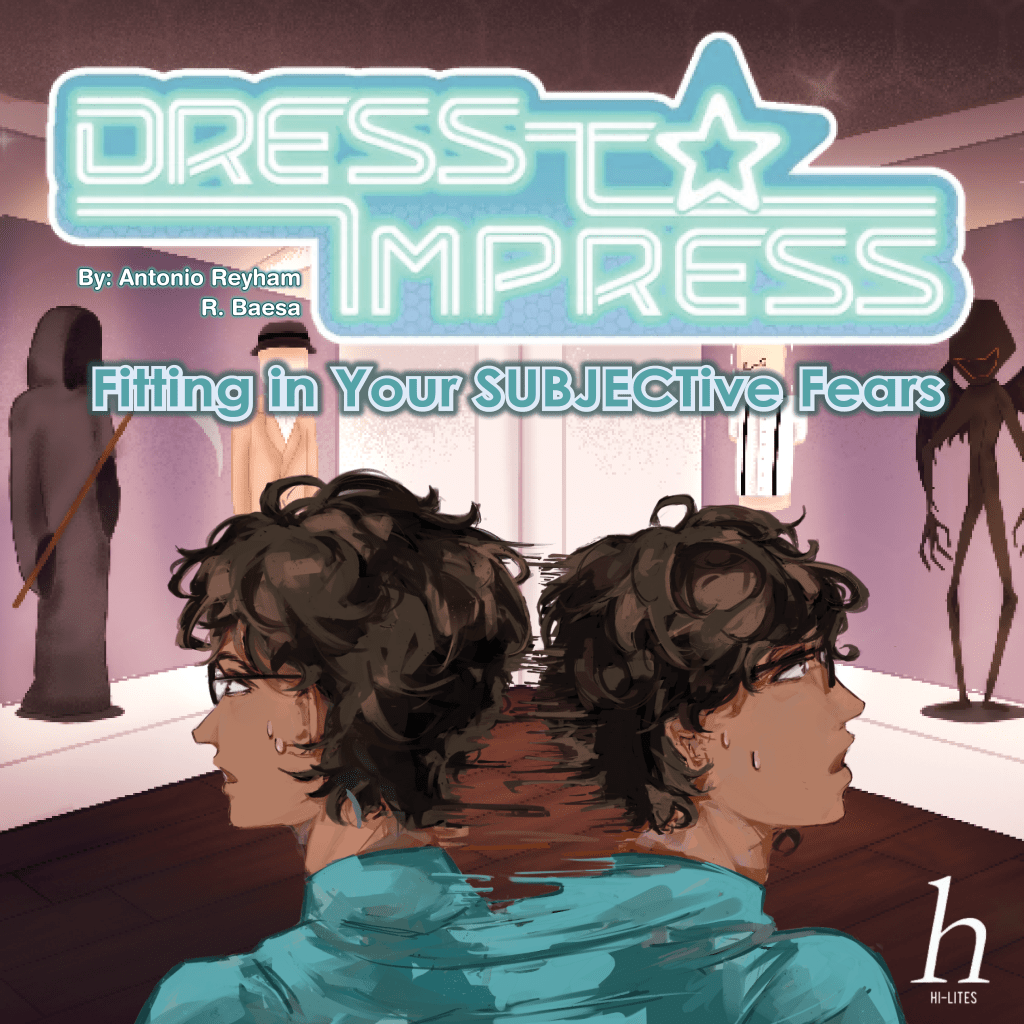
by Antonio Reyham R. Baesa
When one big fight turns into one big fright—that must have been death by a thousand cuts. However, while students often dread the concept of ‘failure,’ teachers, too, carry a great share of such dread. Beneath the marks, checks, and circles on assessments lies a truth: teachers themselves are constantly evaluated.
It goes without saying that teaching is easier said than done. As the bell rings, the lights dim, and students exit the campus, teachers remain at their posts, staying still on the hill facing their fears head-on—may it be the endless piling of paper on their desks or students struggling to grasp the material. This then begs the question: are fears also the ‘best teacher’ for the formators of the Ateneo Senior High School (ASHS)? In this light, ASHS has its own terror subjects—those infamous subjects that have left us in tears, deep contemplation, or even made us want to give up. Try fitting into these costumes as you fit your fears if you dare.
Aba, Baka Filipino Lang ‘Yan!
Draped in the eerie garb of an aswang—tattered baro’t saya, glowing eyes, and razor-sharp fangs—this subject is poised to split your mind translating words into a Jose Rizal-like manuscript. Much like the costume’s duality, Ms. Bea Bautista, a Filipino teacher for Grade 11, perceives teaching Filipino as both deceptively simple and profoundly challenging. As she described it, “Madali, dahil halos lahat ng tao ay gumagamit ng wikang ito. Mahirap, dahil ginagamit lamang ito at hindi pinapahalagahan.”
In her nine months of teaching this subject, Ms. Bautista has experienced two different worlds. Contrary to her time teaching in a public school which dressed Filipino as a beloved, facile subject, her entry into ASHS brought a different costume: Filipino was a horrifying aswang everyone tries to avoid. Given that most students speak English, students are dismayed by making mistakes. Aware of this, Ms. Bautista strives to cultivate a ‘ligtas na klase’—a place where mistakes are not signs of vulnerability but embraced as embryos for growth—not fodder for an aswang’s hunger.
Like an aswang that shapeshifts from familiar to fearsome, Filipino is beyond the connotation “Filipino lang.” More than vocabulary and grammar, this subject unearths the Filipino identity, culture, and beliefs—making it a reflection of who we are as a people. For Ms. Bautista, teaching Filipino goes beyond the textbook; it’s about fostering pride in ourselves and our nation. The subject may have a haunted allure, but it guides us into the roots of our heritage, connecting us to the country’s story in a way as compelling and shadowed as an aswang’s mystique.
Eeries and English
Needless to say, nothing perturbs you more than an ancient spirit clacking the typewriter tormenting you with words—which pretty well sums up the English topic. Like the harrowing typewriter, Mr. Joselito-Antonio H. Hidalgo, the English Subject Area Coordinator, finds checking papers laborious. Beyond the endless papers, analyses, and reports, he faces another challenge: closed-minded students.
Spilling out and twisting into the air, this language-based subject demands you to find the perfect words to explain how simple (or tough) it may be. Mr. Hidalgo feels that English is not a particularly daunting subject, as he simply states, “Most students underestimate it, I think.” Despite this, some students continue to stumble. That being said, he said that one of his techniques is to spread affirmation and conduct individual consultations in the hopes of opening people’s eyes to the richness of language one word at a time.
With over two decades of teaching experience, Mr. Hidalgo understands that teaching English is more than simply words on a page. For him, English is a strong vehicle for expression that leads to fresh views and critical thinking, but it needs patience and determination to help learners understand this. Despite the obstacles—piles of papers to grade, pupils hesitant to accept new ideas, and the lingering dread of failure in every classroom—he is dedicated to establishing an environment in which every student feels seen and heard.
Unmanaged Expectations
What about a marionette string hanging tasks, deadlines, and everything in between, tickling with a clock pendant—surely that’s a picture-perfect costume for Management. Analogous to a puppet master, Management is the study of orchestrating an organization’s moving parts and making sound decisions.
Mr. Jerome Christopher Po, a Grade 12 Management teacher, suits the costume well. For him, the most difficult aspect of teaching is guiding students through a subject many are encountering for the first time. Likewise, he firmly believes that an actual understanding of Management is learned from experience, not from memorizing terms and theories. “As a management teacher, I have found that building on the different experiences of students helps in assisting them navigate the complex nature of management,” he explains.
So, be sure to don your clocks as you learn to juggle time, budgets, market trends, advertisements, and social media buzz with Mr. Po. Break your unmanaged expectations as Management is far from boring—it’s not about pulling every string to pass, but more so being the master of your own puppet.
One Unit to the Right and Three Units Off My Rocker
Finally, we undress Mathematics cloaked in an enigmatic attire—a grim reaper in jet black. In the words of Mr. Luis Melosantos, students’ anxiety about Math isn’t merely rooted in their previous hardships; it also stems from their surroundings—be it schools, peers, or even the educators themselves—transforming math into something less than enjoyable. Despite the difficulties of Math, Mr. Melosantos believes that it is not a reason to be pessimistic about learning.
The costume depicts a chalkboard full of insurmountable equations, with each symbol encompassing the challenge Mr. Melosantos faces in assisting students to ‘learn to learn.’ He combines traditional strategies, such as piling on practice problems, with a push for students to attend study halls and consultations, each strategy designed to ignite the thrill of cracking math’s mysteries. His aim is not just to assist students through the formulas, but as well to expose their intellects to fresh perspectives on the world of mathematics, altering how they understand each problem and pattern along the way.
True failure is not defined by the number of marks or crossed-out answers on your paper. It is the act of holding back, allowing the fear of not being ‘good enough’ to hinder you from trying. For teachers, failure transcends beyond a QPI (Quality Point Index) score or midterm grade.
Mathematics may be a complicated mental labyrinth that only the brave are inclined to explore, but Mr. Melosantos tells his students that “failing is basically not even trying.” For him, success isn’t about statistics or perfect marks. Alternatively, he argues that any genuine effort, no matter how minute, initiates a learning process that results in growth, even if the progress is scarcely apparent.
For Ms. Bautista, as cliché as it may sound, failure is an inevitable component of the path to success. She explains, “Dahil para sa akin hindi nasusukat ang galing ng isang tao sa isang kabiguan. Nabibigo ang isang tao dahil natatakot siya at bago sa kanya ang kanyang ginagawa.” Moreover, she supposes that giving a failing grade is a stern wake-up call for teachers, a sign that they’ve fallen short in fulfilling their own role as guides.
Mr. Hidalgo echoes the same sentiment, stating, “Of course. No teacher wants to give a failing mark.” Similarly, Mr. Po describes failure as when students fail to satisfy the course objectives. Recognizing that students approach learning in different ways, he constantly reexamines his teaching approaches and concentrates on where students are most challenged, committed to helping his beloved Ateneans attain their full potential.
In reality, these subjects are not intended to be a ‘burden’ for students, but rather a runway to flaunt their getups—their multifaceted definitions of hard work, similar to how teachers suit up and show up these subjects in their own unique ways. Be the next Top Model—an Atenean unfearing of the unknown, unfearing of taking risks, and unfearing of failing.
 HiLites ASHS