
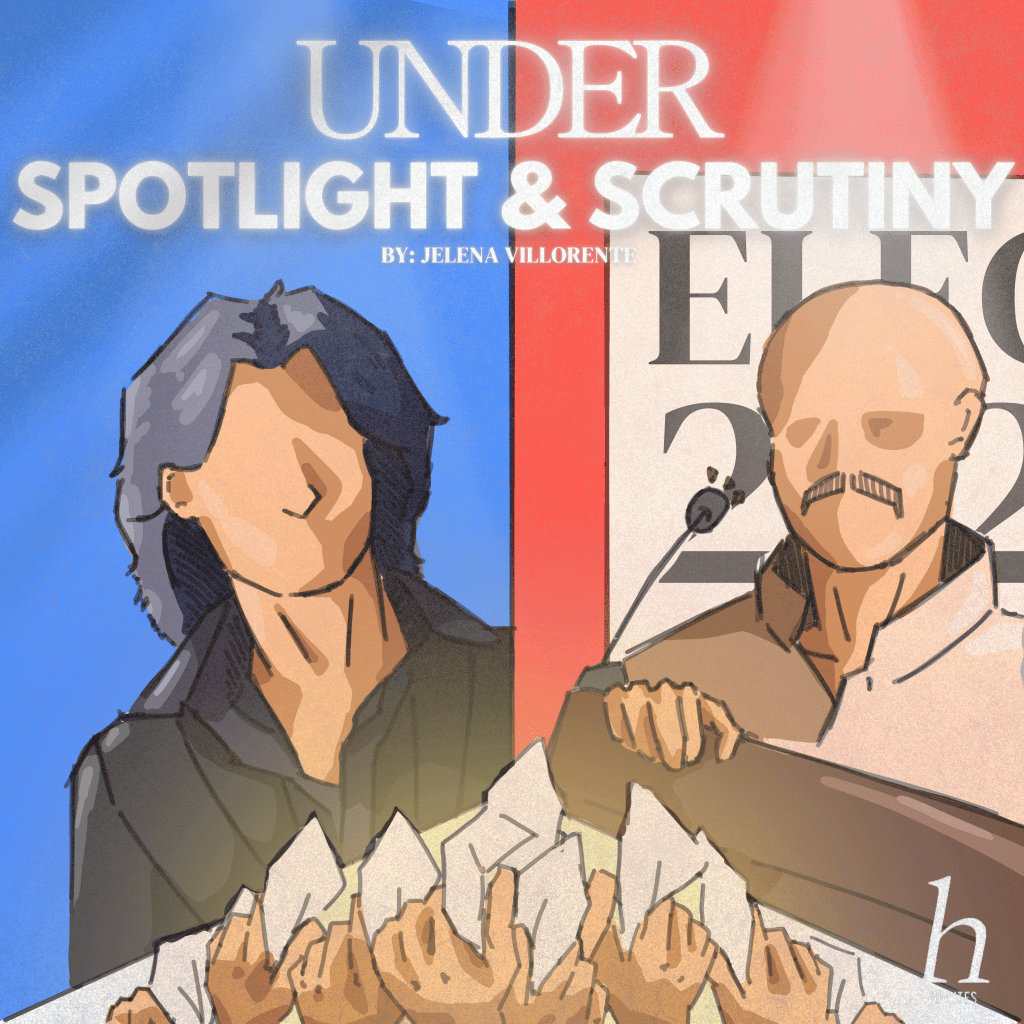
by Jelena Villorente
Running for a government position is a commitment one shouldn’t take lightly. Whatever the context — be it in a local or national setting — positions such as these were tailored to ensure order within the population being handled and the effective operation of systems. Needless to say, it’s a noble yet hefty responsibility that only qualified people are able to handle.
Last October, it was reported that almost 100 celebrities and social media personalities filed Certificates of Candidacy (COC) for the upcoming 2025 elections. On a positive note, sure, this may be a breeding ground for potential leaders who have already established themselves in the entertainment industry — yet, with this mindset, are they possibly just being given the benefit of the doubt?
In truth, this reality cannot automatically be dismissed as downright problematic. It would grant us more clarity, however, to look at it from a broader point of view.
Long-established Leniency
Celebrities running for office is an occurrence that’s nothing new in the field of politics. Some notable names are Isko Moreno, former actor and ex-mayor of Manila, and Manny Pacquiao, former professional boxer — both of whom ran in the 2022 Presidential Elections.
In terms of what propagates this actuality, a study conducted in 2015 by Clarissa David and Jenna Atun of the University of the Philippines Diliman and the Ateneo de Manila University respectively found that various factors contribute to the likelihood of people voting for celebrities as President or Vice-President, such as TV exposure, socio-economic class, education (of both voters and candidates), and candidate fame.
In the end, the research ultimately highlighted the need for further study on this occurrence, yet also underscored the reliance of the public on prior knowledge and media exposure when it came to casting their vote. How easily swayed one can be by campaigns and how well-informed one is of politics, based on the study, are some of the variables that may potentially dictate a person’s probability of voting for a celebrity in a Presidential election.
This only goes to show how long-established this issue is, especially in a country ruled by free will.
Based on the 1987 Constitution, the qualifications one must be able to meet to become a politician in the Philippines vary across positions, yet are greatly similar regardless. All positions require candidates to be Filipino citizens (natural-born for President, Vice-President, Senator, and Congressman), able to read and write, and a registered voter. Depending on the position, candidates must be at least a certain age and a resident of the Philippines for at least a specified number of years.
To say the least, these qualifications are highly lenient when it comes to those who can file COCs and become candidates for these positions. It encapsulates the majority of the general Filipino public, and with these mere requirements, Philippine society is bound to be well-represented by leaders from all sectors of society — implying that you are eligible to file COCs regardless if you belong to the lower, middle, or upper class, counted that you also pass all the other requirements.
Few standards mean more opportunities for many to run for public office, and with the possibility of fair representation across various societal sectors, especially those without access to quality education, common expectations are for concerns to be duly raised and fruitful dialogue to be catalyzed in pursuit of authentic equity in society.
These few standards too, however, carry their own set of downsides. For instance, the Constitution makes no mention of any requirement barring criminals, convicted or detained, from running for a position. The Constitution does not also bar those possessing no educational background from running. The Constitution enables virtually any average Filipino citizen meeting the minimum required age to run. This freedom provides a leeway for those possessing no political knowledge, background, or experience to run for political positions — and it’s the very same freedom allowing celebrities to run for public office.
This particular characteristic of these Constitutional qualifications is one that truly tests voters and their ability to establish their principles on choosing the right person to vote for. Freedom in whoever may run provides a diversity in candidates, more specifically a diversity in contexts, capabilities, and agendas, as representation from all societal sectors is embraced by this very leniency.
Only this wide array of options, however, should prompt voters to be well-informed of candidates’ backgrounds and experiences — as these can be truly telling in the way these candidates may lead and organize agendas when bestowed with the authority of their desired position.
In the case of celebrities and personalities running for these positions, however, it should be underscored that their capability cannot immediately be discredited merely because of their prior involvement in a different industry. At the end of the day, they are still candidates wishing to fulfill a position in public office, and they must also be deemed as such with their mere context defined by prior fame.
What becomes of their repute due to this transition, however, depends on the public’s ever-varying perceptions.
Behind the Ballots
Celebrities engaging in politics may be viewed by some as proactive and empowering, given this inclination towards societal affairs deviating from the field of entertainment. The other side of the spectrum, however, may perceive these celebrities as insincere — with the perpetuated idea that these personas may have only run for the sake of encouraging public attention and approval for their name.
It becomes a nuanced reality in such a way that there cannot be a clear line telling us whether the reality of celebrities running as politicians is good or bad. The case is multifaceted, spanning a vast range of factors that one cannot effectively quantify in order to come to a definitive conclusion.
In spite of preconceived notions and potential, the decision ultimately falls into the hands of the voters, which, in practice of the democracy the country has already long held onto. Its manifestation through the election season per se merely brings about a nation’s dependency on its people, a dependency on perception and discernment as new leaders are to be chosen by who most people choose to point towards.
While it seems the most ethical to point towards who seems the most qualified after ample consideration, it is so often that Filipinos prefer to stick to their comfort zones and vote for who they already know. It’s like seeing a familiar name in the cast of a newly-released movie and buying a ticket to watch it because of the known persona.
It may look harmless in plain sight, yet in reality, this habit penetrates deeper than it seems. Voting for a familiar name without even so much as putting in the effort to be informed of platforms and backgrounds constitutes a breeding ground for political dynasties and potential corruption as a result. In pertinence to the celebrity politics our country is so frequently confronted with, Filipinos voting for a celebrity just because they’re a famed name contributes to the already-lenient system of the Constitution’s qualifications — which is also why these personalities win most of the time.
Truly, in this point of view, it is a shame that a number of voters do not realize the immense value possessed by every ballot put into the boxes. The opportunities seem promising for such a lenient system — yet democracy’s reality may tell a different tale.
Over Same Ground
Suffrage is a right that all of us are granted. It is a right that enables the government to be run by the people, for the people, and in their best interests. Being a country that has fought against colonialism for centuries and even authoritarian rule, it must already be a routine for the public to be wise in appointing a qualified leader.
In this light, why is it, then, that criminals are being voted as leaders? Why is it that political dynasties continue to thrive within our government? Why do societal issues continue to be overlooked by these very pillars?
At the same time, however, would it even be ethical to blame the voters?
Every election season exposes them to schemes of coercion devised by candidates in hopes to tip the scales in their turf. It’s as if these voters are being pulled by desperate arms from all directions, hearing persuasive calls from all around guaranteeing the betterment of the nation. Bombarded by political campaigns and daring statements of promise, it might seem like a matter of which voter is the easiest to pull — yet could it also be a matter of which candidate pulls the strongest? A matter of how these candidates have done so?
In the end, every constituent plays a part. Voters and candidates each have responsibilities to fulfill in their respective roles, and it is imperative that the gravity of these roles is recognized. Living in a society wherein both voters and leaders can be incompetent is most definitely not promising, and it becomes only a backfire in the face of hope for a truly just government.
In the same way, celebrities going for politics is not a case that’s black-and-white. It only becomes a problem when voters do not let their perceptions of these personalities transcend what they are already known for, or if the motives of these celebrities are for anything other than societal service.
What becomes of this situation, then, is the highlight of our individual responsibilities as the elections draw near. Despite the many inextricable challenges that impede the ability to exercise this collective duty however, such as the lack of access to information along with poverty, as well as the long-established colonial mentality building trust on already-known figures, the public must still take accountability. Fair criticism and wisdom are values each voter must be able to exercise to elect a leader of authentic positive influence, and to avoid being swayed by whatever appeal some celebrities may exhibit to the masses.
A society of promising growth cannot be made possible by only our government. With the spotlight flashed and scrutiny centralized on famed personalities seeking to be a part of this very government — society is left in the hands of voters to put the right ones in position, and only time will tell whether they’ve picked the right roster.
 HiLites ASHS