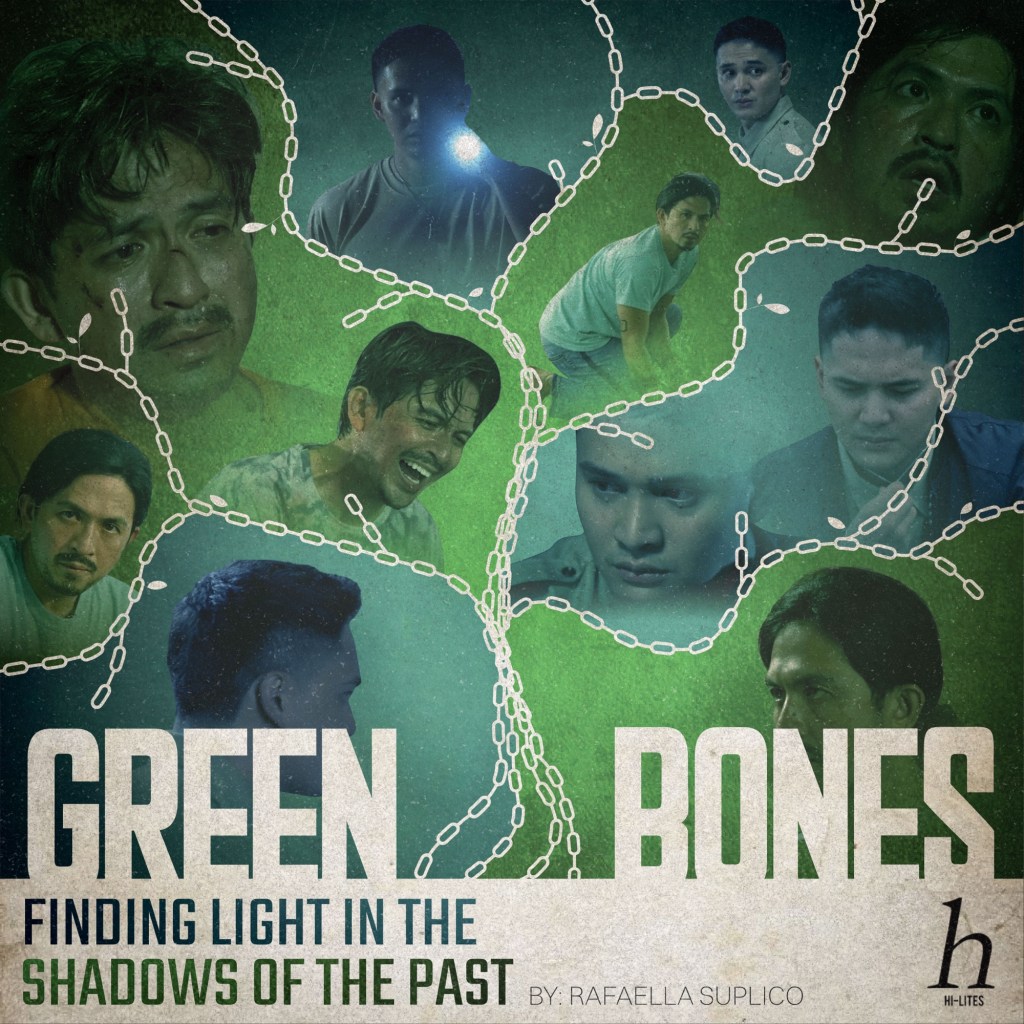
By Rafaella Suplico
Editor’s Note: Before reading, do note that this movie review will contain spoilers for Green Bones. Viewer discretion is advised as the film addresses themes such as murder and suicide. Lastly, this movie review does not reflect the views of this organization.
BABALIKAN kita! I will come for you!
When these words are spoken by a man regarded as a cold-blooded murderer—someone viewed only as a ruthless criminal—fear is the natural response. Such a figure would seem like nothing more than a monster lurking the dark. But in the case of loved ones left behind, these words serve as a promise, a beacon of hope, a faint but unwavering light, that justice, no matter how distant, will eventually find its way to the light.
Unveiling the Story
A heart-gripping tale of redemption and justice, Zig Dulay’s entry to the 50th Metro Manila Film Festival (MMFF) compels audiences to confront the question: What does it truly mean to be free? And, perhaps more disturbingly, Is redemption ever truly within reach?
The award-winning Best Picture, titled Green Bones follows the story of Xavier Gonzaga (Ruru Madrid), a newly assigned prison guard who mourns the tragic death of his sister, and Domingo “Dom” Zamora (Dennis Trillo) who has been serving time for the brutal murder of his sister and niece.
Haunted by the murder of his sister, Gonzaga is determined to keep the peace within the prison walls, and even more hell-bent on making sure Domingo Zamora, a convict who refuses to speak, will forever call this prison his home. With his bias set in stone, the young prison guards believe that all criminals are beyond help, Zamora being of no exception, with no room for redemption nor the capacity to change for the better.
The tension between Zamora and Gonzaga is palpable, conveyed through chilling, cold exchanges of eye contact and the sharp, snarky remarks from the latter that highlights their mutual disdain. However, as the story progresses, Gonzaga’s curiosity begins to chip away at his indifference. Driven by an increasing need to unravel Zamora’s past, he starts following Betty (Alessandra De Rossi), the mysterious woman who frequently visits Domingo Zamora.This action signifies a turning point in the film, offering viewers a glimpse into his past—a life marked by petty crimes, chaos, and and how he found a way to love unwaveringly, a love that ultimately changed him for the better.
Green Bones is a well-paced, emotionally-charged narrative, enriched by a dynamic cast and brimming with thought-provoking lessons that make you pause and reflect on the society in which we live today. It’s a film that challenges the idea of morality and the often blurry line between right and wrong.
Truthfully, the heart of the story lies in its dialogue; the audience gets an exquisite display of both ends of the stick, from the prison guard’s story to what really happened to Domingo Zamora. It’s a masterful attempt at showcasing communication beyond words, as Green Bones shines a light on the beauty of sign language. Amongst the characters, his niece who uses sign language to convey her thoughts, teaches Zamora how to sign so that they can communicate with each other. Throughout the film, the audience can see Zamora use his skill of sign language teaching those with him in San Fabian. Through this subtle yet powerful inclusion, the film emphasizes how connection and understanding goes beyond words, adding layers of depth to the experiences in this already tasteful film.
Behind the dialogue lies the stunning backdrop of San Fabian, the rural penal colony where the prisoners reside—a more humane place than most prisons, where inmates are encouraged to experience freedom despite their incarceration. It embodies the simplicity of life in the provincial countryside, where they farm, fish, and sell wood carvings to the locals, all in an effort to repent and move beyond the crimes of their past. The dialogue, enriched by the nuanced performances of these talented actors, helps viewers realize that while it may be tempting to portray Gonzaga, the prison guard, as the hero, and Zamora, the prisoner, as the villain, that reality is far more complex than that, shedding light on the lives of those who have been wronged—people who have been robbed of light, their dignity, and justice in broad daylight.
A heartwarming, tear-jerking sequence in the film features the Tree of Hope, a majestic tree on the outskirts of San Fabian, its branches adorned with handwritten notes from the prisoners, each expressing their humble wishes. Many of these notes include simple requests such as “pagkain para sa’keng kuting,” (food for my kitten) and “damit para sa pamilya,” (clothes for my family). These messages, gently swaying on the branches of the Tree of Hope, symbolize the enduring power of hope, even in the face of hardship. Each wish, while deeply personal, also contributes to a shared, collective dream—an expression of hope that unites them all.
Blockbuster Boom
The 50th MMFF saw Green Bones dominate the spotlight, earning the prestigious title of Best Picture, along with four additional awards—Best Screenplay, Best Child Performer, Best Cinematography, and Best Supporting Actor. This impressive haul makes Green Bones not just a standout, but a historic milestone for Filipino cinema.
In fact, it marks the first time GMA Pictures has secured back-to-back wins for Best Picture, adding another feather to its cap in the festival’s storied legacy. The film’s emotional depth, powerful performances, and striking visuals certainly made it a standout in this year’s crop of entries.
Alongside Green Bones, the 2024 MMFF boasted a diverse lineup, taking audiences on an emotional rollercoaster with genres spanning from horror to comedy. One of the most talked-about films was Vice Ganda’s highly anticipated return to the screen with And The Breadwinner Is…, which took the box office by storm, with Green Bones following closely behind.
It’s clear that this year’s festival not only delivered on a range of stories but also reaffirmed the growing strength of Filipino cinema both in storytelling and commercial success. With a new generation of filmmakers entering the picture industry, this year’s festival stands as a testament to the bright future ahead for Filipino film.
A Reality for Many
The narratives of Zamora and Gonzaga are not just highlighted in theatre screens but are outrightly manifested in the world around us. As screenwriter and National Artist Rickly Lee says, “At the same time, there are far more evil people outside of prison. Are they good just because they walk among us?” They’re often criticized, dehumanized, and looked down upon as people less than human, but we seldom question the morality of those who roam freely among us, wearing the guise of respectability while wreaking havoc in their own subtle or even loud, ways.
With the breeze of the wind, the movie begs the question reiterated in one of the film’s most noteworthy lines, “Sino ba ang mabuti? Sino ba ang masama?” (“Who is truly good? Who is truly evil?”). With a justice system such as the one experienced by Zamora, people hidden by a veil of power and privilege continue to tarnish names that they deem worthy.
A superstition, unbeknownst to many, is that people who have served goodness in their lives are seen to leave green bones once their bodies are cremated. Once someone crosses the rainbow bridge, the departed’s final goodbyes are left in the form of these lucky-colored bones. And perhaps, in a world that often devalues what is truly good, those who leave behind green bones are the ones who have truly escaped the chains of injustice.
Green Bones is more than just a movie—it’s a reflection on the society we live in today. If there’s one lesson to be learned from this film, it’s that justice is not always black and white. The line between good and evil is often blurred, and the truth is often far more complicated than it seems. This film urges viewers to reconsider what it means to be free, to forgive, and to seek redemption—not just for ourselves, but for the world around us.
Even when hope feels faint, Green Bones reminds us that it can endure, no matter how dark the path may seem. The question is, will you choose to see it?
 HiLites ASHS