
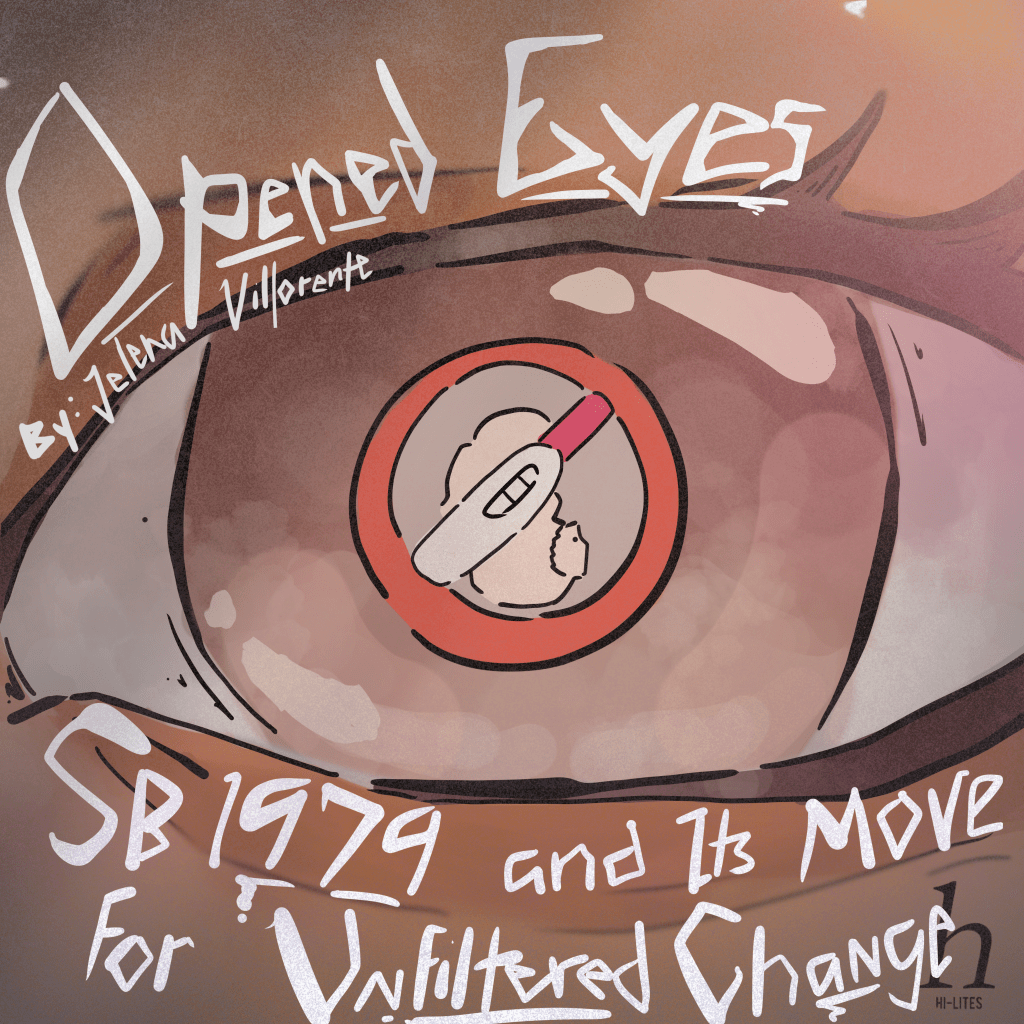
By Jelena Villorente
Education is the cornerstone of learning — learning that transcends the academe and paves the way towards the greater scheme of things. It is quality education that serves this very purpose, and in a country that glorifies hope in the youth, it is the very thing it needs to propel this noble desire. In pursuit of this, the Philippine curriculum has undergone various reforms across the years, aiming to address issues it has confronted at the time — for instance, the K-12 curriculum implemented in 2012 further advanced the Philippines’ schooling system on a global scale and the MATATAG curriculum established in 2023 confronted cramped modules and lackluster performance.
At present, the curriculum is at a dilemma of a cusp, now weighing on whether or not it will dabble in educating the youth about sex — in particular, a heavy transition brought to light by Senator Risa Hontiveros in the bill she filed called the “Prevention of Adolescent Pregnancy Act of 2023.”
What appears to be a potential turning point in our country’s education system, however, faces unideal feedback, with politicians lambasting the bill’s provisions and scrutinizing ambiguity — and yet, in the midst of massive criticism, it remains a significant posit that must be greatly considered for the sake of the country’s youth.
Progressive Pursuits
Senate Bill No. 1979, also known as the “Prevention of Adolescent Pregnancy Act of 2023,” was filed by Senator Hontiveros in hopes of tackling the pervasive issue of teenage pregnancy at the grassroots level — an issue that the Philippines, most unfortunately, is no stranger to. Our country is known to be one of those with the highest teen pregnancy rates in the Asia-Pacific region — even despite its decrease from 8.6% in 2017 to 5.4% in 2022, as it still holds its continuous stagnancy — and it is a title that no nation must be proud to bear. A study by Manzanilla et al. (2024) narrated the root causes of and challenges engendered by adolescent pregnancy, being inadequate education on family planning and contraception, insufficient and low-income healthcare services (for mothers and children), financial struggle, and social scrutiny and judgment.
In parallel with this, the bill provides curriculum additions grounded upon sex education, seeking to mandate Compulsory Sexuality Education (CSE) at all levels. According to the Department of Education’s Briefer on the Comprehensive Sexuality Education, this curriculum adapts an age-appropriate approach involving lessons that precede and “anticipate biopsychosocial milestones by about two years,” and is inclusive of lessons such as “human development, personhood, healthy relationships, sexuality and sexual behaviors, sexual and reproductive health, gender, culture, and human rights,” to be conjoined into various subjects such as MAPEH, Araling Panlipunan, and Science.
In essence, it vows to equip youth with the knowledge and skills necessary to make better, well-informed decisions about their sexual and social relationships — envisioning a world wherein a balanced understanding of sex is perpetuated amongst the younger generation in lieu of ubiquitous travesties that threaten to taint their perceptions of sex and intimacy.
Subsequently, what this bill authentically entails on a greater level is monumental. As is, integrating sex education into the current curriculum is a major trailblaze amidst the conservative views reigning our country.
Even though the deprecating impacts of teenage pregnancy have already been so long-established, there still persists the lack of access to contraceptives and ample family planning strategies in the country, especially amongst the lower classes — who prove to be the most vulnerable sector crumbling under this very burden. The proposal of sex education is a bold dissent in the face of the traditional belief that deems sex a taboo topic amongst children, yet provides an active plan addressing this very lack and evades cultural barriers eclipsing a proper understanding of sex in one’s formative years.
This potential transition towards sex education also implies that learners will ultimately be formed to make better choices for themselves, segueing adolescents into maturity that comes in coalition with responsibility for one’s own social relationships. This, in turn, enables them a spectral understanding of sex at an early age, which entails the provision of trust in their ability to utilize this knowledge for their own self-development as wise citizens.
With these promising benefits, alongside many others, this bill is painted as a lustrous opportunity for the mitigation of teenage pregnancy at the grassroots level, and yet, however significant this may potentially prove to be, reality tells us that kind intentions do not always entail kind feedback — and Senator Hontiveros’ proposal is no stranger with its share of political backlash.
A Clap at Lasciviousness
As one could almost anticipate at this juncture, critical apprehension met the bill at its first taste, coming from the tongues of conservative Senate members and groups held rigid by their traditional beliefs.
One particular initiative called Project Dalisay, under the authority of the National Coalition for the Family and the Constitution (NCFC), came out as a frontliner in the scrutiny of this bill. Various claims were made against implications they drew out of vague statements and assumptions of the initial bill.
For instance, they called out an ambiguous statement within the bill they deemed “unconstitutional,” enshrined in Section 6, indicating that CSE “shall be integrated within the school curriculum, guided by DepEd and according to international standards.” Project Dalisay upholds that the term “international standards,” falls under the standards provided by the World Health Organization for sex education in Europe, insinuating that CSE would eventually end up teaching children aged 0-4 years old about masturbation, kids aged 9 years old about sexual rights, and anal and oral sex to teenagers, among others — despite the bill making no mention of any European document, alongside any of the keywords relating to “masturbation,” “anal sex,” and “oral sex.”
Project Dalisay also stands upon the notion that Senate Bill 1979 would devalue the role of parents in being guiding posts for their children, questioning the open access to health services and facilities provided to children without parental consent, as well as raising concern on the whole bill being non-compliant with the Constitution and supplementing their stance with a study that found the inefficacy of CSE in mitigating teenage pregnancy.
In particular, the said study entitled Re-examining the Evidence for Comprehensive Sex Education in Schools by the Institute for Research & Evaluation is essentially a review of studies that have been conducted on CSE implementation across the globe. Overall, it highlighted the inverse outcome of international school-based CSE integration, with its impacts defying intended effects in pertinence to student health and affairs. It mentioned the lack of reports on CSE’s effect on teenage pregnancy across the majority of the reviewed studies and only one recorded result of reduced teenage pregnancy being sustained up to 12 months — alongside other negative effects such as increased sexual activity and ineffectiveness of consistent condom use.
Ultimately, the study ended up recommending the abolishment of CSE implementation on a global scale, given the “compelling lack of evidence of effectiveness for school-based Comprehensive Sex Education,” in general.
Even President Ferdinand “Bongbong” Marcos Jr. chimes in with joint criticism for the filed bill, going as far as to label it “abhorrent,” and perpetuating “woke,” ideologies — seemingly insinuating his contempt for the progressive alternatives provided by the bill as per the claims made by Project Dalisay.
In plain sight, one could observe that it is only scrutiny provided by these parties. News articles and reports could only narrate the backlash that emerged in retaliation against the bill, with neither party mentioning any potential interventions that could be made to mitigate the very limitations pointed out in the midst of lambasting. This silence in pertinence to constructive criticism speaks volumes of government bodies’ authentic motive in response to not only the bill’s provisions but the issue of teenage pregnancy it intends to combat as a whole — it could be that each loophole being pointed out is a testament to the government’s apprehension of this proposal.
In response to this spiral of doubt, Senator Hontiveros later on submitted a revised version of the bill, clarifying points of ambiguity raised prior and combating the misinformation being perpetuated by Project Dalisay’s stance. For one, alluded to in her bill was the Responsible Parenthood and Reproductive Health Act, and ensured in it that CSE would ensure the provision of “age-and-development-appropriate,” topics such as human sexuality, informed consent, adolescent reproductive health, and women and children’s rights. She reiterated the non-negotiability of parental authority in the field of CSE and took the measure of enabling only adolescents aged 16 years and older to access health services and resources, especially on the topic of family planning, while those below would only be granted access upon consent from a parent or guardian.
Senator Hontiveros also countered the study utilized as evidence against her bill, remarking discrepancies within the research’s analytical framework and overall findings that do little to truly supplement their claim.
In the spirit of passionate defense, it is clear that this constitutes a battleground between advocacies, using loopholes to discredit the other and weaponizing statements of obscurity to break the other down. Comprehensive Sexual Education, evidently, is a concept that does not fare well among those in support of authentic tradition and Filipino culture, with the hopes of the youth adapting to the roots of their motherland as they mature in principles grounded upon conservativeness.
The flip side of the coin, however, acknowledges culture as dynamic, appropriating itself to the sign of the times with each passing generation. It takes notice of issues that have been unsolvable in the past and seeks alternative solutions that adapt to the needs of contemporary society, being open to new traditions and progressive provisions.
These ongoing deliberations on the sex education bill only prove how apprehensive the government is when it comes to openly educating the youth about sex and sexuality, potentially due to the restraint on the topic of sex in the country’s religious and traditional culture, as it has long been perceived as an overly mature topic for adolescents, heavily influenced by Christian views that have long shaped the Filipino way of life.
In spite of this shackled reality, however, the taboo concept of sex is constantly breached among the country’s youth, as external factors such as peers and social media expose them to this very topic — more often than not, tainting their perception of sex and intimacy due to the perpetuation of sexual travesties such as risqué humor, pornography, and even prostitution. This would gradually engender poor decision-making on the part of the young demographic and subsequently lead to exacerbated impacts of current societal issues circulating around this very populace — only hammered down further by the prevalence of teenage pregnancy in the country.
Given this, what this reality essentially reveals is the government’s insistence on the “taboo,” nature of sex in spite of the glaring defiance as truly reflected in society. SB 1979 acts upon this by attempting to segue into the desensitizing the youth to the concept of sex through its official integration of CSE into the curriculum to ultimately prevent the perpetuation of misconceptions regarding sex — yet the government’s decry in the face of this actuality only suggests their insistence on their own views, disregarding those of the actual population impacted by sex-related issues and only neglecting the service these people are due.
Truly, these setbacks only backfire on the orthodox reasonings being thrown against the integration of CSE in the curriculum and only necessitate it further, given the cascading effects that are sure to be augmented as time goes on without urgent succor. Teenage pregnancy is an exigent issue that is far from recent in the context of the Philippines, and its heightened cases are mainly attributed to the inadequacy of knowledge pertaining to adolescent sex — only supplementing the significance of sex education and its integral role in the grassroots alleviation of this long-standing issue.
Growth In Dynamicity
In the end, Senate Bill No. 1979 is more than just ordinary educational reform — it is a noble pursuit of social maturity and responsibility among the growing youth. It stands as a beam of hope in a country plagued by unjust choices and unethical circumstances, bestowing upon the youth the autonomy to grow as moral citizens through the development of their capabilities in decision-making for the betterment of not only themselves but others as well.
Sex education is necessitated by our country shackled by conservative views and past ideals, only amplifying the reflection of a need to acknowledge the dynamic society the Philippines is enshrined in and its requirement for a progressive system that appropriates the needs of the current society, addressing contemporary issues faced by the masses in a manner that is far from stagnant. Educating the youth on sex is not meant to be a premature dip into lewd experience, as some may misconstrue it as — but rather a raw glimpse into its technical aspect and its integral influence on circumstances being confronted at current.
Growth is not guaranteed if no move is made for authentic, unfiltered change, and the same exact notion goes for education. Learning from mistakes is to make the effort to not repeat them — and as the Philippines gradually continues to wander into progressive ideals amidst its own shortcomings, it must be in the Filipino’s best hopes that the stain of past mistakes be finally wiped off clean and kept that way for the future’s sake.
 HiLites ASHS