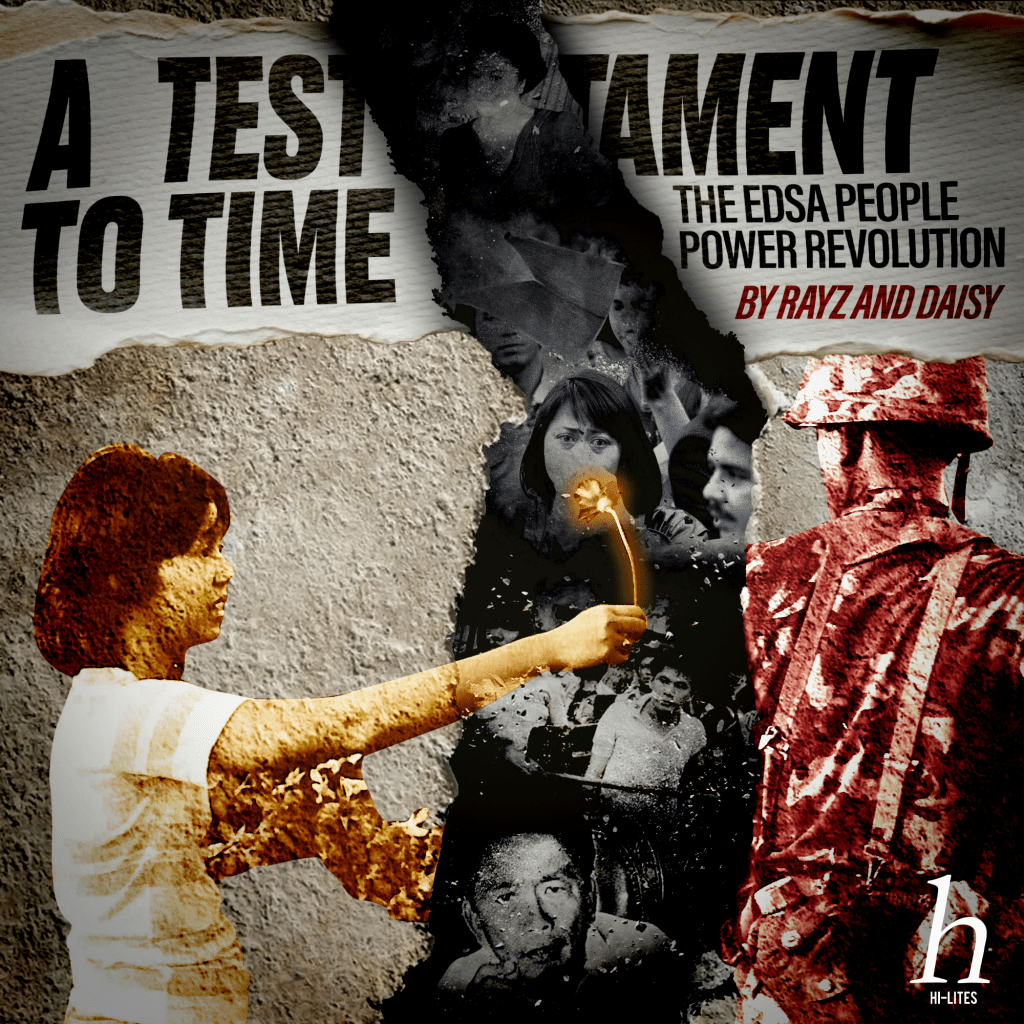
By Rayz and Daisy
Tighten the yellow ribbon.
February 25 — a day to commemorate the resilience and collective power of the Filipino people against the authoritarian rule of former President Marcos Sr. and the country’s commitment to a true democracy. The coming People Power Anniversary 2025 will mark 39 years since the historical “bloodless revolution” and turning point wherein Filipinos flooded the streets of the Epifanio de los Santos Avenue (EDSA) to call for an end to the 21-year dictatorial reign of former President Ferdinand Marcos Sr. According to Amnesty International, “around 70,000 were imprisoned, 34,000 were tortured, and 3,200 were killed,” while the World Bank states that Marcos stole billions of dollars from the country during his administration. The severity of these human rights violations beg for a mark on the memory of the hearts of the Filipinos.
Yet, after all the suffering endured by our people at that time, we, the Filipinos, and most especially the youth of the present-day Philippines, are gradually forgetting the value and the truth of this holiday.
After 39 Years
The historical distortion of the Martial Law era has become prevalent in the media, and we consume it for hours on end. This disinformation has contributed to the gradual rewriting of our country’s history books, erasing its significance to a blank page in the minds of students. Between the tiresome days of long tests and confounding quizzes, the awaited date of the People Power holiday appears to students as a shining hope of rest and relaxation. While a day away from the piles of test papers is one that is painfully needed, this perception often undermines the value of the day when our ancestors fought for the country we call our home.
“Nakakalungkot na hindi na naging parte ng ating buhay ang magkipaglaban para sa ating karapatan.” Ms. Bea Bautista expressed, describing her experiences as a Filipino teacher in the Humanities and Social Sciences (HUMSS) strand. “Some students only share posts about the event; pubmats that show the date after that wala na, ano na?” She shared, explaining how important it is for students to be actively curious about the real events of our history.
It takes more than sharing an Instagram post about the People Power Revolution to truly celebrate a crucial moment for the Philippines. Our online posts have become our new “windows to the soul,” showcasing everything we need to know about one person. This has led to the phenomenon of “performative activism,” where people often share posts about social issues for the sake of appearance rather than to genuinely support a cause. While these actions may aid in spreading awareness, in their totality, they may lack real substance. Hashtagging #NeverForget is just the tip of the iceberg. Commemorating this event entails the continuous fight against attempts at oppression and erasure from the very people who perpetrate this. Especially when these so-called commemorative posts may even play a prominent role in such distortion.
With the Philippines leading the global rankings of social media usage and the average Filipino spending approximately 4 hours each day on social media in 2021, it has become a major source of information and news. These platforms, however, have been filled with disinformation about the Philippines’ Martial Law era, painting it in a pretty, nostalgic light as the so-called “golden age,” that people long to return to. This significantly affects the perspective of the youth now, who were not there to witness the revolution and who rely on information given to them by different social institutions, such as family, schools, media, religious institutions, and the government. Many of the youth now have a “shaky understanding,” of what happened in the Martial Law era.
“By definition, historical revisionism is not inherently bad,” Sir Nikko Jay Ramos, a teacher from the Social Science Department, explained. “What is happening today is what historians call the historical distortion–the twisting (or even misrepresentation) of the historical facts to serve a certain political ideology or movement. Historical distortion is evident, particularly on social media. In almost every Martial Law-related post I see, the majority of them contain negative comments about the event. There are even YouTube videos that distort the event and garner a million or more views! This network of disinformation and misinformation (as proved by the works of Dr. Jonathan Ong) contributes to the diminishing remembrance, and even challenges the ideals and moments of celebrations of EDSA People Power I.”
As students, we will never have the capacity to fully understand the experiences of those who have lived through the Martial Law regime. However, that does not mean we must simply stop trying. We have the capacity and the privilege to educate ourselves on this celebration in the hope of keeping its spirit alive.
Fiction or Fact?
While the media we consume online may contribute to this unclear grasp of the country’s history, the main determinant of this uncertainty lies in the institutions meant to educate us. Schools in rural areas are more vulnerable to these gaps in education, often portraying Marcos’s dictatorship as an era of economic prosperity ignoring the atrocities of the time. Due to this, young Filipino students may memorize the dates and historical figures of this time; yet they might lack the capacity to look at this period with a more critical lens.
The educational curriculum lacks education regarding the history of the Marcos dictatorship. In many textbooks, they mostly teach about the Philippine Presidents’ accomplishments and teach very little about their mistakes or abuses, such as those made in the Marcos regime. According to sociologist Jayeel Cornelio, this discourages their ability to critique and question the political events happening in our society. Adding fuel to the fire, there is a growing distrust of traditional sources of information, such as schools, textbooks, and the media. As Editor Joel Salud said, “The information being absorbed by the newer generations is coming from a million and one sides… This is democracy on steroids.”
In 2014, the subject of Philippine history was removed from the high school curriculum, despite many petitions countering this. With it being taught in the grade school curriculum, the young students’ minds are still growing and struggling to grasp history’s grueling concepts. They are still learning how to be critical readers and thinkers, making it difficult to instill the lesson and value of the history of Martial Law in their developing minds unless it would be reiterated in higher levels. However, this does not happen, leading us to wonder if they have structured our curriculum in this way so that this history was bound to be forgotten. Instead of the government encouraging us to remember, it is the non-government organizations and human rights advocates who are constantly fighting for this cause, though they are not the ones who have the true and full power to create structural change.
“The post-People Power I period influenced our education by institutionalizing several subjects that were believed to better equip the students. Unfortunately, over time, the topic of People Power I in itself is becoming less and less included in different subjects,” Sir Ramos stated, expounding on the current gaps in the Philippine education system. “For instance, the changing of the curriculum led to the omission of Philippine History in high school, despite the addition of 2 more years. It is also absent in the core social science subject, Understanding Culture, Society, and Politics, in Senior High School, leaving everything to the teacher’s discretion,” He further explained the responsibility of the government and state as a whole to do their duty truthfully, setting the environment of events that define who we are today.
The result of the 2022 elections unfortunately saw history repeating itself, further emphasizing the need for a more educated Philippines. The country’s past of fear, oppression, and bravery during the dictatorship of Marcos is a fact that should remain unchangeable to every single Filipino, not only for the acknowledgment of those we have lost in the past, but for the generations to come in the future. Though we cannot change our leaders now that the President has been there for nearly 3 years, we can still hope and demand for accountability from them. 39 years have passed and the Marcoses still deny and avoid questions about what happened during the Martial Law, refusing to own up to their family’s wrongs.
The Undying Spirit of EDSA
Since 1986, history has slowly been revised, and an “alternative history,” has been introduced by the Marcoses. In the way that even the celebration of the holiday itself has been changed. In 2023, it was moved to February 24 as a special non-working holiday, supposedly extending the weekend. In 2024, it was removed as “a public holiday and a yearly celebration and a reminder of the historic revolt that ended Marcos’ dictatorship in 1986.” In 2025, the anniversary was declared as a special working day. Ever since President Ferdinand “Bongbong” Marcos Jr.’s assumption of the Presidential Office, he has continuously undermined the anniversary’s worth. Moving it to simply extend a weekend makes it seem like just another holiday to take a break, removing it as a holiday makes it seem like it is not worth celebrating at all, and having it as a “special working holiday,” removes the people’s time to once again go to the streets to commemorate the freedom and reclaiming of rights that the Filipinos before us fought for. All of that effort was just for their family to return to our government. Even the altering of the holiday shows the Marcoses’ attempt to downplay its significance and disregard the horrific history of the Martial Law regime of their family.
In spite of it all, the essence of the EDSA People Power Revolution is a spirit that should live on in our hearts, holiday or not. The ripple effect sparked by that day continues to transcend generations, culminating in a symbol of hope that resonates uniquely with every Filipino. For Quincy Ballon of HUMSS, commemorating the People Power Revolution is not just important to preserve a key historical moment for the country but to also honor the lives that were unfortunately taken.
“It keeps the idea of democracy alive; it emphasizes the power that the population carries, and how their will and decision-making impacts the very foundation of this country,” Ballon shared, expounding on what this event means to him and the country, showcasing how we Filipinos have the power to fight for real feasible changes. In times when silence is suffocating, we will always possess the power to create a cacophony for freedom.
As for Karmille Ramos of HUMSS, she described how it felt to grow up hearing the tales of the People Power Revolution, noting how moving and impactful it was despite its peaceful efforts.
“It has always driven me to embody what it is like to be a Filipino—one who is courageous, God-fearing, and one who has immense love for their country,” she expressed, detailing how this has inspired her. To Ramos, with this celebration comes the surge of pride of being Filipino.“It is important as it is a stark reminder of how people can peacefully join together in solidarity to fight for what is right for themselves and for others. Ang People Power Revolution ay nagsisilbing tanda o marka ng tunay na pagiging Pilipino. Isang maka-Diyos, matapang, at mayroong matinding pagmamahal sa bansa.” Indeed, the EDSA People Power Revolution encapsulates what it means to be a Filipino, one whose immense bravery is built on the foundation of love. Love for the people, country, and the Lord above.
Sir Ramos then highlighted the essence of this peaceful revolution, the solidarity among our fellow Filipinos. “The EDSA People Power Revolution showed how the majority of Filipinos could unite for a cause. Despite differences in political views, physical appearances, yes there [were] PWDs who were in EDSA back then, and financial situations, it demonstrated how we stood up against a dictator. Furthermore, the event brings hope and light that, once, we as a country agreed [to stand] up for what we deemed as right and just.” With crossed hands and open hearts, the EDSA People Power Revolution shows us that in spite of any difference each one of us shares, we are all connected by the same love for our country — one that runs deeper and stronger than the blood we share as Filipinos.
Though historical distortion is becoming an evident effort in politics and the government today, we can hold on to the victory that our people made only a few decades ago and remember the sacrifices made to reach it. We, the people, still have the power to never forget the reason for the special holiday that is February 25, People Power — a testimony of the democracy of the Philippines.
 HiLites ASHS