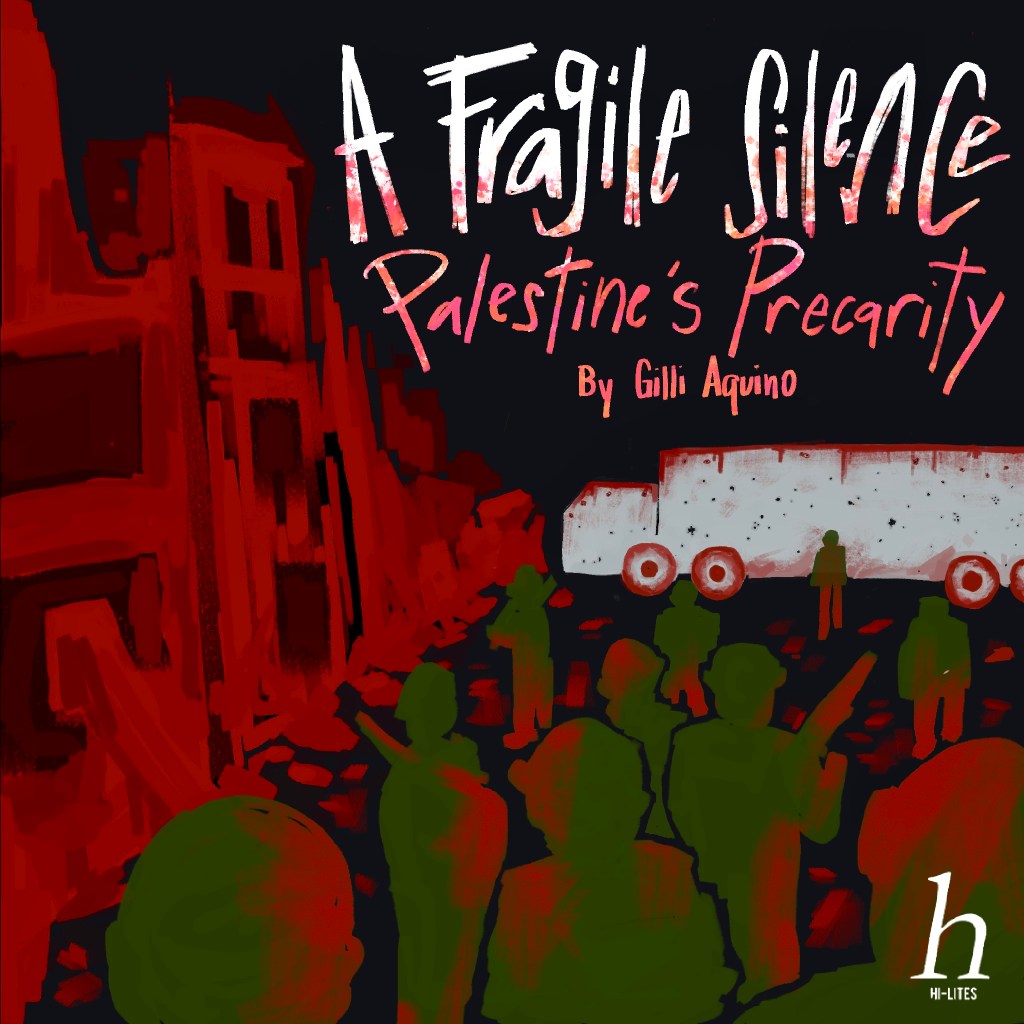
By Gilli Aquino
“Peace, like war, must be waged” – George Marshall
The echoes of resilience reverberate around Palestine as celebrations erupt with the announcement of a ceasefire. With waving flags and hopeful cheers, Palestinians let out a sigh of relief, knowing they may look forward to a night of respite. This ceasefire serves as a symbol of promise for Palestinian families–in the hopes that the rubble and ruin along their streets may again look like the country they call home.
However, despite the rejoices of this announcement, a lingering anxiety seeps within the air as the gravity of grief still hangs over Palestine. Months of never-ending violence, loss, and devastation for Palestine has caused some to remain weary. The implications of this announced ceasefire remain ambiguous; is peace fragile, or is war an unyielding force?
Students in Solidarity
“We must not let the stories of the Palestinian people ring hollow across the globe–all eyes, all ears, must be kept on Palestine”
It has been more than a year since the Palestinian Militant Movement Hamas first launched an attack on Israel on October 9, 2023, killing 1,200 people and taking more than 250 hostages. Since this, the mainstream media has done a good job at downplaying the harsh realities of this ongoing war, as posts that aim to spread awareness of the current situation slowly lose engagement with some even becoming censored, effectively silencing the voices of Palestinians. In the midst of distortion and disinformation it is easy to lose grasp of the realities that the people of Gaza are currently living. However, in spite of these challenges, numerous youth groups and organizations continue to fight for the truth with student activists standing in solidarity alongside Palestinians.
Through educational discussions, fundraisers, and protest actions, Ateneo 4 Palestine is a broad network of organizations, councils, publications, and individual volunteers from the Ateneo system that are united in the movement for the liberation of Palestine. In the words of one of the organization’s heads, Annika Torres, Ateneo 4 Palestine aims to express the solidarity of Ateneans with the global solidarity movement for Palestine and to further this consciousness by linking and raising it to our own struggle for national liberation.
“Ateneo 4 Palestine finds it of utmost importance for Filipinos to further our solidarity beyond sympathy but through a more concrete understanding of our realities and shared struggle.“ Torres details connecting the Philippines’ historical struggle for freedom to the current fight that Palestinians face on a daily basis. The organization believes that efforts are more impactful when they are collective under a clear objective and direction, which they aim to do by providing Ateneans at different levels of commitment and awareness an avenue to participate and foster their solidarity with the Palestinians.
Ateneo 4 Palestine is one of the many youth organizations that continue to bring the realities and complexities of this war to the forefront. As these student activists continue to endlessly advocate for peace, international efforts to mitigate the violence have only just emerged.
A Promise of Peace?
“The call remains, not only for a ceasefire–but the total end to the genocide”
On January 19, 2025, a ceasefire deal between Israel and Hamas came into full effect. Officially announced on January 15, 2025, the deal was drafted through extensive negotiations between the United States, Egypt, and Qatar. The proposal was set out by former United States President Joe Biden in May of 2024 involving three main stages each lasting 42 days.
The first stage involves the release of hostages for both Israel and Gaza, with Hamas to release 33 hostages in exchange for the release of hundreds of imprisoned Palestinians, prioritizing women and children. Stage two involves negotiations for a permanent ceasefire and the release of the remaining Israel hostages and Palestinian prisoners. Lastly, the final stage calls for the return of deceased bodies from both Israel and Palestine, signifying the end to all violence and the beginning of a newly rebuilt Gaza.
From the looks of it, the terms of this agreement appear to be the key to sustained peace between Israel and Hamas, aiming to end the conflict for good. However, the long and complicated history between Israel and Palestine is a multi-layered conflict that is difficult for most to grasp; its deep roots in territorial, religious, and political matters make it impossible to solve overnight.
“The ceasefire, although a much-awaited pause and temporary victory for the Palestinians who had been under siege for 500 days and counting, had never been for the genuine end to the genocide,” Torres explains describing this announcement as a temporary tactic in response to international pressure, rather than an action for permanent peace.
While the ceasefire agreed upon between Israel and Hamas has officially been put into action, various challenges and violations from both parties have strained its implementation. Merely a few days after January 19, 103 people were killed, and more than 264 were wounded as a result of Israel’s attacks. Israel has been consistently accused of violating the ceasefire agreement, from blocking humanitarian aid into Gaza to launching airstrikes killing and wounding hundreds of Palestinians.
“Even with the ceasefire deal, Israel had transgressed all conditions, barring relief trucks, denying Palestinians medical help, and even continuing to launch offensives under it,” Torres states. “It is clear that the ethnic cleansing of Palestine was never about self-defense, nor any hostage.” She explains, defining it rather as a violent process of colonization that escalates each day.
The obstacles that have arisen merely a few days after the ceasefire was put into effect portray this deal as an empty promise rather than an effort at peace. Given the lengthy history of unsuccessful efforts of reconciliation between Israel and Hamas, it may not be surprising that violations continue to arise despite supposed agreements. With numerous extensions, delays, and outright disobediences, the eventual end to this conflict remains uncertain.
A Call to Youth
“Students have always had a historical precedent and task to ally themselves with the oppressed peoples of the world.
With the internet at our fingertips, today’s generation has become increasingly desensitized to the injustices happening all around the world. It is tempting to look away from distressing and overwhelming information that often makes us feel powerless. However, it is in this exposure which unlocks the responsibility of our generation to continuously advocate against these injustices.
“Our task, as the youth, is to be responsive to the urgent call of the times, of the conditions of society–to be unable to tolerate injustice and violence wherever it exists.” says Torres on the responsibility of the current generation. The recent intensification of the attacks on Gaza is not merely a call for awareness, but a cry for us to exhaust all opportunities to fight for its end. For Torres, this entails the recognition of our role in society to shape a commitment to pursue justice and lasting peace, even as mere students.
While the term “student activist” may seem to be a daunting role to fulfill, it does not necessarily require the creation of rapid world-changing solutions. Rather, it entails the drive to advocate for human rights within the world that currently surrounds you, in the hopes that this will spark a ripple effect of permanent change. In the words of Torres, “Being students, we have the time and energy to arouse masses of people, even exponentially–to spread the word from a baseline of simple awareness, up to the point of action and mobilizing for true justice and lasting peace.” As updates on the ceasefire continue to emerge, we must strive to keep this discourse going through standing in the face of deceit and disinformation.
The resistance to disinformation is not something entirely new to Filipinos. According to Torres, looking at this issue from the perspective of a Filipino involves linking our struggles not just as a student but as a nation in order to identify the common root of our hardships. As a country with a complex history of colonization, the fight for freedom is a battle that should resonate amongst all Filipinos. These shared experiences give us the responsibility to ceaselessly fight for the emancipation of others, such as Palestinians. This collective duty extends beyond borders, reminding us that the pursuit of peace is a universal struggle.
As students, we are not just passive observers of history—we are active participants in shaping its course. The fight for justice in Palestine is not an isolated struggle; it reflects broader issues of oppression, colonialism, and human rights that resonate across the world, including in our own country. Its conflict is one older than every individual who continues to write, speak, and fight for the hope of peace. It may not be a war we will ever fully grasp, but what we must continue to understand is the reality that innocent Palestinians face every day. At the end of every territorial, religious, or political matter is an innocent family caught in the crossfire. Peace is not the absence of conflict but the presence of will to remain unbreakable, and it is a peace we must persist to fight for.
 HiLites ASHS