
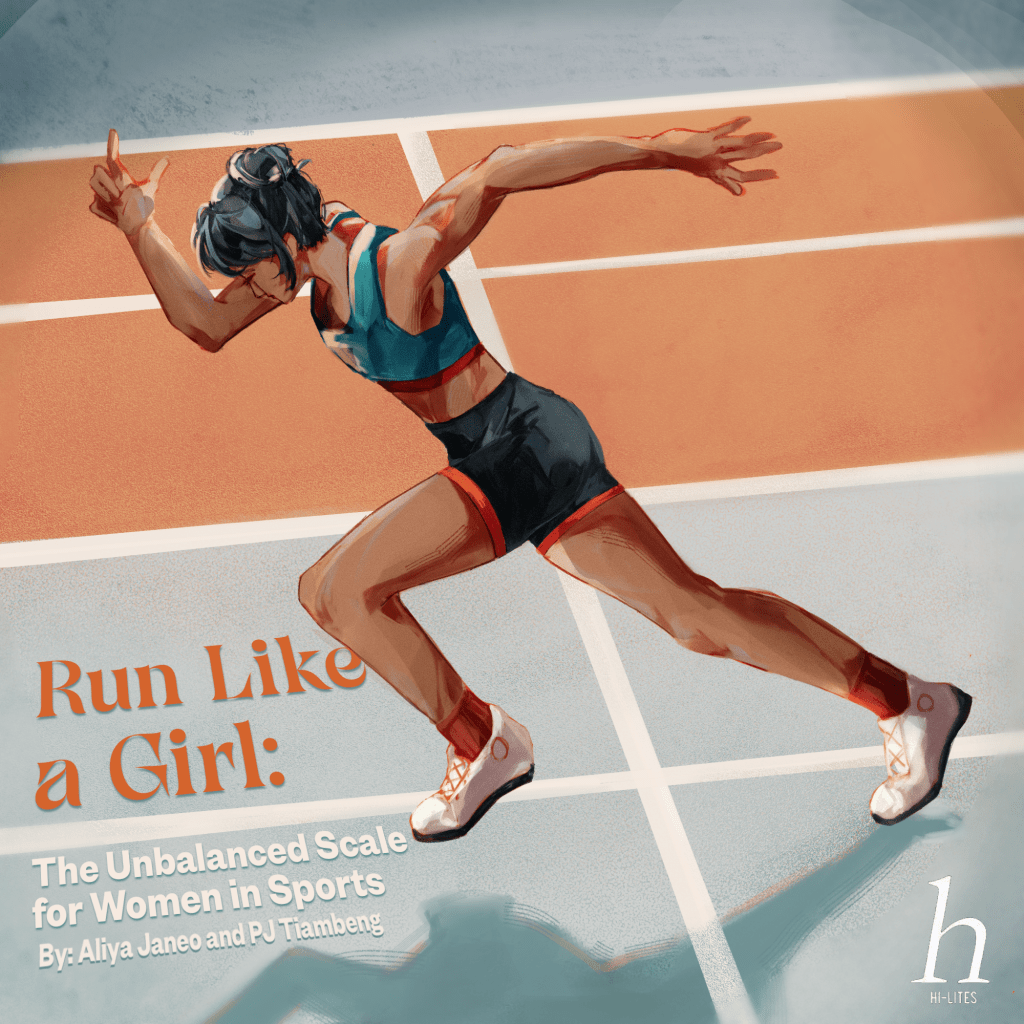
By Aliya Janeo and PJ Tiambeng
Run like a girl. Throw like a girl. Play like a girl.
For as long as sports have been present in society, the opportunities for women in sports have been limited. Although there are many women-athletes bursting with talent and potential, part of our world today is still stuck in the ancient mindset— the playing field is a man’s field. However, that is far from the truth, as women-athletes are constantly pushing the boundaries to prove that playing like a girl means to play strong, with all heart.
The History of Women on the Playing Field
Sports slowly started seeping into the cracks of society during Ancient Grecian times when the earliest form of the Olympics were established. Women had a miniscule share of sporting events during this time, often limited to occasional footraces or small events for good show to honor the Divine. Still, while the torches of the games burned bright, the blazing spirit of women were put out as even spectating the games was a privilege only for the men to have.
On the contrary, the women of Ancient Sparta had the free will to participate in more sporting events such as wrestling and javelin throwing. Sparta itself was a society ahead of its time that held women to a high regard, viewing all its citizens as equals. In a more fortunate universe, sports would be a modern Sparta where all men and women are seen of equal skill.
Honing in on the Philippine context, women’s colleges have been the starting point for women-athletes in the Philippines— giving women the chance to compete for fun and nurture passions they never knew existed. Following this, the Philippine Women’s Basketball League was established; though not possessing the same visibility and attention as the men playing the same sport, they still persisted to take up the space they deserve.
Now, the country prides itself on talented women-athletes such as Olympic Gold Weightlifter, Hidlyn Diaz and Motorsports driver Bianca Bustamante— women-athletes like them continue to wave the flag of the Perlas ng Silangan, and that flag is one that is slowly being waved higher than ever before.
A Woman-Athlete’s Love for the Game
“Victory feels even greater when shared with those who believe in you”
There’s nothing more fulfilling than stepping on the top spot of the podium and realizing your blood, sweat, and tears have all more than paid off. Yet, a feeling that can equalize the thrill of a gold medal is the support that comes from the people around you who have seen you at your strongest and at your weakest. This sentiment resonates heavily with the Captain of Ateneo’s high school swimming team, Liaa Amoguis, whose trophies are a reminder of the school she represents and the rigorous training that continues to pay off.
Amoguis’ love for her sport began in her childhood; always drawn to the water as a child, her mother took this as an opportunity to nurture both an essential skill for survival and passion. Currently competing for the Ateneo Fast, her competitive spirit has been sparked by coaches who believed in her potential and encouraged her to swim to greater lengths— proof that a sturdy support system can go a long way.
“Those moments on the court, knowing we gave it our all, made everything worth it.”
The blue and white flag of Ateneo is a heavy one to carry, yet it is a great honor to wield the name of the mighty eagle. For Seth Cacanindin of the Ateneo girl’s basketball team, to represent Ateneo is motivation enough to get through each game. Every court appearance, win or lose, is a showcase of all the hard work the team and its coaches have dedicated to the sport— a show of resilience and drive.
Cacanindin’s basketball journey first started when she represented her section in grade 11 for the girls 3×3 basketball event during sportsfest. Besides one clinic over summer with friends she attended for fun, Cacanindin’s experience representing her section has been the only time she has been able to exercise her budding talent. Still, this didn’t hold her back from taking a chance with the girl’s basketball team, and opening up to new relationships, lessons, and memories.
Slow Swimming with a Side of Fouls
“She’s good– for a girl.”
Although the early training hours and constant fatigue have amounted to good results for Amoguis, that doesn’t mean that she hasn’t had her own share of run-ins with the stereotypes and microaggressions many women-athletes face. “True recognition comes from valuing an athlete’s dedication and hard work, not qualifying their achievements based on gender,” Amoguis states as she details her own experience of people undermining the effort she has put into her sport— the best effort in her perspective.
But of course, there is more to sports than just winning 24/7— the ball is round and anything is possible. Amoguis details instances where she has fallen short of her own expectations, and the doubt that seeps into her morale when she makes a mistake; losing is inevitable, but it is not the end. It has taken many mistakes for Amoguis to realize that her failures are simply stepping stones for growth, and since then she has taken this lesson with her as she works with her coaches to improve where she falls short. Still, staying true to the sentiment of a strong support system, she mentions how the motivation and comfort that comes from her number one fans— her team, friends, family, is truly a guiding current when she feels lost.
“Every game taught us something, and I think that growth says a lot about our determination and character.”
Cacanindin and the girl’s basketball team have been at the receiving end of much criticism following the end of their UAAP season; with Cacanindin even reiterating the sentiments of Freedom Wall entries that talked about how boys that weren’t even on the varsity team would easily outshine them. Still, Cacanindin responds to this by stating how men and women are in different divisions for a reason: “…we’re not trying to prove we’re better than the boys. We’re here to grow, improve, and compete at our best within our own league.” She emphasizes that although the team’s UAAP run wasn’t the most triumphant, they still held their own during the AAPS (Athletic Association of Private Schools), and the growth that came from these events are much to be proud of.
Similarly, a reliable group of supporters seem to be a common light for many athletes in general, as Cacanindin believes that her teammates have been motivation for her to push through the academic burdens she has to balance alongside varsity duties. She talks about days when she has had to skip training due to the sheer exhaustion that comes with commitments inside and outside of school; at the same juggling the pain that comes from losing games after tireless training sessions. Still, Cacanindin and many women-athletes continue to hold their heads up high and look past these losses, as of course, the final score does not dictate the labor and love that goes into sports.
An Unjust Play
In 2024, no woman placed in the list of the world’s 100 highest paid athletes. Even as women devote themselves to their sports to the same degree as their male counterparts, women’s sports athletes and teams have had a long standing-struggle of unequal pay in sports. Female athletes earn 80 – 84% less than males, three times more than the 20% pay gap average worldwide. It is unfair. But with little support and promotions, comes lower revenues which, more often than not, lead to unequal pay. Sometimes, however, even if women’s leagues do have high revenue, they continue to be undervalued. For example, despite the US women’s team making $20M more in revenue in 2015 after they won the world cup, they were only paid a fifth of what the men were paid.
Other than their wage, their prize money is also less than men’s. Another example, in 2023, the Women’s World Cup was awarded 150$ million in prize money. Though it was a 300 percent increase from 2019, it was still only about a third of the 440$ million the men got in Qatar 2022.
Even worse, there is a prevalent issue of Wage theft (unpaid salaries) for women’s teams in Jamaica, Colombia, Nigeria and South Africa. A recent study by FIFPRO, the global professional footballers’ union, found that 29 percent of women players who responded had not received any payments from their national teams for World Cup qualifying tournaments.
Another issue though is with less recognition for women in sports, less of them are encouraged to step up to pursue it. In the Philippines, with fewer female athletes in basketball, it is difficult to build a full roster and fund successful competitions, teams, and leagues. This is especially true in the rural areas, where teams already struggle to get exposure to quality matches. Female athletes are also not able to get much access to higher levels of competition or opportunities to make sports their career.
The Next Step for Women in Sports
Both Cacanindin and Amoguis have their eyes set on academic pursuits after high school. Though they are grateful for their experiences with their sport, they do not see themselves pursuing athletic careers. They will however, continue to keep these as hobbies and cheer for Ateneo.
“I recently saw Sabrina Ionescu… it was so surreal to see her play with my basketball idols from the Philippine National Basketball team, Gilas. Moments like that are inspiring, not just for me, but (also) for girls younger than me who dream of pursuing basketball.”
Cacanindin is ecstatic to say that she has definitely noticed more exposure for women’s sports now compared to before. She also recognizes the rising popularity of Women’s football, reflecting on watching the Las Filipinas play in 2023 and celebrating the recent wins of the Ateneo girls’ football team, which her own teammates are a part of. “The growth is promising, but there’s still a long way to go. More exposure, more support, and more awareness will greatly benefit women’s sports in the Philippines. It’s only up from here!” she said.
“I’ve seen female swimmers work just as hard but face more challenges in gaining recognition and leadership roles. While the sport is fulfilling, true equality still requires greater support and visibility for women.”
In agreement with Cacanindin, Amoguis says that women’s sports have come a long way, but gaps in funding, media coverage, and recognition remain. In swimming, opportunities have grown for women. Nonetheless, men’s events still gain more attention and sponsorships.
One female athlete hailing from the Philippines that has recently gained traction si Alexandra Eala. Many of our countrymen watched her matches with anticipation, cheering her on. And after being the first Filipina to reach the semifinals in the Miami Open, Eala recently became the first Filipina in the World’s Top 100 on the Women’s Tennis Association website. She sets an example for just how much potential and skill our Filipina athletes already have.
We should continue to appreciate and support our female athletes and teams. Recognize their hard work and their accomplishments, celebrate with them, and cheer for them as well. After all their blood, sweat, and tears, they deserve their own stardom, with or without the winners’ podium.
 HiLites ASHS