
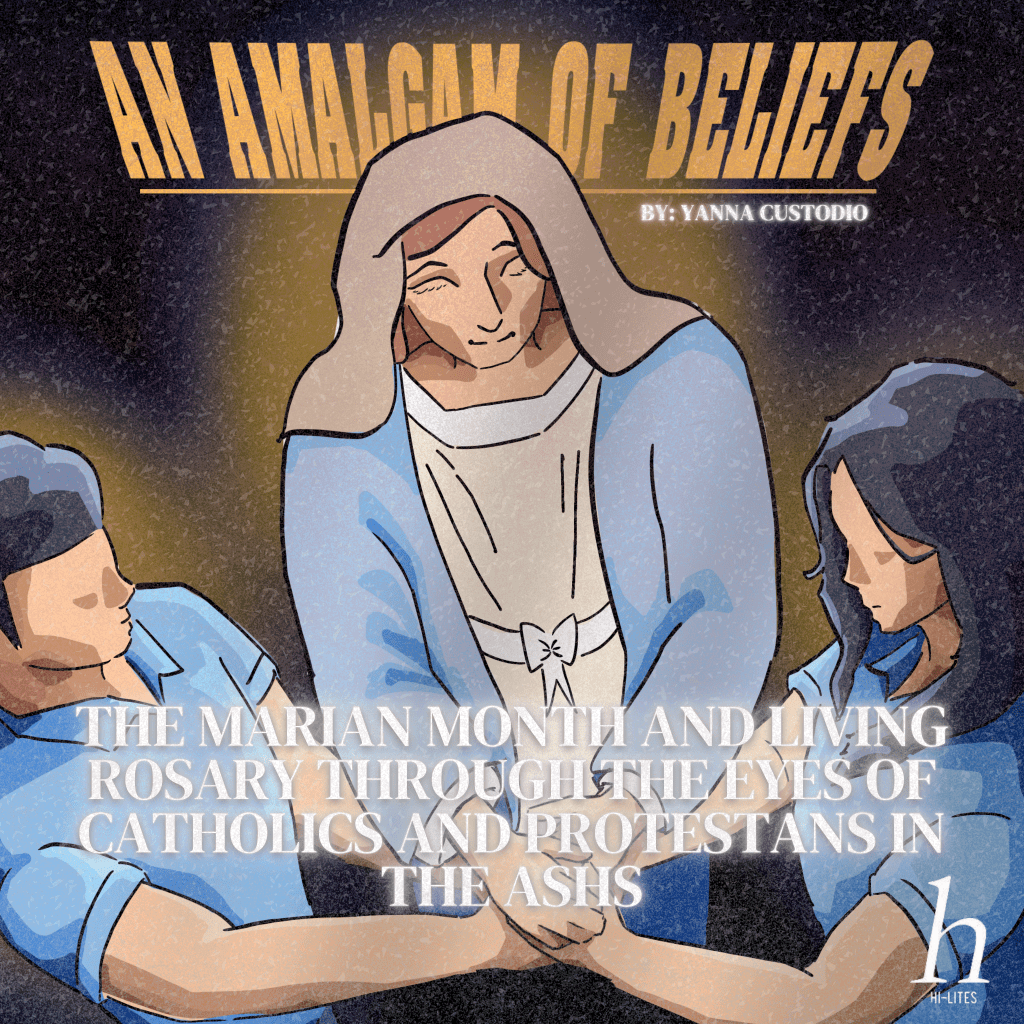
By: Ellianna Custodio
If there was one string the human race adamantly held onto, it has always been religion. It is what provides meaning for the life of some and a sense of purpose for others. Our religion, the faith we have in God, is where the needle of our moral compass points to, the foundation of our beliefs and customs — and with these customs come the celebrations.
Each religion has a different manner of upholding traditions that are as old as time. Some conduct idyllic festivals, declaring their beliefs through varicolored embellishments and high-spirited communal merriments, such as the Flores de Mayo, Sinulog Festival, and the Dinagyang Festival — on the contrary, some festivities are done through solitude, as its constituents seize that time of stillness to plant the roots of their faith deeper within. Either way, both approaches carry similar intentions, which is the celebration of what we believe in, and the Ateneo Senior High School (ASHS) does not lag behind with sustaining the prevalent Catholic culture in Ateneo as a whole.
Though the ASHS is a Catholic institution in all technicality, its student body poses diversity in varying degrees. Among those degrees is the divergence of beliefs and manners in which one’s faith is practiced, despite the majority of the population comprising the Roman Catholic denomination, it is undeniable that the ASHS can still be considered as a school where there is a coalescence of religions.
Last October, the ASHS community celebrated the Living Rosary as well as Marian month. It is through events like these alongside the regularly orchestrated masses, Catholic topics ingrained in the curriculum, and the Ignatian maxims employed by the institution as they nurture and mold the values of the students that show the strength of Ateneo’s belief in the precursory Jesuit tradition of the school.
With all these matters now at hand, it is important to acknowledge that Catholics and Protestants are two sides of the same coin, coexisting together in the ASHS community and sharing the same anchorage of Christianity in their faith. Throughout the month of October, what could be the uncharted accounts and stories on the festivity of the two aforementioned respective communities sharing similar foundational beliefs?
Through Her Peace
Consueverunt Romani Pontifices (“The Roman Pontiffs are accustomed”) were the first words written on the papal bull, declaring the rosary in its present configuration. Its author, Pope St. Pius V, established October 7 as the feast of “Our Lady of the Rosary,” in light of the Christian cohorts’ triumph in the Battle of Lepanto on October 7.
Preceding that battle was the hearty request of St. Pius V for the Christians to pray the Rosary, and so, when victory came knocking at their door, he implored all to owe their win to the compelling power induced by the Marian prayer.
The month of October possesses indubitable significance in Catholic culture, its essence does not only weigh in the formerly mentioned context in history, but in the spiritual journey of Catholics as well. With this month, the community is reminded of the purports of the Rosary and the power it yields in the navigation of our day-to-day occurrences. The intent of the month encourages the sodality’s devotion to prayer with the Rosary as a vital tool and prompts them to remember who Mary is in salvation too, as she is the Mother of God, regarded as the Queen of Saints, and is deemed as the beau idéal of faith.
“We reflect on her role as the Mother of God and her model of faith so that, in return, we can also exemplify the same,” Margareth Valenzona, head of the Ateneo Catechetical Instruction League – ASHS (ACIL-ASHS), stated when asked about the significance of October in Catholic traditions and beliefs.
Valenzona deems these practices and those of the like to be a means wherein she can nurture her faith and immerse herself in God’s love and mercy. Through celebrating the Marian month, her relationship with Mary was further nourished as it provided opportunities for personal reflections — and with these reflections, a belief she upheld within her was strengthened, the belief that Mary gives her a hand in reflecting her life through her image of faith, obedience, and humility. To Valenzona, Mary’s intercession can bring her prayers closer to Jesus, her Son.
“Celebrating the Marian month and praying the Holy Rosary feels like a personal time with Mary, where I can turn to her as a mother figure who understands my struggles and joys,” Mr. Mark de Guzman noted, conveying the feelings invoked within him throughout the month.
To de Guzman, a teacher from the CLE department, the celebration of the Marian month as well as praying the Rosary reinforces his faith and illuminates his path in growing closer to Mary — and to the larger Catholic family too, knowing that he is sharing this profound tradition and praying fervently alongside others.
The eminence of peace, comfort, and solace within de Guzman was as clear as day for the entire duration of October as he gained inspiration from Mary to break free from the shackles that hold him down and surrender everything to the will of God because of Mary’s faith in Him.
“By dedicating a month to Mary and the Rosary, Catholics deepen their spiritual lives and foster a closer relationship with God,” De Guzman expressed when asked about the significance of the Marian month and the Rosary.
Through His Grace
Though predominant, Catholic practices coexist with other beliefs in the ASHS, with one being the previously mentioned existence of Protestant Christians. Unmediated prayers to God, redemption of sin as well as salvation only through His unmerited grace and faith in Him alone are some beliefs that are interwoven into the culture of Protestantism — and being a part of that community in the ASHS means being met with one eye-opener after another in terms of celebration, application, and enactment of Catholic beliefs.
“October seems to hold great significance for Catholics. As a month dedicated to honoring Mary, it is a time when Catholics are reminded to reflect and embody her values in their daily lives,” Jade Espino, a Protestant Christian from 11-Hoyos, answered when asked about her personal understanding of why celebrating October as the month of the Living Rosary and as a Marian month is important.
The worshiping of Mary is not an effectuated practice in Protestant Christianity, nor is the usage of the Rosary during times of prayers, and so the direct exposure to both during the month of October may have brought upon feelings of incertitude to the community at hand — and a thorough comprehension of the manner in which the celebration was enacted may be rather farfetched in the case of Protestants due to the differing — and withstanding — belief systems.
Despite this, the celebration can be deemed as a time when Protestant Christians may have gained a wider understanding of what significance Mary holds in the birth of Christ and the prominence of the Rosary in the prayers of Catholics.
“It is amazing to see that she is still praised and prayed to, receiving recognition from the Catholics, when [Protestant] Christians do not give her that same praise,” Daisy*, another Protestant Christian, exclaimed in awe.
As the days of October crusaded through the fabric of time, the unceasing clutch of confusion breathed down the necks of Protestants. Questions of why’s and wonders fell into a roster as individuals part of this community were entangled in the middle of an unfamiliar religious structure.
For some, growing accustomed to the practices employed in the ASHS was somewhat of a cakewalk as prior exposure has already taken place for their personal experience, while for others, breezing through it might be anything but a doddle due to the freshness of some concepts and their direct contact with them. Then there could be some that stood in the gray area as there were traditions that did not align with Protestant faith but still took into account the mutual basis of Christ even with the differing practices.
Espino beamed, “Praying the rosary before class felt uplifting as it helped us make time for God before the hectic day began. The mysteries also helped us to reflect on how God would want us to live our lives.”
And for individuals such as Espino, they found October as a leeway to dig further and deeper within their faith. In Protestant Christianity, intimacy with God through prayer is given emphasis. Akin to how the prodigal son wound back up to the father after splurging his inherited wealth and committing one sin after another, prayer is how Protestants retrace their trail back to the Lord — ergo, their personal beliefs could still somehow be acted upon, and this can be said even beyond the days of October as praying is also a heavily integrated fundamental element in the ASHS.
“I think both Protestant and Catholic believers could gain something out of exploring each other’s perspectives,” Basti*, a devout Protestant Christian, expresses.
Upon the settling of the sun, whichever angle this matter can be looked from, it is beyond doubt that Protestantism and Catholicism tread their paths on the same sidewalks, trudge through storms beneath the same umbrella, and derive direction from the same map, all of which being Christianity.
It is nearly impossible for this one piece to encompass all harboring creeds from every Protestant Christian in the ASHS; to say that the heaves laid here cannot embody the fixed thought this community might have would be stating the obvious. Nonetheless, the sheer, fine lines between the two belief systems are endowed with our resolve as a Christian community in our recognition and steadfast faith in God’s omnipresent love and mercy for us.
Daisy* preaches —“He loves without restraint.”
Through our Faith
Over the course of the month, the community was able to celebrate the Living Rosary and give an ode to significant Marian images — the efforts exuded by the Campus of Ministry Office (CMO) are deserving of acknowledgement and applause. Eyes were opened, faiths and beliefs were strengthened, the celebration was able to embody its intent, and the ASHS populace was able to come together through Him.
The Lord is our golden thread, tying us all together with His grace, love, and ultimate sacrifice. Though Catholicism and Protestantism stand in different places, both are planted upon the same soil and are sown from one type of seed. We, as an institution, as a community, stand firm in our resolve — that His grace saves, that His love paves.
Some lines between practices and the celebration of our Lord between the two denominations are blurred, while others are distinct. Ultimately, both manners are vessels of the faith we are affirmed in, of the faith that we have in Him. Both grasp onto the same maxim, letting that faith shine through: To find God in all things.
In the book of Genesis, a famed parable can be found — Noah’s ark. In that scripture, the Lord gave Noah the order of building an ark and to garner a pair of each kind of animal for the incoming deluge. As Christians, we are two halves of that pair, standing firm on the ark we rely on, the ark that shows who He is and the preeminence of His mercy.
We are of the same kind, we are from the same love, and to that love we will both exalt and shall return to.
“All the believers were one in heart and mind. No one claimed that any of their possessions was their own, but they shared everything they had.” — Acts 4:32.
Names marked with an asterisk (*) are pseudonyms and were used in place for interviewees who opted to remain anonymous.
 HiLites ASHS