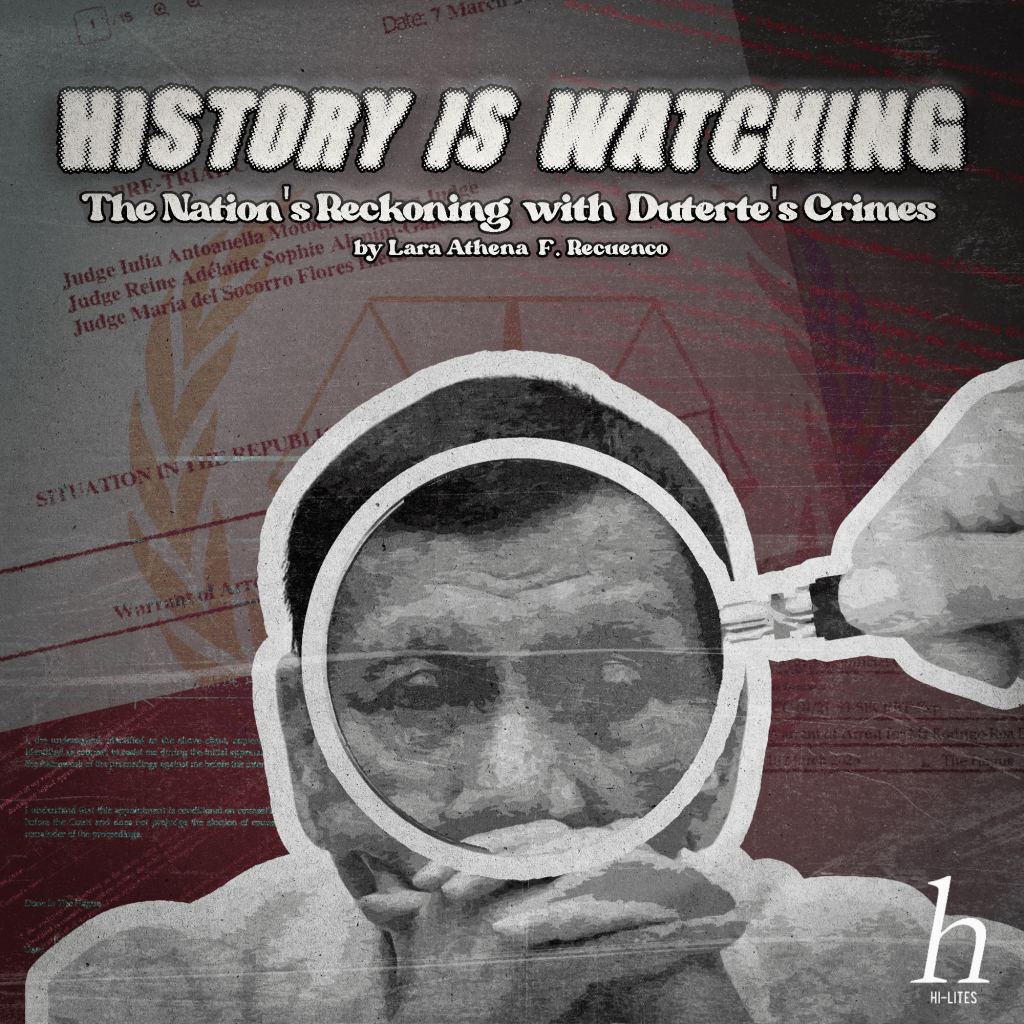
By Lara Athena F. Recuenco
Rodrigo Duterte’s presidency was marked by the controversial War on Drugs and widespread allegations of human rights violations. His administration’s policies led to extrajudicial killings and a culture of unaccountability.
As demands for justice increase with the International Criminal Court’s (ICC) investigation, the pressing question persists: Should former president Rodrigo Duterte face prosecution, or will the Philippines remain trapped in the denial of rightful justice?
Going back to the 2016 Philippine Presidential election, Duterte’s reputation as a tough-talking anti-crime crusader resonated with Filipino voters seeking decisive and firm leadership. In addition to that, his time as Davao City mayor amplified his image as a strongman extremely capable of enforcing order. This appeal to public desire for security, along with his promise to eradicate crime within a few months of taking office was indeed pivotal in his electoral victory.
The Deadly Cost of Duterte’s War on Drugs
Once in power, Duterte wasted no time in fulfilling his campaign promise through an all-out War on Drugs. Relentless police raids targeting suspected drug users and dealers that operated under the order of “shoot to kill,” were launched. Despite the officials’ claim that these operations were necessary to restore peace and order in the country, numerous reports of injustices and human rights abuses quickly surfaced.
Extrajudicial killings (EJKs) became rampant, disproportionately targeting impoverished communities where many individuals were killed without due process. Thousands were left dead in the streets under highly questionable circumstances, while the government dismissed these deaths as the unavoidable cost of fighting crime.
The numbers behind the killings remain highly contested, as the official number reported by the Duterte administration through the Philippine Drug Enforcement Agency (PDEA) was 6,229 deaths as of March 2022. However, independent investigations, including findings by the Commission on Human Rights (CHR), estimate the actual number of EJKs to be significantly higher, estimating the total death toll to be around 27,000 to over 30,000.
Many of those who were killed had no proven ties to the drug trade, with some being mere bystanders and even minors caught in the crossfire. In spite of mounting evidence of abuses, as well as international condemnation, Duterte’s administration continued to downplay the allegations, portraying the drug war as successful in reducing crime.
For the families of the EJK victims, the search for justice has been a painful and futile struggle. The Philippine justice system has immensely failed to hold perpetrators accountable, with only a handful of convictions in thousands of cases.
The ICC’s Fight for Justice in the Philippines
In 2017, numerous complaints were filed before the ICC, accusing Duterte and his administration of orchestrating a systematic campaign of violence against suspected drug offenders. By 2018, the ICC had officially opened a preliminary investigation regardless of Duterte’s attempt to dismiss the allegations as foreign interference. Even after the Philippines withdrew from the ICC in 2019, the court maintained jurisdiction over crimes committed while the country was still a member, which led to the approval of a full investigation in 2021.
The ICC investigation represents the last hope for justice for the victims or EJKs and their families, as, clearly, the legal system of the Philippines has primarily failed them, considering that cases against police officers and government officials rarely prosper. While the perpetrators of the War on Drugs and the many accounts of EJK remain free and unbound by the country’s legal system, the innocent victims who were killed without due process and their unfortunate families continue to face threats and intimidation.
As the Philippine government remains unwilling to conduct a genuine investigation, human rights advocates and victims’ families turned to the ICC, strongly hoping for international accountability. Despite the Duterte administration’s attempts to block the probe, the ICC ruled in early 2023 that the investigation would continue while citing the lack of credible efforts by the Philippine government to prosecute those responsible.
The evidence against Duterte is overwhelming, including reports from human rights organizations, testimonies from witnesses, and even leaked police records. Several police officers and hitmen have publicly admitted that they were ordered to kill drug suspects, often for cash rewards. Moreover, the CHR and the United Nations (UN) have all documented thousands of cases where due process was ignored. Even in Duterte’s own speeches, he admitted to purposefully encouraging police to kill drug suspects, which is being used as evidence of his direct role in these crimes.
However, Duterte’s allies like former police chief and senator Ronald “Bato” Dela Rosa, who helped implement the drug war, remain steadfast in defending him. Other loyalists and Diehard Duterte Supporters (DDS) also argue that the war on drugs was necessary and that the ICC has no jurisdiction over the Philippines — emphasizing that Duterte did nothing wrong.
On March 11, Duterte was finally arrested at the Ninoy Aquino International Airport (NAIA) upon returning from Hong Kong. The arrest was executed by the Philippine National Police (PNP) in coordination with International Criminal Police Organization (Interpol), following a secret arrest warrant issued by the ICC on February 10, charging Duterte with crimes against humanity, including murder, torture, and rape, linked to his war on drugs. Immediately after the arrest, Duterte was transported to The Hague, Netherlands, where he is currently in the ICC custody awaiting trial.
Holding Duterte Accountable for his Crimes
The said arrest has further exposed the deep divide in Philippine society. While many consider it as a long overdue step toward justice, it is disheartening to know that a significant portion of the population continues to defend him, especially the Duterte loyalists.
The prioritization of Duterte’s legacy over human rights raises critical questions: Why do some Filipinos value authoritarian rule over the lives of thousands lost? The normalization of extrajudicial killings and abuses under the Duterte administration reflects a dangerous precedent — one where the illusion of stability and discipline outweighs basic human rights and dignity.
By excusing Duterte’s actions, a political culture where leaders can rule with unchecked power is enabled. It sends a chilling message that as long as one commands influence, human rights violations and abuses of power can be justified. The fight for justice is not just about holding Duterte accountable. It is about preventing future leaders from wielding authority without consequences.
The prosecution of Duterte is a defining moment for the Philippines’ commitment to justice and the rule of law. Holding him accountable is more than just a legal battle. It is about ensuring that no one, no matter what position they hold, no matter how powerful, is above the law.
This case has the potential to reshape Philippine politics, setting a new precedent that leaders cannot act with impunity and expect to escape the consequences. For too long, the country has immensely struggled to confront past atrocities, allowing a cycle of abuse and unchecked power to persist. Breaking this cycle requires the courage to face uncomfortable truths and to reject blind loyalty that enables oppression and injustice.
We Must Never Forget. Never forget the lives lost in Duterte’s brutal war on drugs.
We must never forget about victims like Kian delos Santos, who was only seventeen years old when the police blatantly ignored his pleas for mercy and executed him. Never forget Carl Arnaiz, Reynaldo de Guzman, and the thousands of others whose deaths were reported as numbers and dismissed as mere statistics. Their families continue to seek justice in a system designed to silence them.
Filipinos must not shy away from their past but instead learn from it in order to build a future where justice prevails over political influence. Only by standing firm in demanding truth, reform, and accountability can prevent history from repeating itself and ensure that never again will the lives of thousands be sacrificed in the name of power.
Never forget. Never allow it to happen again.
 HiLites ASHS