
By Marielle Orbong
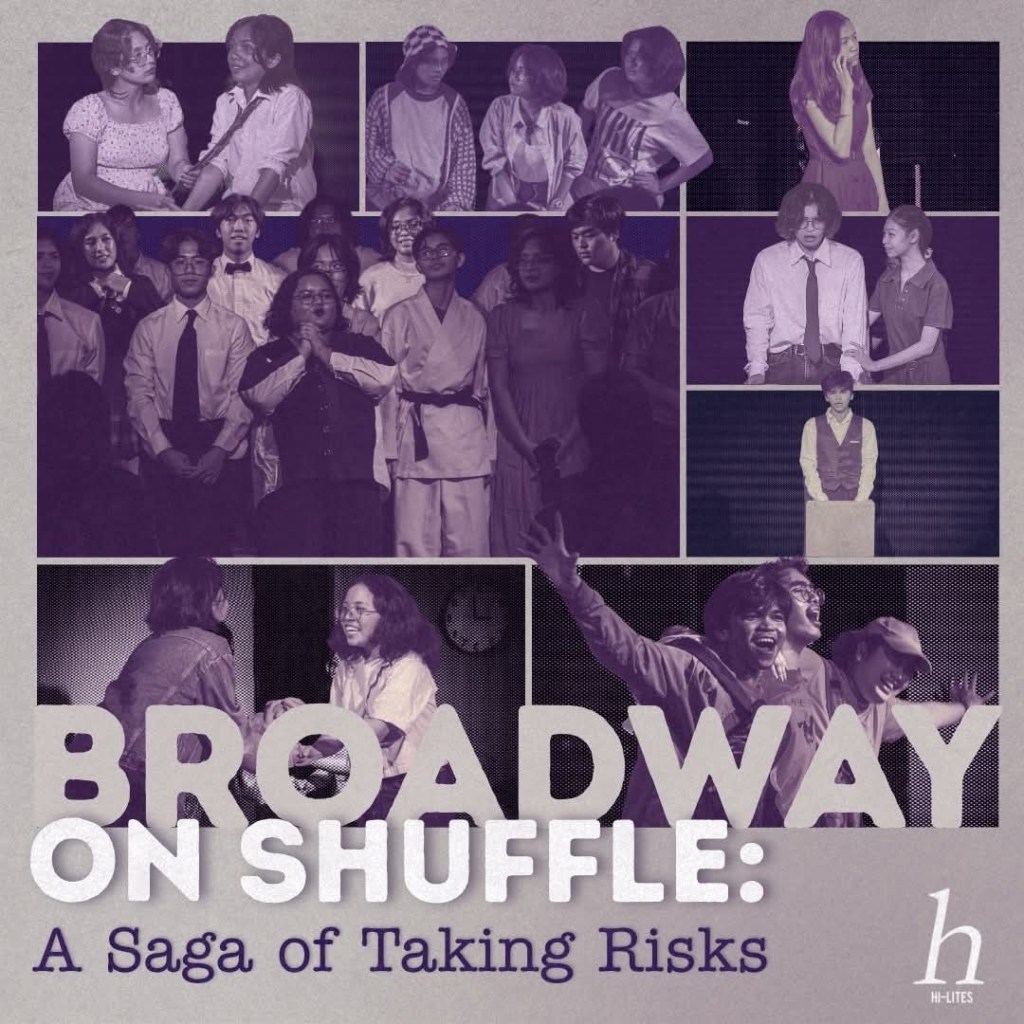
Everything started with the story of uncertainties. Despite being presented with a plethora of opportunities, the characters remain uncertain about how to take the leap of faith. With minds engulfed with what-ifs, they nevertheless demonstrated the courage of facing the unknown. This is exactly what the Broadway Theatre Troupe of Ateneo (BTTA) gave a spotlight to in their exhibit of “Broadway on Shuffle.”
Performed on May 15, 16, 20, and 21, the organization showcased their rendition of a total of 14 musical numbers featuring songs from various musicals. Divided into two acts — five plays in Act 1 and six in Act 2 — the cast played different stories about taking risks on something that they have been holding within themselves for a long time.
Act 1: Towards the incertitude
Upon the opening of the show, the audience was serenaded with the melody of the deep emotion the main characters carry — doubtful of chasing the impossible, yet clinging to the strong longing to find their purpose. The actors gathered on the stage to sing their lines from the song “Relativity,” by Brian Hill, greeting the venue with a glimpse of what to anticipate from the rest of the show.
Suddenly, the stage’s vibrant lights gave way to a dim glow. With that, the first short story of Act 1 commenced. It was a narrative about two friends, Kai and Ash, who wish to see where fate will lead them. Kai, a girl who wants to take the risk of confessing her feelings to the man she has admired for a very long time, is encouraged by her best friend, Ash, to face up to the trouble she is experiencing by allowing her feelings to reach the guy.
Incorporating their experiences into the song, “When He Sees Me,” from the musical “Waitress,” the actresses brought the personalities they played to life by emphasizing each line they delivered with passion.
As the first play came to a close, two new sets of characters were revealed in the spotlight. Rachel, the mother who is afraid of how changing herself might equate not being able to fit in with her friends, is being advised by her daughter, Sara, to take the first step of conquering her fears by facing her friends’ opinions. Despite having second thoughts about what to do, Rachel was progressively persuaded by Sara to be brave enough to embrace a sense of self-acceptance.
Through the expressive dialogues they dropped from the lyrics of the song “I’d Rather Be Me,” of the film “Mean Girls,” they demonstrated how their mother-daughter relationship, rooted in deep love for one another, leads them to growth.
Moving on to the third play, the venue was introduced to the new setting of a workplace. It depicts the encounter of an employee, Hannah, who is having a hard time with her current company, and eventually gets an offer from her old coworker, Sarah, to join her own business instead. Together with Sarah’s assistant, Jackie, they motivated the main character to take the chances. Despite being scared, Hannah musters the courage and embarks on a new chapter of her life, for the better.
Doubtful to let go of the known path, Hannah nevertheless faces her fears. The cast resonated their feelings with the song “Other Side,” from the musical “The Greatest Showman,” filling the atmosphere with emotions.
The next play resonates with the preceding one in the sense that it also tackles the what-ifs of an employee named Jessamine who desires autonomy. It started with a meeting dilemma in which her boss, Carmilla, wanted to decide every element of their company’s magazine — even the tiniest detail of arguing baby blue over powder blue as their branding — making Jessamine frustrated as she is given a limited opportunity to voice out her opinions.
As the message of the song “What If,” from the musical “Firebringer,” becomes its central theme, this fourth play hooked the crowd with the exchange of lines among the characters, which complemented one another with comedy and drama.
Comes the last story of the first act; it illustrates the life of a girl, Abigail, who got an offer from a producer, Mr. Yoo, to be cast in her dream role. However, the fear of this idea consumes her, believing that she could be misled if she quits her steady career to pursue her ambition of working in the film industry. As she has her imaginary talk with her past self and a close friend, Sheldon, she finally gets to take the risk for her dreams after persuasion.
Anchoring the play into the musical piece, “Learn To Do It,” of the film “Anastasia,” Abigail eventually found the answers to questions she used to ponder, and it led her to the direction of her life’s promising tomorrow in the film.
The five stories end with the final song “Do You Hear the People Sing?” from “Les Misérables,” with the main characters of the first act braving into the things that they used to be afraid of. It closes their narratives by singing the lines of not being enslaved by their fears anymore as they move forward on their own respective paths.
Act 2: The chronicle continues
An intermission of a group of coachless mathletes — Percy, Annabeth, and Grover — opened the beginning of the second act. The trio has been striving to reach their goal of competing in a tournament they have always wanted to be a part of. However, challenges still continue to arise. Ares, the coach of the opposing side, supports them as they persevere through the challenges because he recognizes that they are doing their hardest to fulfill their goals.
The song “Drive,” from “The Lightning Thief,” channels the main mantra of their friend group. As they embarked on their dream competition, their burning dedication fueled them to arrive at their destination regardless of the roadblocks they encountered along the way.
For the second story of act 2, it revolves around a kid in a dojo, Kohji, who is afraid to go back to the competition again after what he did in a match before — wherein he tried to interrupt an ongoing match between a blue and yellow belter, thinking that it was obviously an unfair match. After some time, his master, Tora, reached out to him and motivated him to once again enter the competition he used to join.
It was a hard decision at first for Kohji, but he eventually conquered his deepest regrets. Putting his emotions aside, he had a conversation with his master through the song “Go the Distance,” from the show “Hercules.”
This was then followed by the journey of a family who lost their beloved son in an accident. It went on with parents Lapuz and Selena sending their final goodbyes to their deceased son Sol’s casket. As they say farewell, Oulan, their son’s best friend, who was present when Sol died in a vehicle accident, encounters an internal conflict. He harshly blames himself for the outcomes, feeling sorry for himself and utterly devastated.
Through the melody of “Words Fail,” from the film “Dear Evan Hansen,” Oulan was able to connect to Sol’s parents and served as an opportunity for him to communicate all the words that he had been holding within.
Moving on, the following play presented a fresh setting for the theater by focusing on the humorous love story of Charlotte, the suspect in her husband’s death, and the attorney on the opposing side, named Atty. Reynolds. As Charlotte’s lawyer, Atty. Schmidt defends her, it turns out that she has another idea running through her mind — to declare her love for the attorney Reynolds. Perplexed by the situation, Atty. Schmidt walks out of the courtroom as Charlotte continues to beat the odds and charm the one she prefers.
The song “Elephant Love Medley,” from “Moulin Rouge! The Musical,” became the primary connection between the two main characters as their romance developed throughout their plot, making the audience chuckle as they exchanged dialogue about how confidence turns the tables around for Charlotte.
The fifth one delves into the life of a young girl, Abigail, who has been making every effort to compose a love letter to the boy she likes at school. As she is having a hard time creating one, her friends Stella, Andy, and J.C., suddenly caught her and asked if what she was experiencing could be classified as love, knowing that she always does the same thing for every boy she has ever admired.
Helplessly in love, Abigail defended her sincere admiration through the lyrics of “A Guy that I’d Kinda Be Into,” from “Be More Chill.” However, upon its conclusion, it turned out that Kasey and Monika, her bullies, had initiated a live video recording of Abigail’s passionate displays of affection, making her embarrassed.
For the final play, the main protagonist, Hubert, is taking the gamble of pursuing his dreams in film. However, tangled with a decision between a creative career and a profession that would guarantee his stability, he must make a life-changing decision about what he truly wants to do. Despite having only two options lined up in front of him, he still had a hard time figuring things out because of the external forces acting on him, especially his family, who opposed the idea of his dream.
Torn between the two directions that lie ahead of him, he lets out the emotions he has been keeping with the piece “30/90,” from the musical “Tick, Tick… Boom!” As Hubert feels pressured to achieve a milestone in life amidst the constant fear that he may run out of time, he reflects on how he continued to be filled with hope through this song.
Capping the second act to a close, the finale of all the characters performing “Louder Than Words,” from the same show, “Tick, Tick…Boom!” was displayed to the audience. It became the main theme that all of the stories touched on, and the cast’s passionate and intricate singing of their parts left a lasting impression on the audience.
Behind the curtains
The successful production of BTTA Year 8’s Broadway on Shuffle, which was directed by Anton Vergel de Dios and co-directed by Therese Syquia, was the result of the organization’s diligence and commitment to the performance. The play, which consists of eleven brief but meaningful stories, lasts for roughly two hours.
It employs a blank ticketing system, enabling attendees to determine how much to pay based on how much they enjoyed the show. Given that there is no admission charge, this gave the attendees the liberty to contribute based on how they rate and support the event.
Despite displaying different plots, the cast skillfully gave equal highlight to each of the stories and managed to weave them perfectly into the overall theme of taking the risk. It filled the audience with a roller coaster ride of emotions through the different genres it portrays, including humor, love, family, friendship, and drama.
As they maximized the entire theater and scattered through its aisles for certain parts, they allowed everyone to enjoy the show and made them feel included in the play itself rather than just being spectators. Having spaces in between the areas of the seats gave the attendees an experience of being immersed in the characters’ world. Moreover, the interaction of the actors with the audience also fostered an engaging connection between them.
The entire show, however, would not have been successful without the dedication of those working behind the scenes. The artistic creation of the background designs and the creative usage of props made the scenes more realistic and relatable to the crowd. With their resourcefulness in utilizing backdrops that they made themselves, they proved that their troupe contains talents beyond acting.
The switching of lights for the exchange of dialogues also helped in amplifying the mood. From giving a spotlight to the characters while singing to emphasizing the dominant emotion during the climax, this played a key role in the marvel of the stage production.
This also applies to the on-time entrance and exit of the music. Through the careful fade-in of the notes to gradually build up the plot and ending it with a striking drop of beats, it became possible to become engrossed by the ambiance of each storyline. Considering that Broadway on Shuffle was centered on bringing the musical pieces they perform for each account to life, this element was indeed a very crucial aspect of their performance.
Aside from these, through the makeups that further emphasize the actors’ expressions, symbolic costumes that give life to their characters, and well-written lines that empower the narratives, BTTA managed to capture the spirit of each song they used and complement them with the appropriate storyline.
Portraying the characters is definitely another topic. The actors’ versatility in acting out their roles made it look natural, producing the impression that they were the characters themselves. Among its highlights were the expressive facial expressions and strong talent in singing they exhibited. As they sang in unison, their voices blended harmoniously, filling the entire theater with emotion and giving everyone shivers.
All things considered, the performance not only gave the actors an opportunity to flaunt their acting abilities but also deeply impacted the audience by encouraging them to take chances. Their display, which allows the viewers to witness an incredible Broadway play, undoubtedly demonstrates all of the hours of work they put into the production.
Each of the characters may have begun from their unique story of uncertainty, but the conclusion they all reached at the end highlights just how far a leap of faith may lead you.
 HiLites ASHS