
By Jelena Villorente
Day-to-day life is always as expected — no matter who you are or where you live. When you’re accustomed to a routine, your senses are bound to the standard it builds for your everyday endeavors; and even if your environment does not revolve around your every move, its usual hustle and bustle still subconsciously weave the foreground of your habitual ventures.
Such was the case for the city of Makati — until an abrupt scene stuck out like a sore thumb amidst the cascade of familiarity.
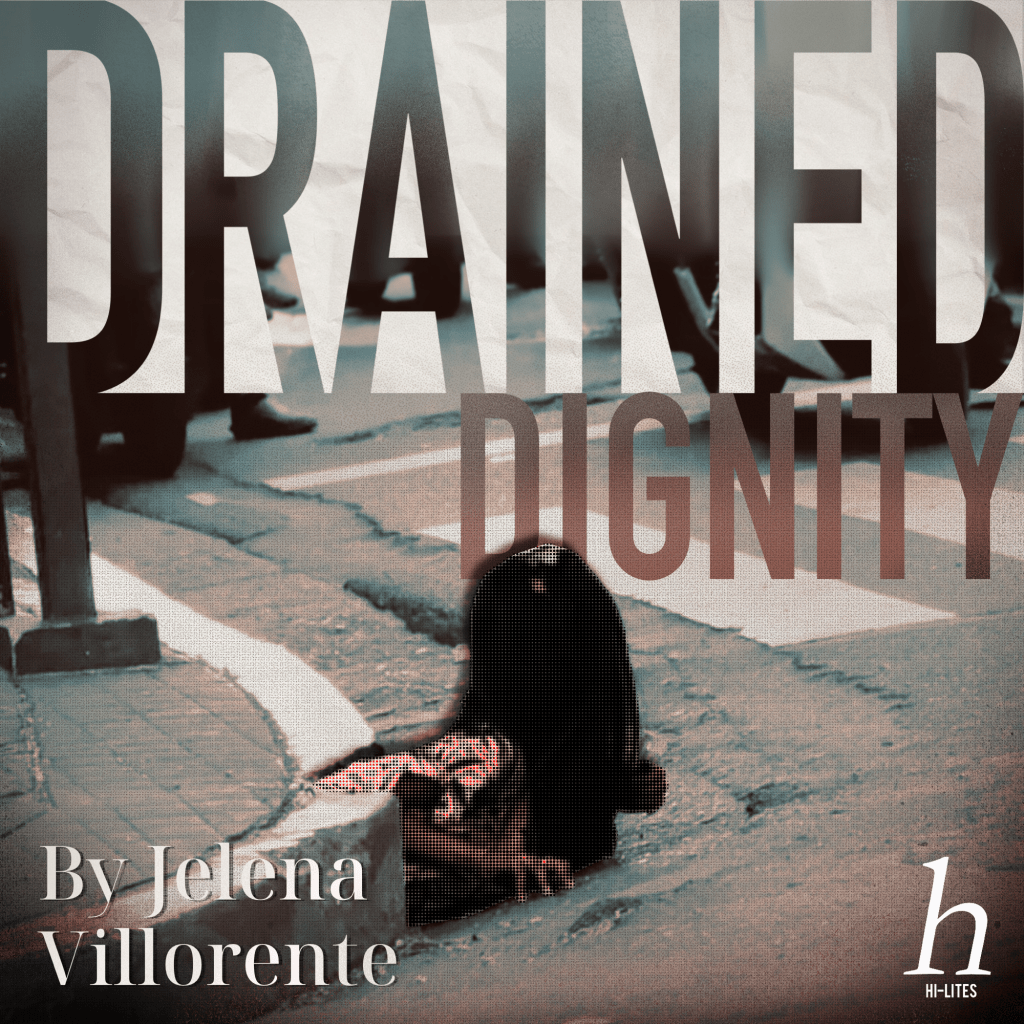
Recent news reports narrate the sighting of a woman crawling out of a drainage system in Makati, stirring up a storm of online discourse about her origins. It’s no surprise that a media sensation was woven out of the incident — especially in pertinence to how the event was like no other, causing an evident rouse in public reaction.
This onslaught in reaction eventually took itself too far, however, and as if fuel was added to the fire, social media posts began to make a mockery of the woman’s predicament. She was made a laughingstock in front of the media, often attributed to the character “Sadako,” with the dawn of her viral situation.
Prying away from an extrinsic perspective, this happening is more than a mere depiction of helplessness; it is a representation of the demographic that continues to linger within the penumbra of Philippine society, overlooked by those already comfortable with their personal lives. It is a portrayal of a deeply ingrained fissure, one that has been long-established in the country — condensed in a quick glimpse and a camera snap that left audiences reeling at the sight.
With the cameras and news reports tailed to the woman’s every move and turn under the public eye, one question is beckoned — would it truly take a predicament such as this for society to pay attention?
Deep-rooted Disparity
On its own, the scene of a woman crawling out of a city sewer would undoubtedly be the cause of appallment for many, especially in the middle of the normally busy streets of Makati. The story itself is painfully blatant — and merely witnessing it firsthand is sure to engrave the thought of it for quite a while.
What this circumstance has catalyzed was not just a shallow reaction, however — it drew a curtain that revealed how desensitized our society has become in pertinence to those suffering from destitution.
The Philippines is no alien to the problem of poverty, having grappled with this obstinate issue for the longest time. According to the Philippine Statistics Authority, as of 2023, the Philippines faces a poverty incidence rate of 15.5%, a significant decrease from a rate of 18.1% in 2021, yet it still carries its own hefty quantity. While many Filipinos are surely aware that various localities suffer from extreme poverty in the country, these communities still end up being overlooked and neglected by the majority of society. Street beggars and squatters in urban areas are seemingly insufficient for people to heed this minority truly — yet it somehow took a woman scrambling out of a drain for the public to raise sympathy once more.
Yes, poverty remains a long-established problem in the Philippine context — but this mere fact does not equate to tolerating the dire situations of people living lives that fall below the threshold. Accepting poverty as a “normal” occurrence and deeming it a conventional attribute of our country won’t mitigate the issue — it’d only exacerbate it.
Even worse, many still choose to make a joke out of the situation, comparing the woman’s circumstance to horror films and poking fun at her predicament. Facebook posts of news stories covering the occurrence garner more laugh-reacts than others, while Reddit threads knit teasing comments about her appearance and escape attempt in the middle of the road. Ridicule became a pronounced motif upon delving into the happening online — overruling comments of concern and sympathy.
The entitlement in this reality is a depiction of the stark fissure plaguing Philippine society at current, with the supercilious choosing to neglect the root issue and focus on the surface-level scene. These responses are pretentious in the way that they present superficial assumptions about the woman they eventually dubbed the ‘Makati drainage girl,’ or ‘imburnal girl,’ despite being unaware of her actual name and origin.
Even if the woman herself addressed the incident later on, sharing that she didn’t actually live in the drain as per the suppositions being thrown about online, the issue’s general reception on the internet illustrates a sense of prejudice and how easy it was for many to thrust claims about the woman’s life given her viral persona — perhaps even her social status, which prods the concern even deeper into the unequal underpinnings of society.
In plain sight, the occurrence isn’t just a media sensation; it’s a showcase of the deep-rooted disparity plaguing our country at present, and a catalyst for public reactions that reflect modern perceptions of poverty. Once aware of these harrowing realities, people are inclined to point fingers — most especially at the authoritative pillars governing our country.
Sweeping Up the Mess
With the emergence of the incident, the government has undertaken quite an initiative in response to the spectacle that arose, more specifically by the care of the Department of Social Welfare and Development (DSWD). Mediating the issue, to them, entailed prioritizing the canal being sealed off and the woman being identified.
With the efforts that have been underway, it was later revealed that a provision of PHP 80,000 was granted to the woman acknowledged under the alias ‘Rose,’ as part of streamlining the DSWD’s Pag-abot Program institutionalized back in 2024. News reports have also amalgamated to clarify the situation even further, stating that Rose went into the sewer to retrieve a blade cutter that she utilizes to collect garbage, as well as noting that she herself earns a living by selling recyclable materials.
According to the DSWD, the financial aid given to her was to help kickstart a sari-sari store she had been hoping to manage, after reportedly being surprised at the aid being extended to her. Ostensibly, her reaction was such because she was not surveyed for and initially eligible to receive the benefits of the Pantawid Pamilyang Pilipino Program (4Ps) — an initiative of the DSWD that provides financial aid to poor Filipino households — given that she did not have any minor children and was among the families and individuals in street situations (FISS). Nevertheless, she accepted the cash with immeasurable gratefulness.
What this response ultimately illustrates is a spectrum in welfare governance. Many people akin to Rose continue to be overlooked, and marginalized families continue to suffer from poverty, yet there are claims of aid being provided and programs being institutionalized. Rose herself was claimed to be a part of those who were not surveyed for these very measures, which is a fact that already begins to tear away the veil of efficacy.
Moreover, the situation itself poses some discrepancy in the way abrupt media spectacles tend to propel these proactive responses all of a sudden, and outside of what is shown on cameras and screens, remains an unyielding reality that is hardly being addressed. Strategies such as these are then subject to question, such as whether or not these are mere band-aid solutions to aid these people and appease those watching in the same run.
Sure, a take such as this may be controversial, but reality beckons another story. What of the individuals sharing Rose’s suffering, yet remain unrecognized? Would they have to crawl out of a drainage too in order to receive the aid they deserve?
Ultimately, what this circumstance as a whole engenders is a polarized discourse about poverty through a media-centric lens and how the government responds to this. Discussions about suffering communities must be fuelled not by viral videos and media trends, however — but by the obligation of providing the quality of life these people deserve.
Empathetic Effort
From a broad vantage point, the state of poverty in the Philippines is evidently difficult to fully surmount. What isn’t out of the question, however, is the collective responsibility this problem catalyzes — and our seemingly blatant disregard for this proactive response.
In the end, what truly remains crucial in confronting poverty is the presence of empathy and urgency in confronting the threshold, especially in a country that has been battling this issue for so long. As a society, what must reverberate in virtue is the fervid solidarity on account of these struggling communities — a value that is necessary in putting effort into the quality of their livelihood and advocating for alleviated situations. It shouldn’t take a media stirrup for concern to arise, nor a government controversy sparking sudden criticism.
This drainage incident must serve not only as a sign of the lingering societal inequality, but also as a reminder that there remain millions out there struggling just as Rose is. There are those adapting to virtually anything to merely make ends meet. There are those making the greatest of sacrifices just to live another day. There are those willing to flush their dignity down the drain in fervent desperation — arms extended and beseeching for assistance.
In the greater scheme of things, maybe day-to-day life isn’t always as expected — and in the case of these very communities, theirs is woven in the fabric of their arbitrary routines, subject to capriciousness at every turn of consternation. Whether these people clamber onto streets out of sewer systems or live quietly within slum areas and tight spaces, their lives still count, and the root problem remains the very same — yet it is one that continues to beckon contemporary society for a silver lining, and a better future.
 HiLites ASHS