
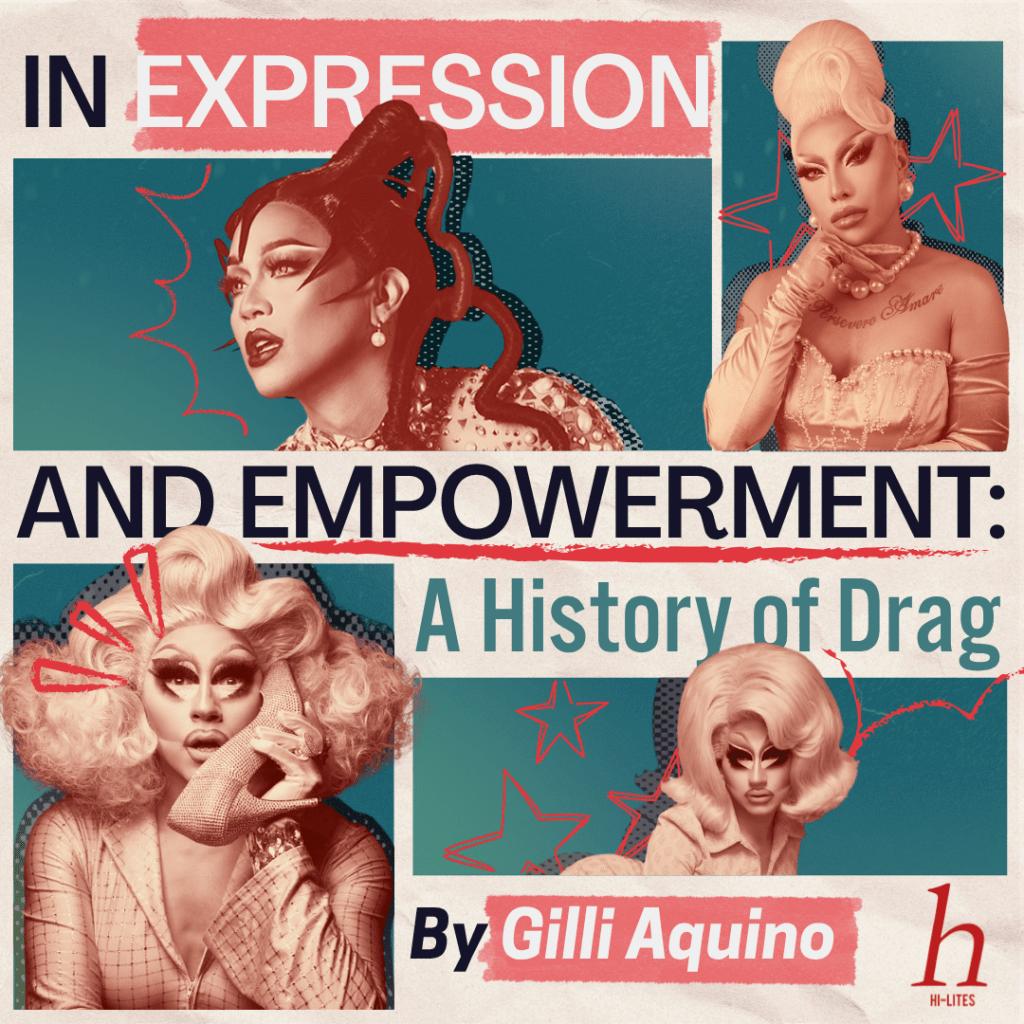
By Gilli Aquino
“We’re all born naked and the rest is drag.”
As vivid lights bounce off the walls in colorful waves, and the thumping of a vibrant song slowly starts to build in your ears, the spotlight finally shines on her. Head to toe in glitz and glamour, the bold colors of her makeup and sparkling costume create an echo that reverberates across the room. Yet, it is not simply the bedazzled outfit nor the dazzling hair that draws you to her; it is more than that. It is the quiet confidence in her loud movements — the sparkle in her eyes that shows complete joy. A happiness not merely fueled by her passion but one that has been charged by the knowledge that right now, in this moment, she is completely herself.
The popularity of drag culture is an ever-evolving “femininomenon,” in the Philippines, a term used to describe a new social craze or trend dominated by feminine influence, culture, and audiences. With the adoration of shows such as RuPaul’s Drag Race and the apparent popularity of drag bars amongst the youth, drag has undoubtedly sparked a new wave of creativity and self-expression in the 21st century. However, the vivacity and fluidity of drag culture have not always been this colorful. With its complex history tracing back to pre-colonial Philippines, the concept of drag has roots that extend beyond mere artistic expression.
Honoring Herstory
The term “drag,” was originally coined in the late 19th century, particularly as British theater slang. The term was used to describe the act of a male actor portraying a female character, where their costume, typically a long dress, would “drag” on the stage floor. The term later evolved to describe the concept of male entertainers presenting as female characters in unique and often eccentric ways, now known as “drag queens.”
In the Philippines, the idea of drag was a concept that existed during the pre-colonial period. While the terminology was yet to be introduced, gender crossing was considered the norm for Filipino men during pre-colonial Philippine society, essentially integrating itself into Philippine culture. Spiritual leaders such as the Babaylan embraced gender fluidity, dressing in more feminine silhouettes. However, the beginning of the Spanish Colonization put an end to these expressions, viewing this culture as “threatening,” leading to the suppression of queer culture in its entirety. Along with this, the period marked the arrival of Roman Catholicism in the country which brought strict prejudice against those perceived to be “queer,” executing men who were assumed to be homosexual.
This wave of conservatism and “macho” masculinity continued to prevail in the Philippines — contributing to an ever-growing homophobia against queer culture. In spite of this, several individuals continued to fight to bring queer culture back into the limelight. A prominent figure in Philippine drag culture is the well-known Crispulo Luna. During the American occupation, he was known as a “gender crosser,” who posed for portraits at Victoria Studios dressed in various styles of female clothing. Additionally, the 1900s saw a reemergence of drag performers in the media in a way that was unseen before, with notable films such as “Ang Tatay Kong Nanay” (1978), “Markova: Comforty Gay” (2000), and many more shone a light on drag artists with the iconic “King of Comedy,” Dolphy Quizon, bringing it into the mainstream media. These individuals were some of the very first artists to break barriers in Philippine media, giving way to queer representation during a time where a culture of strict masculinity supressed queer voices.
In this day and age, various drag icons continue to thrive in the spotlight — serving as role models that live their truth in the hopes that it will inspire others to do the same. What was once merely seen as another form of comedy is now a symbol of artistic expression that aims to touch the hearts of the masses. The local adaptation of Ru Paul’s Drag Race in the Philippines has further propelled the popularity and adoration of drag culture in the media by integrating Filipino cultural elements with queer realities, resonating strongly with local audiences. The show has also served as one of the most notable influences in bringing drag into mainstream Philippine media, which has further uplifted Filipino drag queens.Yet as we comfortably enjoy watching these icons on screen — we must not forget those figures in history who paved the way for drag culture, even through the times it was uncomfortable.
A Show and a Story
While the flair and glamour of drag performances often provide audiences with fun and entertainment, at the end of every multicolored light show or dramatic wig is an intimate ode to drag queens that only they have the capacity to hear — one honoring every struggle, triumph, and story.
“The first time I performed as Megara Nova Gina was at a small bar with my drag family for my debut as a baby drag queen, and I’ll never forget that night.” Meg Lopez, an incoming HUMSS senior, shared the thrilling emotions she felt as she first took to the stage for her drag debut. For Meg, drag has always been a deeply personal and liberating form of self-expression where drag queens can create and express themselves on their own terms. More than the flashy performances that come along with it, drag has always been, and always will be, a dynamic art form that celebrates the story and individuality of every drag queen.
For most drag queens, drag has become an avenue for them to express parts of themselves that are often hidden due to social pressures or norms. However, in recent years, we have witnessed a surge in popularity for drag and queer art in the Philippines that has seemingly inspired queer youth today — allowing them to convey their own stories with less fear. This is an idea that holds for Lopez as well, “For the first time in my life, I wasn’t pretending, I wasn’t hiding. Megara had turned into the real me, and I was the performance.” She recalled, expressing that every move, lip sync, and hairflip was not merely for entertainment but an act of survival and self-love, with the knowledge that she is finally being seen for who she truly is.
It is almost ironic that we call the act of drag something akin to a performance, because wholly and truly, there is nothing performative about each and every queen’s unique expression of identity and truth. No matter how the media industry has strived to place drag culture into a box for amusement, drag will always remain undeniably real and raw — not to be gawked at by those who do not understand, but to be loved and appreciated by those who do.
For Artistry and Activism
Underneath the creativity of every choreographed move and planned look that comes with drag, every little detail serves a purpose that goes beyond the usual glitz and glamour. Above all else, drag has always served as a powerful tool to evoke social change within society — a tool most especially needed in the Philippines. In its totality, drag is political: every little movement in its performance translates into a broader political movement that aims to provide a voice for the queer community.
In history, drag artists have used their platforms to speak out about important social issues that need to be brought into the spotlight. A prime example of this is Pia Labra, more commonly known as Piayuuuh, who utilized drag to raise awareness about HIV/AIDS through her alluring performances. Even during the Martial Law regime where fear and suppression were perpetrated most especially for queer individuals, the drag community continued to exist underground as a symbol of resistance. Nowadays many Filipino drag queens have used their talents to advocate for the passage of the Sexual Orientation and Gender Identity Expression (SOGIE) Equality Bill that aims to protect the rights of queer individuals against discrimination. Aside from this, Filipino drag queens will often use satire as a tool for both entertainment and social commentary, often in portraying political figures to illustrate their faults and hypocrisy. This was seen in Marina Summers, a drag queen on Drag Queen Philippines, impersonating Gloria Macapagal Arroyo with references to her charges of corruption.
In the words of Lopez: “Drag has always been deeper than wigs and rhinestones, it’s revolutionary. Drag will always be political. It’s become a loud glittery protest against the boxes that society tries to force us into.” She described her perspective as a young transwoman as she’s watched how drag has opened doors for conservations about gender, freedom and identity. “It’s not just a stage act — it’s activism, it’s resistance, and it’s hope,” she added.
Now, with the internet and social media platforms, queer voices are amplified even further as drag queens and other queer influencers are given the chance to advocate for their personal and sociopolitical views to an even wider audience. With these avenues, drag continues to challenge patriarchal gender roles on masculinity and femininity, illustrating the fluidity of sexuality against the norms deeply rooted in Philippine society.
As the multicolored lights dim and the vibrant song slowly fades away, the performance you have just witnessed carries a message that will forever live in you. The spotlight may dim on her silhouette, yet it is her story that will continue to shine brightly — a story of expression and empowerment.
 HiLites ASHS