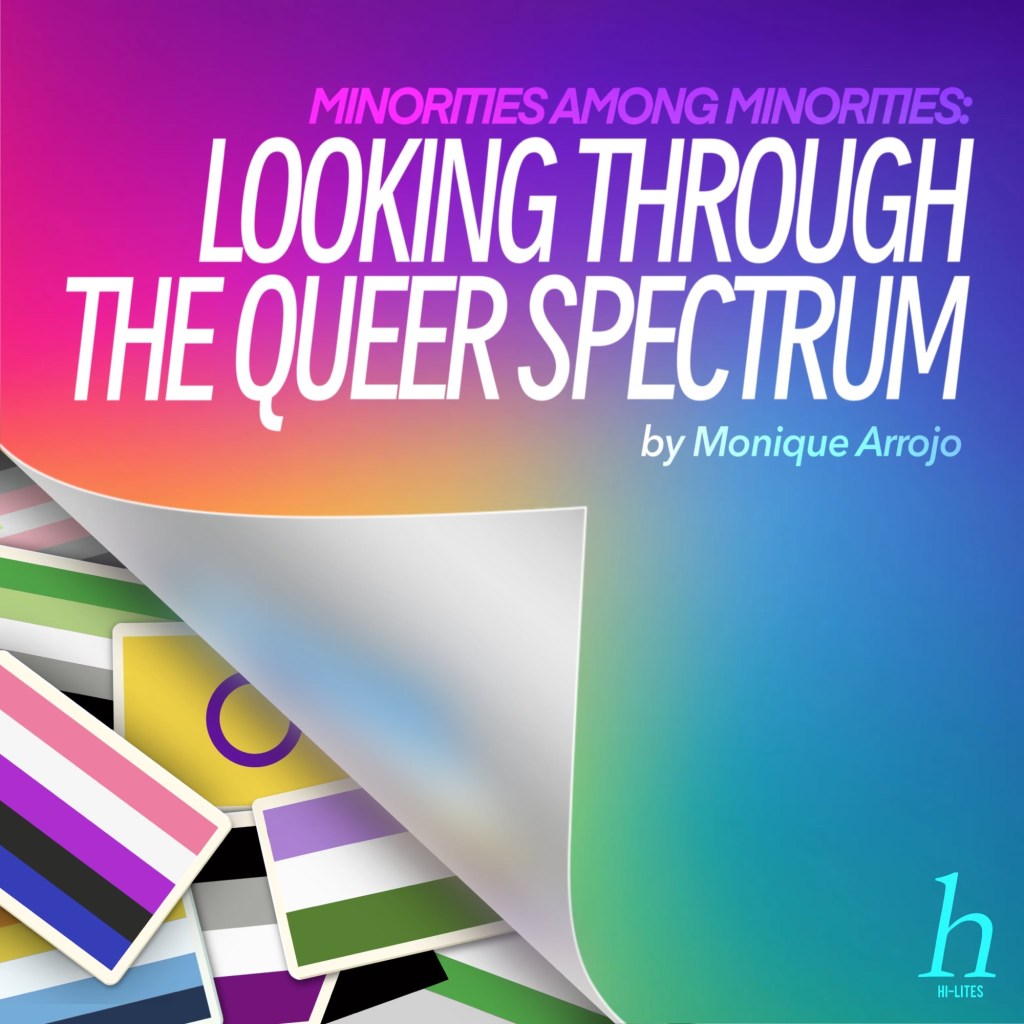
By Monique Arrojo
“Everyone deserves their own bit of representation.”
In the streets during Pride Month, the colors are loud, the celebrations vibrant. Rainbow flags and slogans are waved, painting the road in an array of saturated hues. Voices of the community call to be heard and understood. Still, even through the loudness, not all stories are equally perceived along the red and purple-tinted streets.
Queerness has often been described as a spectrum, much like a rainbow. But that spectrum isn’t always completely prismatic; it can have gray areas — areas without much definition, regions that lie somewhere in the middle of all the hues. Other times, it could be a mix of several shades, a blend that includes a little bit of everything.
From Red, to Green, to Purple, to Everything in Between
“I would not say that I am necessarily treated differently, although it is harder to find people like you that you get to fully relate to.”
For several under the Queer spectrum, finding reflections of their identity, whether in media, relationships, or everyday conversations, can be rare. Thus, finding a community can feel difficult and, at times, a bit confusing.
From the perspective of Silver*, a pansexual and demiromantic, they find it hard to connect with modern culture and dating, where people often go out with someone they’ve never met before. Silver illustrates this by saying that they can’t simply “fall in love at first sight.” For them, developing romantic feelings for anyone requires a deep, emotional connection that usually takes months to form. They further highlighted this by saying, “I don’t think I could ever enter into any sort of relationship with someone with the initial intention of making a romantic connection. That just would not work for me. I firmly believe that, for me, it should be something that develops naturally.” In some ways, this has made it harder for them to resonate with friends who feel differently and to connect with how romance is often portrayed in modern television.
“There’s not a lot of people like me,” expressed Luca*, who identifies as genderfluid, which makes it harder to find others in the community that identify similarly. While Luca shares that they are generally considered under the transgender umbrella, their identity holds a layer of complexity that goes beyond being trans. Nonetheless, they’ve found solace through seeing other people with parallel experiences on social media. They elaborated that encountering something on TikTok that suddenly resonates and sparks an inner ‘Oh, yeah, I get you,’ is one of the few moments that makes them feel seen.
Both Silver and Luca have communicated that they’ve never seen their sexualities or identities displayed on screen. “I’d definitely want to see more genderfluid [characters] and queer media — something like Heartstopper. And I don’t want the people who have the ‘not so popular sexualities’ to be a side character; I want them to be the main character,” Luca emphasized, noting the importance of seeing a character that fully encapsulates their identity.
Hence, media representation isn’t just about relatability, but the relief of being seen and understood — of knowing you aren’t exactly alone and knowing your experiences aren’t so alien. It plays a role in shaping safe spaces for young Queer individuals and allows them to express themselves. A character, a movie, or TV show is its own form of refuge, especially for those who have yet to find their own community or who have yet to be seen.
When Language Falls Short of Color
“Sometimes I wish that I wasn’t me. But at the same time, I love whatever I am.”
Beyond finding representation that reflects those under the Queer umbrella, is the hurdle of finding the words that could best articulate their identity and sexuality to someone that has yet to understand it. For many, coming out to friends and family remains a difficult task that’s usually accompanied by uncertainty and hesitation.
For Silver, being a part of the LGBTQIA+ community while also a devout Catholic has posed some challenges in coming out to their parents. While they consider their parents to be progressive and accepting people, there still lies some uncertainty about how they’ll take Silver’s sexuality. “I tell my parents everything about my day […] and it sucks that I’m scared of letting them know that part of me, because I don’t know how they’d take it,” they elaborated, pointing out the fact that they’ve never been shy to tell their parents about their life.
Identically, Luca has found more difficulties explaining their gender and coming out. They find that the former is an integral, complex part of themselves that they are still figuring out. Luca explained, “I do feel misunderstood — to the point I give up on trying to explain it to people because it’s hard. I don’t really get it myself, so why would I try and explain it to another person?” This ambivalence with their identity has brought about several other emotions; other times, they feel that “[I]t’d be so much easier if I wasn’t like this,” but on better days, Luca feels the exact opposite.
Language can be just as restrictive as it is liberating. While the existence of labels have made things easier to communicate sexuality and gender to someone unfamiliar with it, it can also unintentionally bring about some difficulty and misconceptions. In some cases, it fails to capture the diversity in the spectrum.
In Silver’s experience, they have noted that their pansexuality has often been misinterpreted as bisexuality. They explained that pansexuality is less about being with either a man or a woman — like bisexuality — but rather that “the sexuality, gender, all of that, it didn’t matter to me so much when it came to the people I like or the people I was attracted to.” While this misinterpretation of their sexuality isn’t necessarily done out of willful ignorance or malice, but rather pansexuality isn’t “as common,” as bisexuality.
Luca shares a similar sentiment, but specifically how people misconstrue their fluidity with simply being transgender, or at some times, confuse it as heterosexuality. They clarify this by explaining, “If I’m with a girl, it’s wlw, if I’m with a guy, it’s mlm. And I feel like people don’t get that because they see me as a female.” They add to this by highlighting, “Just because you like the opposite gender, it doesn’t mean that you’re straight.” In part with this, Luca has voiced that it sometimes feels hard for them to express their femininity, primarily out of fear that people would start seeing them less as genderfluid.
While having a disposal of adjectives for those who are unfamiliar with labels and more particular jargon, for people like Luca, it can feel ‘diluted’ and partial. Descriptors, as colorful and vivid as it may be, can be inadequate to reflect the undertones, gradients, and blended hues that truly make up one’s identity.
In the Shades of Familiarity
“All the good people help with the bad people in the world.”
Comfort and solace have nestled themselves somewhere in the softer corners of the world, unfolding themselves in varying ways. For some, this can be something as simple as someone respecting their pronouns, while for others, it could be an inclination to learn and understand more about others’ sexuality.
Silver implores people, both who are a part of the Queer community and who aren’t, to be open, kind, and patient when discussing sexuality, gender, and anything tangent to it — a necessary step to be able to progress with people. Sexuality and gender is not a debate, but a conversation that is necessary. Silver imagines a world “where talks of gender and sexuality don’t turn you into an enemy or an ally,” but instead could just be another integral part of life and living — inalienable from one’s individuality.
For Luca, they wish for people to inquire and be accepting to discussing pronouns, especially for those who associate with more than one pronoun. “If they see someone who’s he/they, they don’t forget about the they/them. Or they see someone who’s they/she, they don’t forget about the she,” they illustrated, reminding that those other pronouns are still a part of one’s identity; pronouns go beyond a substitution for one’s name.
And to anyone who’s yet to fully understand their sexuality or identity, or to those who feel alone in their journey of self-discovery, Luca shared, “I hope na alam nila that they already have a community that’s there and is willing to accept them with open arms.” Somewhere within the tinted streets of Pride will be a community whose shades will ring familiarity.
While Pride has certainly come a long way, there remains room for light to illuminate the colors that have yet to be seen. Despite Luca and Silver’s differing stories, they wish to see a world where their identities are acknowledged, respected, and perceived on or outside the tinted streets of Pride.
Queerness is a spectrum; it is diverse with its colors and shades, adorned with areas of uncertainty that have yet to be fully understood, but past the tints and hues lies a community carving out space, seeking to be seen, and learning its complexity.
Names marked with an asterisk (*) are pseudonyms and were used in place for interviewees who opted to remain anonymous.
 HiLites ASHS